All species › Pigeons and doves › Pigeons and doves › White-crowned Pigeon
White-crowned Pigeon | Patagioenas leucocephala
Witkapduif | Paloma cabeciblanca
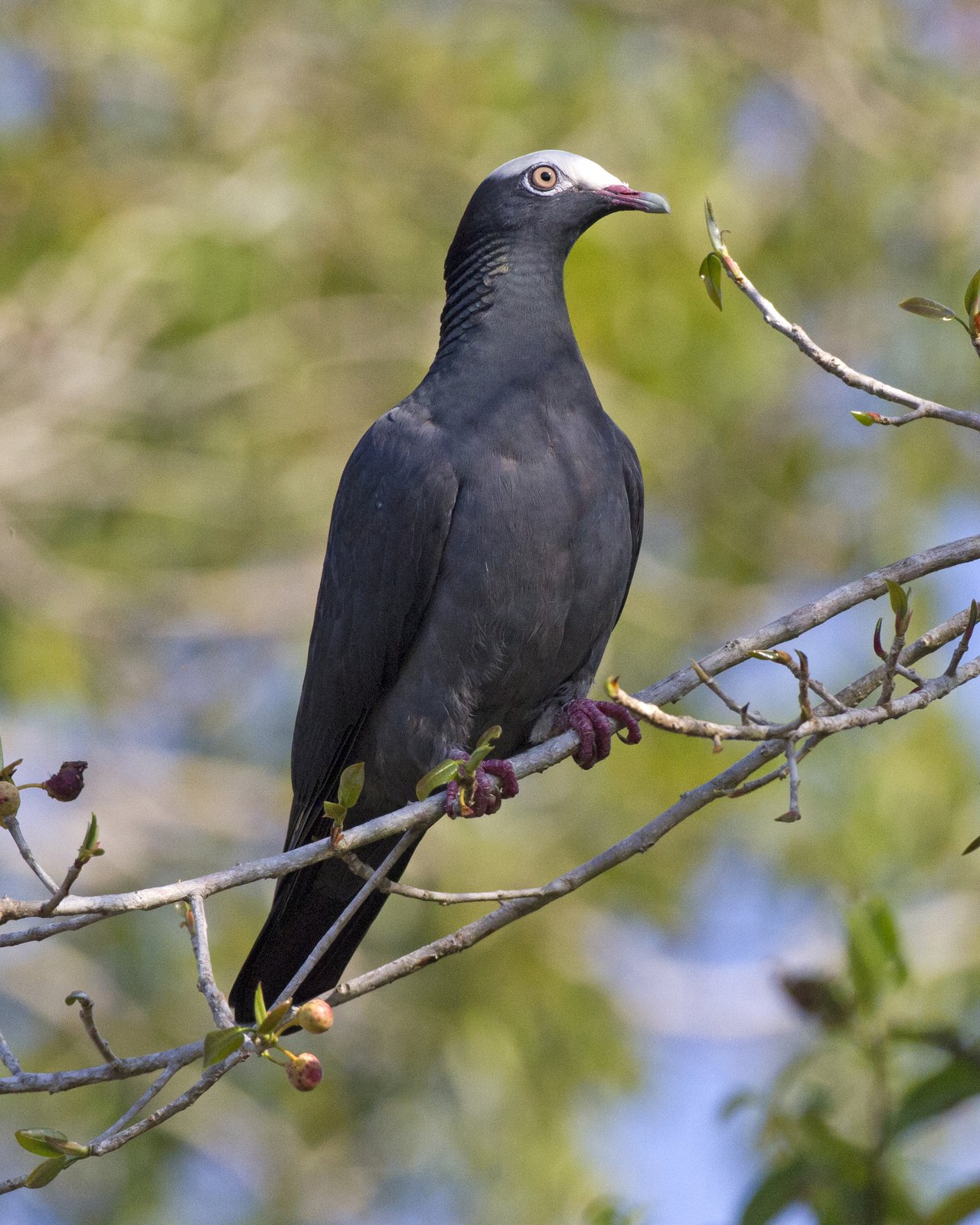
The White-crowned Pigeon is a large, almost black pigeon with a bright white crown, the characteristic pigeon of the mangroves and offshore cays of the Bahamas, the Greater Antilles and the northern Lesser Antilles. It nests in colonies on mangrove islets and commutes daily in fast flocks to the mainland to feed on fruit. In Cuba it is called torcaza cabeciblanca, in the Dominican Republic paloma coronita.
Voice
A low, powerful coo with an owl-like quality: croo, croo, coo-crooo, often repeated many times from a hidden perch. On take-off the clatter of the wings is audible.
Recording: GABRIEL LEITE — CC BY-NC-SA 4.0 · shortened to the first 60 s, mono · xeno-canto
Identification
33–35 cm, slim, with a fairly long tail. The entire plumage is dark slate-grey, appearing black at a distance. The crown is pure white in the male, greyer white and less extensive in the female. The nape carries a patch of iridescent green feathers with a fine black-and-white scaly pattern, visible only in good light. The iris is white, the bill red with a pale tip, the legs red. Young birds are browner grey, lack the nape patch and the white iris, and show at most a few pale feathers on the crown. Flight is fast and direct, often low over the water.
Confusion species
No other pigeon in the region combines a white crown with a dark body. Scaly-naped Pigeon Patagioenas squamosa is also dark, but has a wine-red head and neck and no white on the crown. Plain Pigeon P. inornata is much paler grey, with wine-red on head and breast and a white edge along the wing. Dark Rock Doves Columba livia have a dark head, a white or pale rump in many birds and black wing bars; they keep to towns and harbours.
Habitat
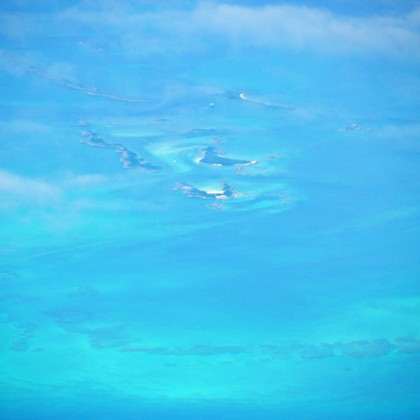
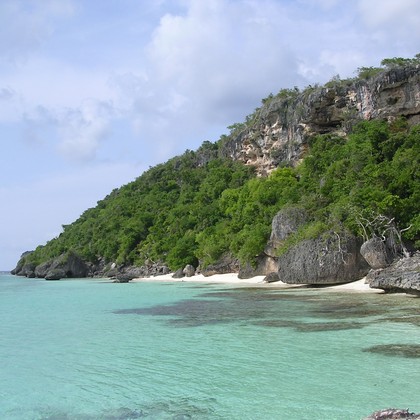
Breeds colonially in mangroves on small coastal islets and cays, locally also in coastal woodland and, in recent decades, in gardens and parks in coastal towns. It feeds in dry lowland forest, coastal woodland, gardens and scrub some distance inland, commuting there in flocks. The diet is almost entirely fruit and berries, including those of figs, gumbo-limbo Bursera simaruba and poisonwood Metopium toxiferum; the breeding season coincides with the ripening of these fruits. The nest is a flimsy platform of twigs in the mangrove.
Where the bird is most at home, classified by the vegetation types of the Caribbean.



Range and movements
The Bahamas, Cuba and its offshore islands, Jamaica, Hispaniola, Puerto Rico, the US and British Virgin Islands, Anguilla, Sint Maarten, Saint-Barthélemy, Saba, Sint Eustatius, Saint Kitts and Nevis and Antigua and Barbuda, as well as the Cayman Islands, the Turks and Caicos and San Andrés and Providencia. Further south in the Lesser Antilles scarce to rare, with records to Guadeloupe and beyond. Outside the region in southern Florida and the Florida Keys and along the coast and on the islands of Mexico's Yucatán Peninsula and Belize. Birds move between islands; part of the Florida population winters in Cuba and the Bahamas.
- Resident
- dark = core range, pale = thinly spread
How and when to look
Early in the morning and late in the afternoon along the coast, when flocks commute between the breeding cays and the feeding areas. In the Bahamas and the Cayman Islands it also visits gardens with fruiting trees; the call often gives it away before the bird is seen.
Conservation status
Near Threatened. The population is declining through the loss of dry lowland forest, disturbance of breeding colonies and hunting, which in several countries is partly legal within an open season. Because the species breeds in large, localised colonies and depends on seasonal fruit, hurricanes are a further risk.
Scientific name
Patagioenas leucocephala | (Linnaeus, 1758)
Linnaeus described the species in 1758 as Columba leucocephala; because it was later moved to another genus, the author and year stand in brackets. The genus Patagioenas was introduced in 1853 by Reichenbach. Patagioenas is Greek, from patageō 'to clatter' and oinas 'pigeon', after the clattering wings on take-off. leucocephala is Greek, from leukos 'white' and kephalē 'head', after the white crown. The specimen the first description was based on came from the Bahamas.