All species › Pigeons and doves › Pigeons and doves › Plain Pigeon
Plain Pigeon | Patagioenas inornata
Wijnrode duif | Paloma sabanera
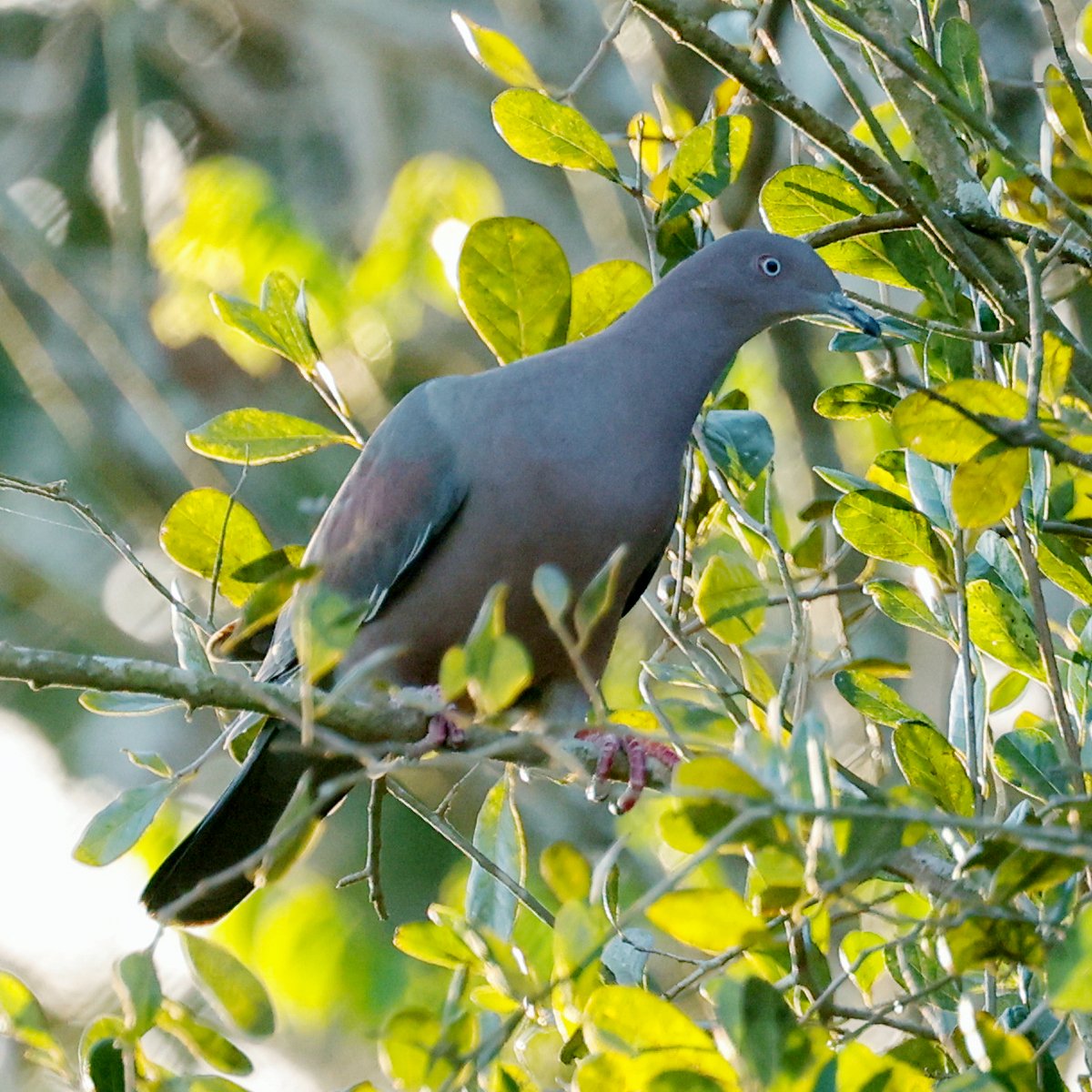
The Plain Pigeon is a large, pale grey pigeon of the Greater Antilles, with a wine-red wash over head, breast and wing coverts. It lives in open, partly wooded country, where it perches in treetops and moves in flocks along forest edges. In Puerto Rico it had almost disappeared by the 1970s and, after a conservation programme, can again be seen in many places. In Puerto Rico it is called paloma sabanera, in Cuba torcaza boba, in the Dominican Republic paloma ceniza.
Voice
A low, short coo in three parts, stressed on the last syllable: who, who-whooo, sometimes with an extra note in front. Deeper and softer than the call of Scaly-naped Pigeon.
Recording: Daniel Parker — CC BY-NC-SA 4.0 · shortened to the first 60 s, mono · xeno-canto
Identification
38–41 cm, robust and somewhat stocky, mainly pale grey at a distance, about the size of a heavy Rock Dove. Head, hindneck, breast and part of the wing coverts are washed with wine-red; the belly is paler, grey to pinkish-grey. A narrow white line runs along the leading edge of the folded wing, forming a white band across the wing in flight. The iris is pale yellow, the bill black, the legs dark red. The female is slightly smaller and duller than the male. Young birds are browner, with pale fringes to the wing feathers and a dark eye.
Confusion species
The white wing edge separates it from every other large pigeon in the Greater Antilles. Scaly-naped Pigeon Patagioenas squamosa is much darker, slate-grey with a wine-red head and neck, and has no white in the wing. White-crowned Pigeon P. leucocephala is almost black with a white crown. Rock Doves Columba livia have black wing bars and often a white rump. In Jamaica, Ring-tailed Pigeon P. caribaea has a dark band across the tail and an iridescent green nape, and lives in montane forest.
Habitat
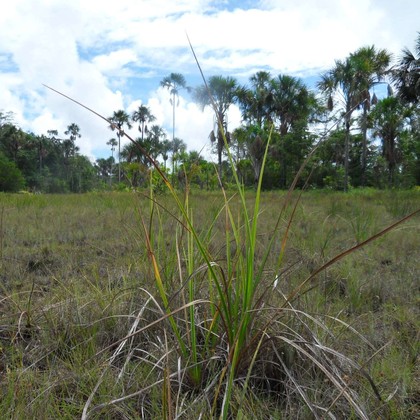
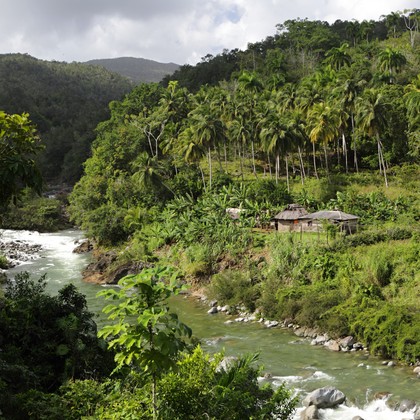
Open woodland and forest edges, savanna with scattered trees, lowland forest interspersed with farmland, pastures with clumps of trees, and in Puerto Rico also farm mosaic and village edges in the hills. In Hispaniola also in dry forest and pine forest in the interior. It eats fruit, berries and seeds taken high in trees, and occasionally comes to the ground. The nest is a flimsy stick platform, usually high in a tree; often several nests close together.
Where the bird is most at home, classified by the vegetation types of the Caribbean.



Range and movements
Endemic to the Greater Antilles. In Hispaniola, in the Dominican Republic and Haiti, still locally common. In Cuba scarce and local, scattered across the island. In Jamaica rare and very local. In Puerto Rico it has grown from a small remnant population in the east-central hills to an estimated few thousand birds, spreading over a larger part of the island. The species does not occur outside the Greater Antilles.
- Resident
- dark = core range, pale = thinly spread
How and when to look
In Puerto Rico in the hill country of the east-central part of the island, where flocks sit on tall bare branches and show the white wing band in flight. In the Dominican Republic in open country with scattered trees in the interior and along forest edges.
Conservation status
Near Threatened. It declined through deforestation and hunting; in Puerto Rico it came close to extinction and then recovered through protection and the release of captive-bred birds. In Cuba and Jamaica the species remains scarce, and in Hispaniola too the populations suffer from hunting and forest loss.
Scientific name
Patagioenas inornata | (Vigors, 1827)
Vigors described the species in 1827 as Columba inornata; because it was later moved to another genus, the author and year stand in brackets. The genus Patagioenas was introduced in 1853 by Reichenbach. Patagioenas is Greek, from patageō 'to clatter' and oinas 'pigeon', after the clattering wings on take-off. inornata is Latin for 'unadorned', after the rather plain plumage. The specimen the first description was based on came from near Havana, Cuba.