All species › Pigeons and doves › Pigeons and doves › Bare-eyed Pigeon
Bare-eyed Pigeon | Patagioenas corensis
Naaktoogduif | Paloma cardonera
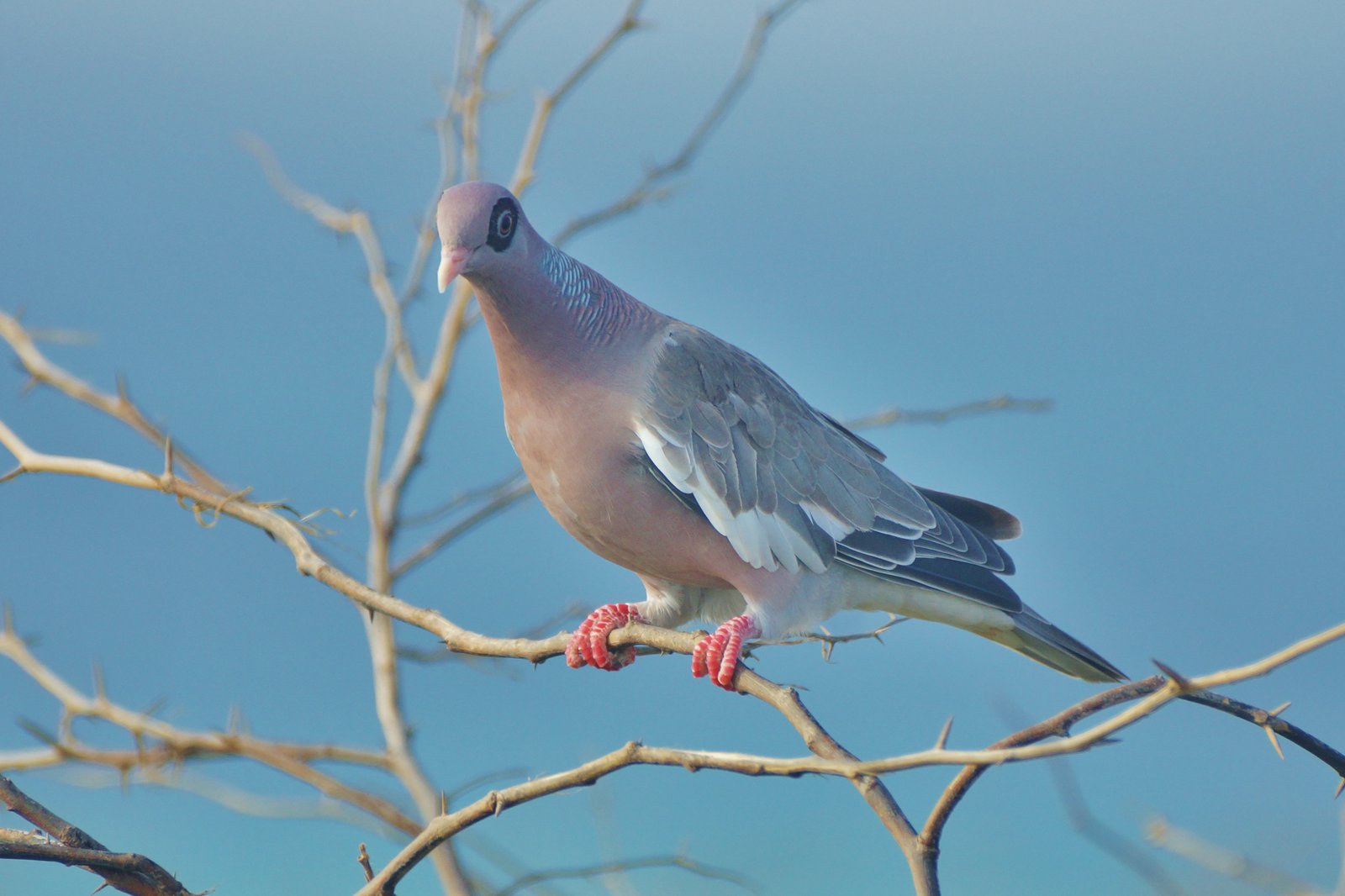
The Bare-eyed Pigeon is a medium-sized, pale pigeon of the dry coast of northern South America, with a wine-coloured head, a white patch on the closed wing and a large area of bare skin around the eye. In the Caribbean it is native to Aruba, Curaçao and Bonaire, where it is called ala blanca. On Saint Martin it was introduced around 2012 and has increased rapidly since.
Voice
A rhythmic series of low cooing notes, repeated in the same pattern, roughly coo, coo-oo, coo-coo-oo. Often from a tree or pole, mainly in the morning.
Recording: Francisco contreras @francontreras.80 — CC BY-NC-SA 4.0 · converted to mono · xeno-canto
Identification
30–37 cm; males average somewhat larger than females. Head, neck and breast are mauve to pinkish-vinous. Around the orange-brown eye lies a large area of bare skin: a narrow blue inner ring and a broader reddish-brown outer zone, which gives the bird spectacles even at a distance. Neck and upper back have a scaly pattern of bronze-black and pale brown feathers; the lower back is pale blue-grey. The closed wing shows a distinct white patch, visible in flight as a white band. The sexes are alike in colour.
Confusion species
Scaly-naped Pigeon Patagioenas squamosa, on Curaçao, Bonaire and Saint Martin, is larger and much darker slate-grey, with no white in the wing. Rock Dove Columba livia has black wing bars and a pale rump, without a white wing patch. On Saint Martin, White-winged Dove Zenaida asiatica also has a white wing stripe, but it is smaller and grey-brown, with a blue bare eye-ring and white tail corners.
Habitat
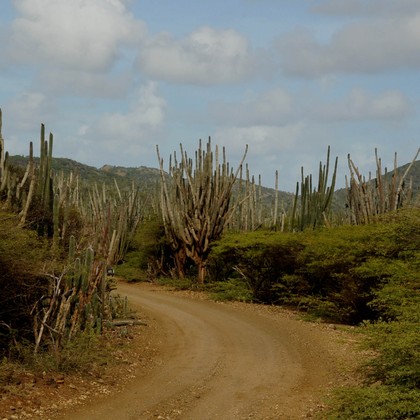
Dry country: cactus scrub, thorn scrub with acacias, dry forest and mangrove edges, as well as gardens, yards and villages. On Saint Martin at first mainly around the coastal lagoons, later also in residential and built-up areas. It eats seeds and fruit, including those of cacti. The nest is a platform of twigs in a tree or shrub so thin that the single egg can be seen through it from below; breeding is triggered by rain.
Where the bird is most at home, classified by the vegetation types of the Caribbean.



Range and movements
Native and common on Aruba, Curaçao and Bonaire. On Saint Martin it was first seen in January 2013, shortly after a presumed escape or release of captive birds in late 2012; it has since spread over the whole island, on both the French and Dutch sides. From other islands there are only isolated records. Beyond the region along the Caribbean coast of Colombia and Venezuela and on Margarita and La Blanquilla.
- Resident
- dark = core range, pale = thinly spread
How and when to look
On the ABC Islands seen in gardens, yards and on the cactus plains, often on posts, wires and in trees. The white wing patch and pale spectacles can be picked out even at a distance.
Conservation status
Not threatened globally. Common on the ABC Islands. On Saint Martin the population is a fast-growing alien; what this means for the island's native pigeons and doves is not yet clear.
Scientific name
Patagioenas corensis | (Jacquin, 1784)
Jacquin described the species in 1784 as Columba corensis; because it was later moved to another genus, the author and year stand in brackets. The genus Patagioenas was introduced in 1853 by Reichenbach. Patagioenas is Greek, from patageō 'to clatter' and oinas 'pigeon', after the clattering wings on take-off. corensis refers to Coro in north-western Venezuela. The specimen the first description was based on came from Coro, Venezuela (inferred from the name).