All species › Passerines › New World warblers › Whistling Warbler
Whistling Warbler | Catharopeza bishopi
Sint-Vincentzanger | Reinita de San Vicente
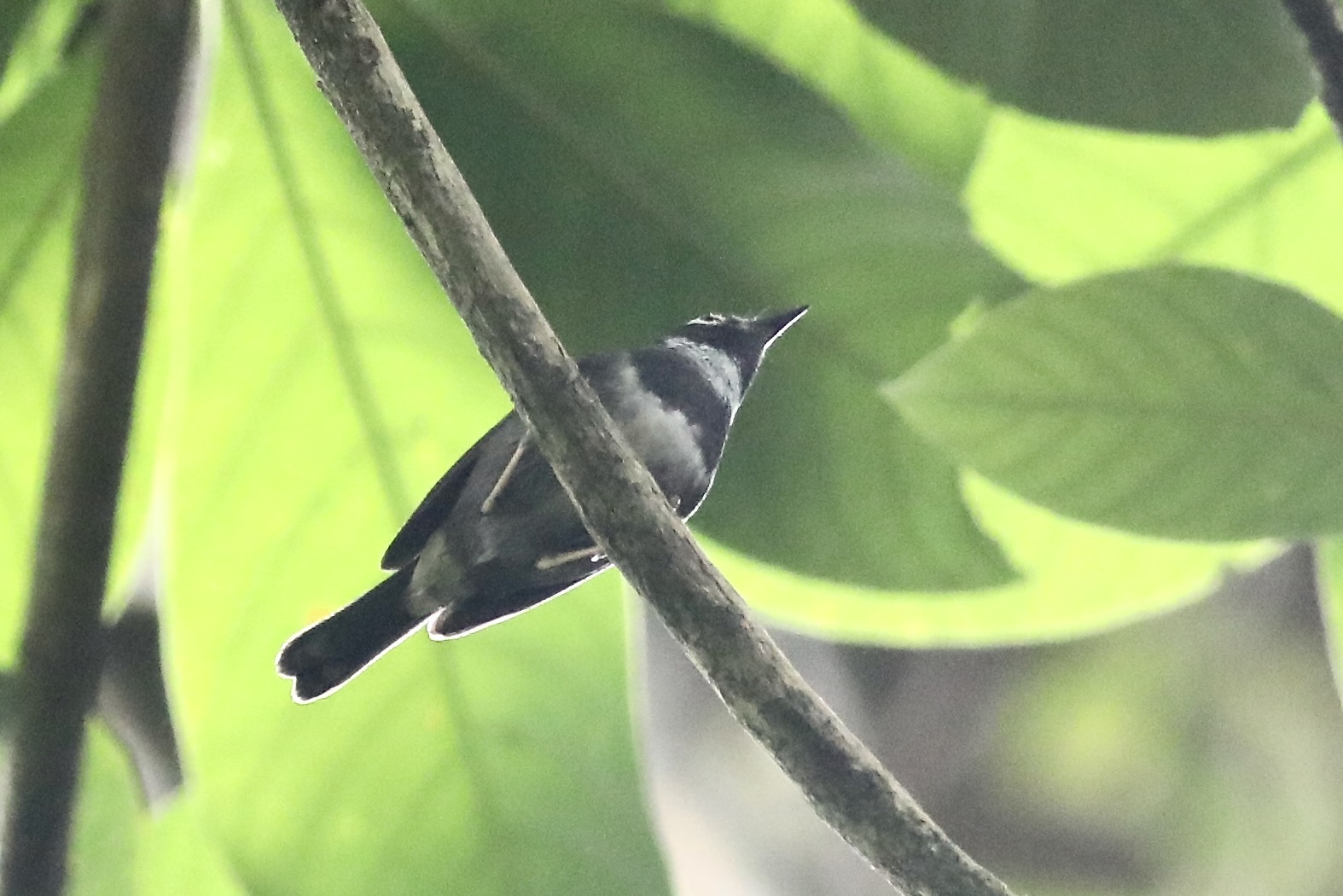
The Whistling Warbler is a dark, large warbler found only in the montane forests of Saint Vincent, and the only species in the genus Catharopeza. Its name refers to the loud, whistled song, which is often the only sign of the bird in the dense undergrowth.
Voice
The song starts with a few soft whistles and builds in speed and volume into a series of loud, clear whistled notes, usually lasting four to six seconds. The call is a short chip.
Recording: Jesse Fagan — CC BY-NC-SA 4.0 · converted to mono · xeno-canto
Identification
14–15 cm, fairly bulky and long-tailed for a warbler. Adults are slaty black above, with a black head and a broad white eye-ring. A black band crosses the breast between a white throat and a grey-white belly; the flanks are grey. The outer tail feathers have white spots. The sexes are alike. Juveniles are olive-brown above and paler below, with a pale, brown-tinged eye-ring instead of a white one.
Confusion species
No other resident warbler on Saint Vincent resembles it. Black-and-white Warbler Mniotilta varia, a rare winter visitor, is streaked black and white and creeps along trunks. The male Black-throated Blue Warbler Setophaga caerulescens is blue-grey with a black throat and a white wing spot, and has no white eye-ring.
Habitat
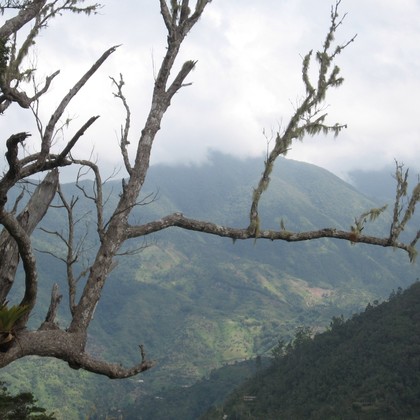
The understorey and lower levels of moist montane and lowland rainforest, palm brakes and elfin woodland, between about 300 and 1100 m, especially in ravines and valleys with undisturbed forest. It forages low, on and just above the ground, for insects and other arthropods.
Where the bird is most at home, classified by the vegetation types of the Caribbean.



Range and movements
Only on Saint Vincent, in the mountainous interior, with strongholds around Richmond Peak and Grand Bonhomme and in the upper reaches of the western valleys. The occupied area is estimated at about 90 km². The species does not occur outside Saint Vincent.
- Resident
- dark = core range, pale = thinly spread
How and when to look
The Vermont Nature Trail in the interior of Saint Vincent is the best-known site, also for the Saint Vincent Amazon. In the early morning the song is the best lead; the bird itself moves low and shyly through the undergrowth and often appears only briefly.
Conservation status
Endangered (EN). The population is estimated at a few thousand birds in a small area. Eruptions of La Soufrière, including those of 1902, 1979 and 2021, hurricanes and forest clearance for agriculture have repeatedly reduced or damaged its habitat.
Scientific name
Catharopeza bishopi | (Lawrence, 1878)
Lawrence described the species in 1878 as Leucopeza bishopi; because it was later moved to another genus, the author and year stand in brackets. The genus Catharopeza was introduced in 1880 by Sclater. Catharopeza is Greek, from katharos 'bright, clean' and peza 'foot'; Sclater glossed it as Latin clarus and pes. bishopi probably honours the American explorer Nathaniel Holmes Bishop (1837–1902); the species was described by Lawrence in 1878. The specimen the first description was based on came from Saint Vincent.