All species › Passerines › Tyrant flycatchers › Western Wood Pewee
Western Wood Pewee | Contopus sordidulus
Westelijke bospiewie | Pibí occidental
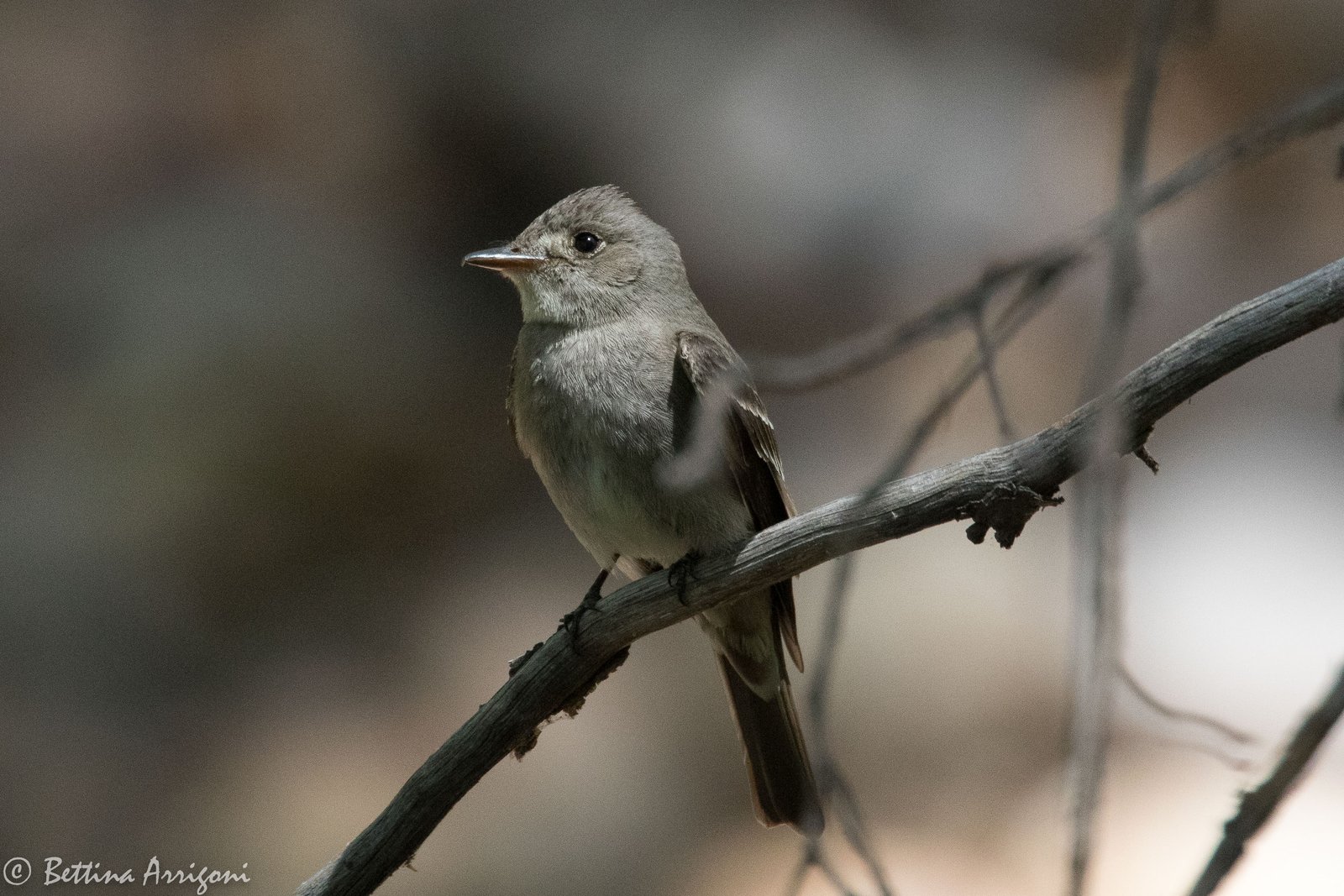
The Western Wood-Pewee breeds in open woodland in western North America and the highlands of Mexico and Central America and winters in north-western South America. Its migration route runs far to the west of the Caribbean, where it is a very rare vagrant. Since it closely resembles the Eastern Wood-Pewee in the field, secure records depend almost entirely on the call.
Voice
The call is a burry, descending peeer, clearly harsher than the clear, whistled pee-a-wee of Eastern Wood-Pewee. It also gives short, dry chip notes.
Recording: Greg Irving — CC BY-NC-SA 4.0 · shortened to the first 60 s, mono · xeno-canto
Identification
14–16 cm, slim, with long, pointed wings, a slight crest and a fairly long tail. The upperparts are dark greyish olive. Breast and flanks are uniformly dark grey, forming a vest that is barely open in the middle; throat and belly are paler, the belly often faintly yellow-tinged. The wings show two greyish wing bars. The lower mandible is usually mostly dark, with only some yellow or orange at the base. The sexes are alike.
Confusion species
Eastern Wood-Pewee Contopus virens is very similar but on average slightly greener above and paler on the breast, with more contrasting wing bars and usually a mostly orange lower mandible; these features overlap and are useful only in good views. Olive-sided Flycatcher Contopus cooperi is larger and shorter-tailed, with a sharply defined white central breast strip. Empidonax flycatchers are smaller, with an eye-ring and shorter wings, and flick their tails.
Habitat
On migration forest edges, open broadleaf woodland, coastal woodland and lines of trees. It perches on an open branch in the middle or upper layers, sallies after flying insects and often returns to the same perch. On the breeding grounds open conifer and broadleaf woodland, riparian woodland and parks.
Where the bird is most at home, classified by the vegetation types of the Caribbean.



Range and movements
A few reports from Cuba, mainly during migration; there are hardly any documented records from the rest of the region. It breeds from Alaska and western Canada through the western United States to the highlands of Mexico and Central America and winters from Panama to the Andes of Peru and Bolivia.
- Resident
- Summer visitor (c. Oct–Mar)
- Winter visitor (c. Apr–Sep)
- Passage (Mar–Apr, Oct–Nov)
- dark = core range, pale = thinly spread
How and when to look
Any pewee in the region giving a burry, descending peeer deserves a sound recording; without the call a Western Wood-Pewee cannot be identified with certainty here.
Conservation status
Not threatened. The species is common on its breeding grounds, although it has declined in parts of its range in recent decades.
Scientific name
Contopus sordidulus | Sclater, 1859
Sclater described the species in 1859 and placed it straight away in the genus where it still stands. The genus Contopus was introduced in 1855 by Cabanis. Contopus is Greek, from kontos 'pole, shaft' and pous 'foot', after the short legs. sordidulus is Latin, diminutive of sordidus 'dirty, dingy', after the dull grey-brown plumage. The specimen the first description was based on came from Orizaba, Veracruz, Mexico.