All species › Passerines › Tyrant flycatchers › Eastern Wood Pewee
Eastern Wood Pewee | Contopus virens
Oostelijke bospiewie | Pibí oriental
The Eastern Wood-Pewee breeds in deciduous and mixed woodland in eastern North America and winters from Central America to northern South America, especially along the Andes. On migration part of the population passes through Cuba and the Cayman Islands, where it is the most frequently seen migrant pewee. Further east in the region it is seen far less often.
Voice
The song is a clear, drawn-out, whistled pee-a-wee with a rising final note, alternating with a falling pee-yer; it is also heard on spring migration. The call is a dry chip or a short, rising pweet.
Recording: Rory Nefdt — CC BY-NC-SA 4.0 · converted to mono · xeno-canto
Identification
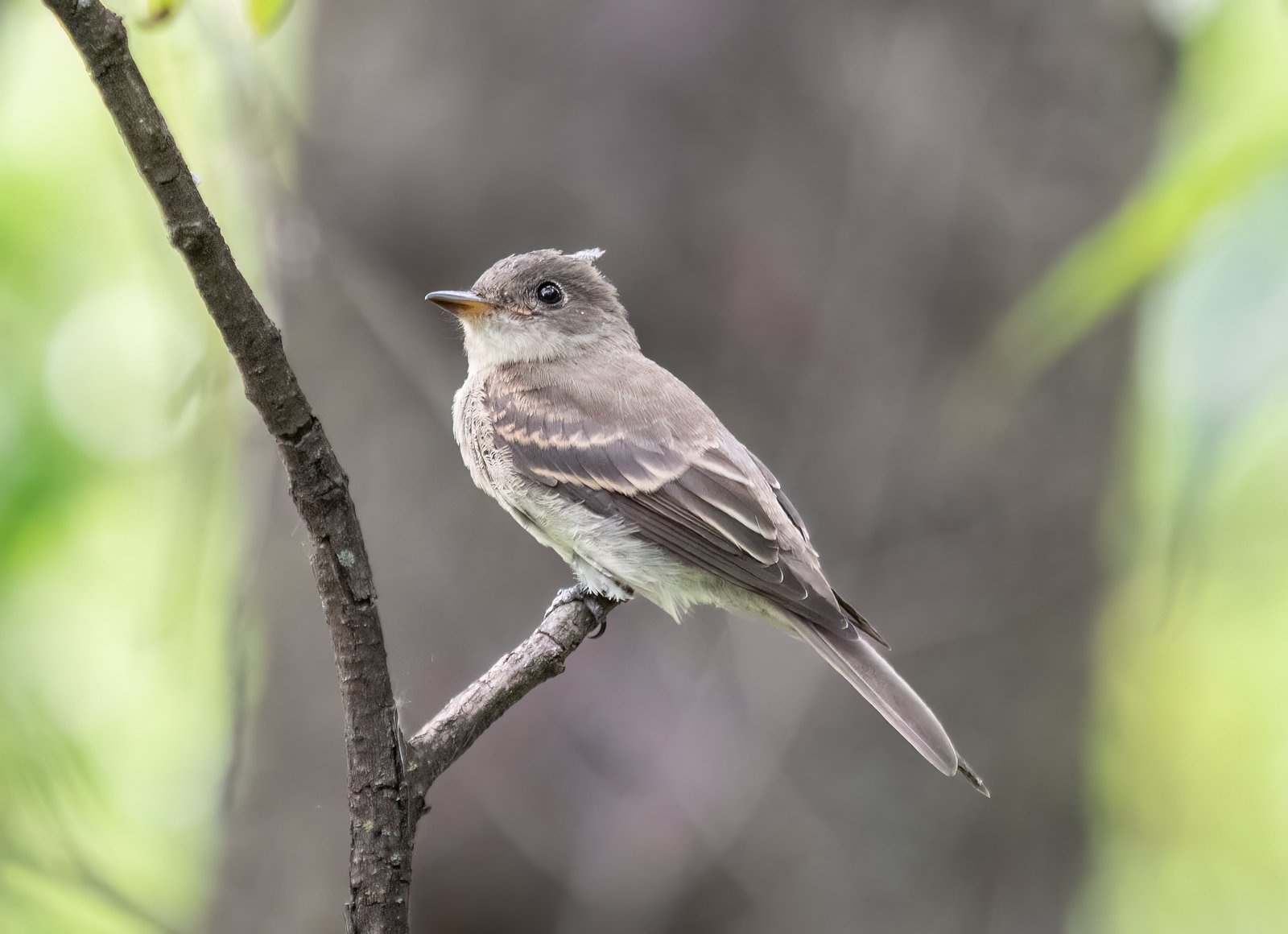
13.5–15 cm, slim, with long, pointed wings, a long primary projection, a slight crest and a fairly long tail. The upperparts are greyish olive. The breast is greyish with an olive wash, forming a vest that is paler in the centre; throat and belly are white to yellowish white. The wings show two distinct whitish wing bars. The upper mandible is dark, the lower mostly orange or yellowish, sometimes with a dark tip. Juveniles have paler yellowish to buff wing bars.
Confusion species
Western Wood-Pewee Contopus sordidulus, a vagrant, is almost identical but on average darker and more uniform on the breast, with a darker lower mandible; it can be separated with certainty only by call. Cuban Pewee Contopus caribaeus of Cuba and the Bahamas is browner, with an ochre belly, a white crescent behind the eye, faint wing bars and shorter wings. Jamaican Pewee Contopus pallidus is darker, with faint wing bars. Tropical Pewee Contopus cinereus of Trinidad has pale lores and shorter wings. Empidonax flycatchers are smaller, with an eye-ring, and flick their tails.
Habitat
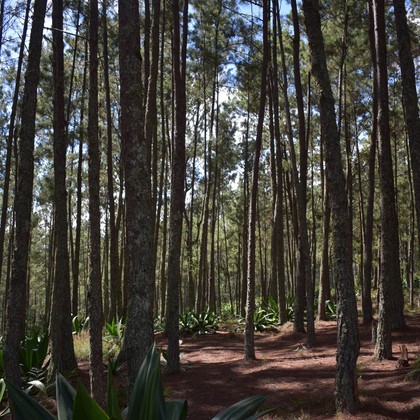
On migration all kinds of woodland: dry and moist broadleaf forest, coastal woodland, pine forest and forest edges, also parks and gardens with tall trees. It perches on an open branch in the middle or upper layers, sallies after flying insects and often returns to the same perch.
Where the bird is most at home, classified by the vegetation types of the Caribbean.




Range and movements
A fairly common passage migrant in Cuba and the Cayman Islands, mainly from August to October and less so in April and May; scarcer in the Bahamas, the Turks and Caicos Islands and Jamaica; rare in Hispaniola, Puerto Rico, the Virgin Islands, the Lesser Antilles, the ABC Islands and Trinidad and Tobago. It breeds from south-eastern Canada to the Gulf Coast and Florida and winters from Costa Rica to northern Bolivia.
- Resident
- Summer visitor (c. Oct–Mar)
- Winter visitor (c. Apr–Sep)
- Passage (Mar–Apr, Oct–Nov)
- dark = core range, pale = thinly spread
How and when to look
The best chance is in autumn in Cuba and on Grand Cayman, at forest edges and in parks with tall trees. A slim pewee with distinct wing bars and long wings giving a clear pee-a-wee is this species.
Conservation status
Not threatened. The species is common on its breeding grounds but has gradually declined there in recent decades; in Canada it is listed as a species of special concern.
Scientific name
Contopus virens | (Linnaeus, 1766)
Linnaeus described the species in 1766 as [Muscicapa] virens; because it was later moved to another genus, the author and year stand in brackets. The genus Contopus was introduced in 1855 by Cabanis. Contopus is Greek, from kontos 'pole, shaft' and pous 'foot', after the short legs. virens is Latin for 'green', after the olive tinge of the upperparts. The specimen the first description was based on came from Carolina (USA).