All species › Passerines › New World warblers › Townsend's Warbler
Townsend's Warbler | Setophaga townsendi
Townsends zanger | Reinita de Townsend
Townsend's Warbler is the western counterpart of the Black-throated Green Warbler: it breeds in coniferous forest from Alaska to Oregon and Montana and winters along the Pacific coast and in the mountains of Mexico and Central America. In the Caribbean it is a very rare vagrant, with a handful of records in the Greater Antilles, the Bahamas and the Cayman Islands.
Voice
The call is a sharp tsip or tik, hardly separable from that of Black-throated Green. The song, rarely heard away from the breeding grounds, is a buzzy series such as zee-zee-zee-bzz-zee.
Recording: Paul Marvin — CC BY-NC-SA 4.0 · shortened to the first 60 s, mono · xeno-canto
Identification
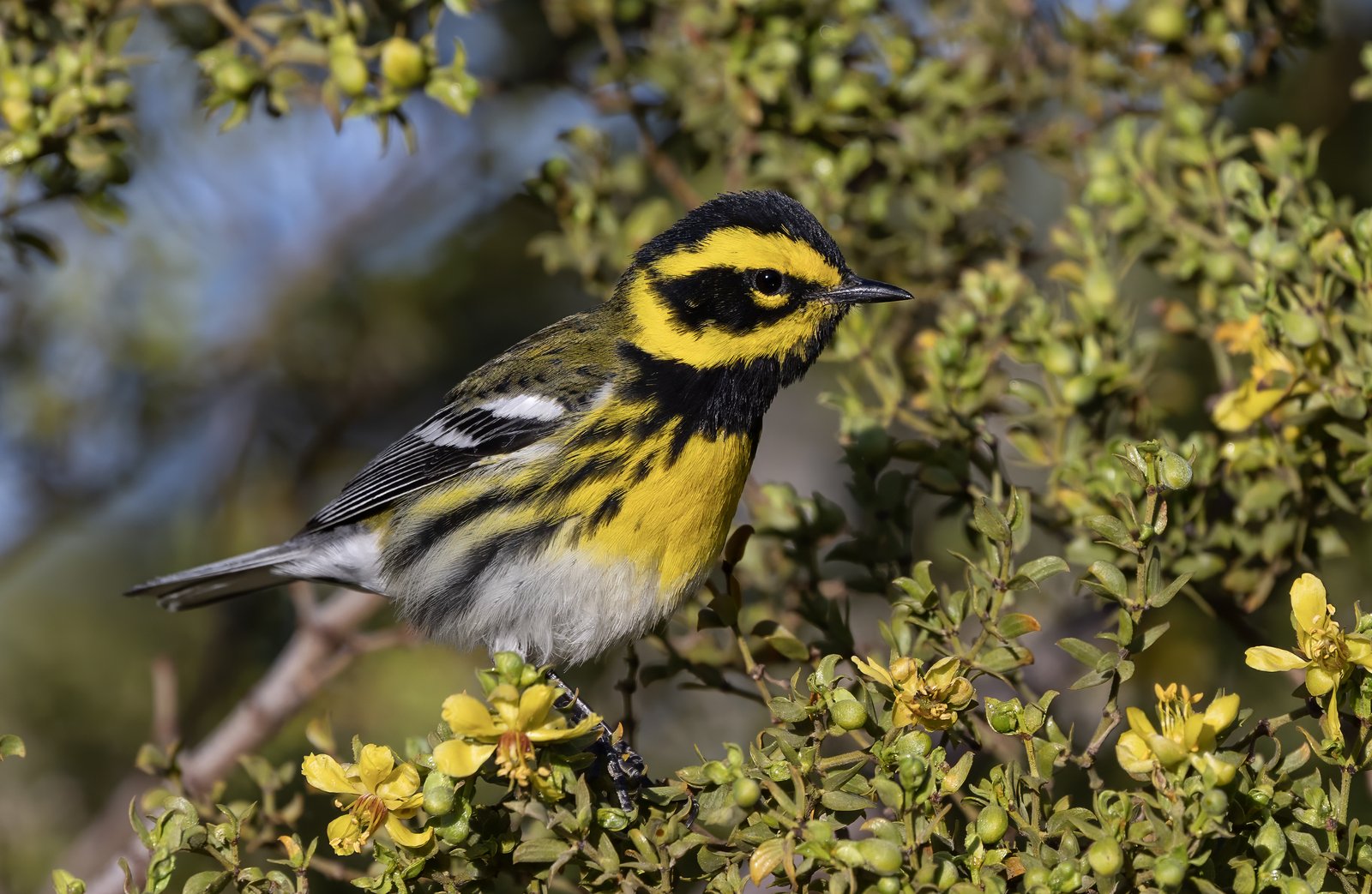
11.5–12.5 cm, with a fine, pointed bill. The face is yellow with a dark cheek patch running from the bill through the eye, framed in yellow. Upperparts olive-green with dark streaks, two white wing bars and much white in the outer tail feathers. The male has a black crown, a black cheek patch, a black throat, a yellow breast and black streaks on the flanks; the belly is white. The female has an olive-green crown and cheek patch and a yellow throat with some black on the upper breast. Young birds resemble the female, with less black.
Confusion species
Black-throated Green Warbler Setophaga virens has a yellow face with at most a faint olive cheek border, no dark cheek patch, an unstreaked back and a white breast. Female and young Blackburnian Warbler Setophaga fusca also have a dark cheek patch, but pale streaks on the back, a yellow-orange throat and a whitish belly without a yellow breast. Yellow-rumped Warbler Setophaga coronata, a winter visitor, is browner, with a yellow rump.
Habitat
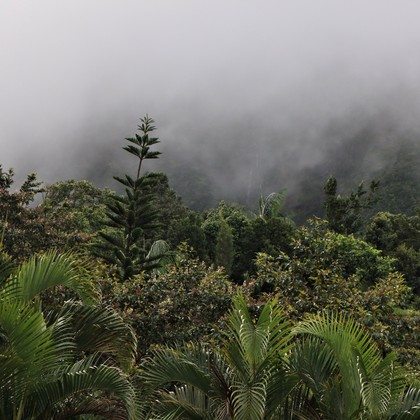
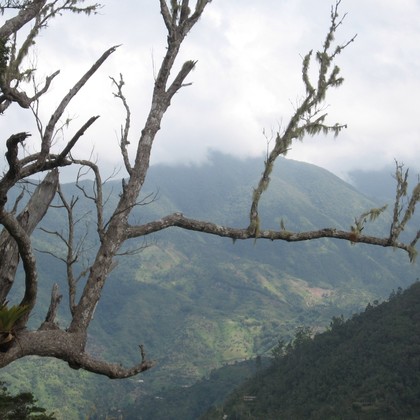
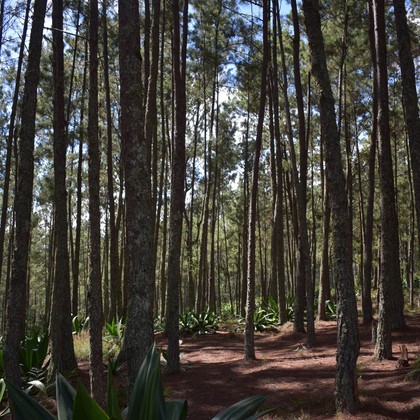
On the breeding and wintering grounds, forest with conifers or tall broadleaf trees, especially in mountains. Caribbean records came from montane rainforest and cloud forest in Puerto Rico and Cuba, from a botanic park on Grand Cayman and from lower woodland and scrub in the Bahamas and the Turks and Caicos Islands. It forages in the middle and upper levels for insects, often in mixed flocks with other warblers.
Where the bird is most at home, classified by the vegetation types of the Caribbean.

Range and movements
Records in observation databases come from Grand Turk (January 1986), Grand Bahama (October 2009), Grand Cayman (February 2014), Cuba (Topes de Collantes, February 2015), north-western Dominican Republic (November 2019) and Puerto Rico, where a bird stayed along the Ruta Panorámica between Ponce and Jayuya in February 2020 and another was seen near Jayuya in November 2023. Not all of these have been formally reviewed. Outside the region the species breeds from Alaska and Yukon to Oregon, Idaho and Montana and winters from the west coast of the United States through Mexico to Nicaragua.
How and when to look
A Black-throated Green with a dark cheek patch and a yellow breast deserves a second look, especially in mixed flocks in montane forest. A photograph of the head and breast is needed to document the record.
Conservation status
Not threatened. The population is large and fairly stable. Loss of old-growth conifer forest on the breeding grounds and of montane forest on the wintering grounds may cause local declines.
Scientific name
Setophaga townsendi | (Townsend, 1837)
Townsend described the species in 1837 as Sylvia townsendi; because it was later moved to another genus, the author and year stand in brackets. The genus Setophaga was introduced in 1827 by Swainson. Setophaga is Greek, from sēs, sētos 'moth' and -phagos '-eating': 'moth-eater'. townsendi honours the American naturalist John Kirk Townsend (1809–1851), who collected the species on the Columbia River. The specimen the first description was based on came from Fort Vancouver on the Columbia River, Washington (USA).