All species › Passerines › New World warblers › Connecticut Warbler
Connecticut Warbler | Oporornis agilis
Connecticutzanger | Reinita de Connecticut
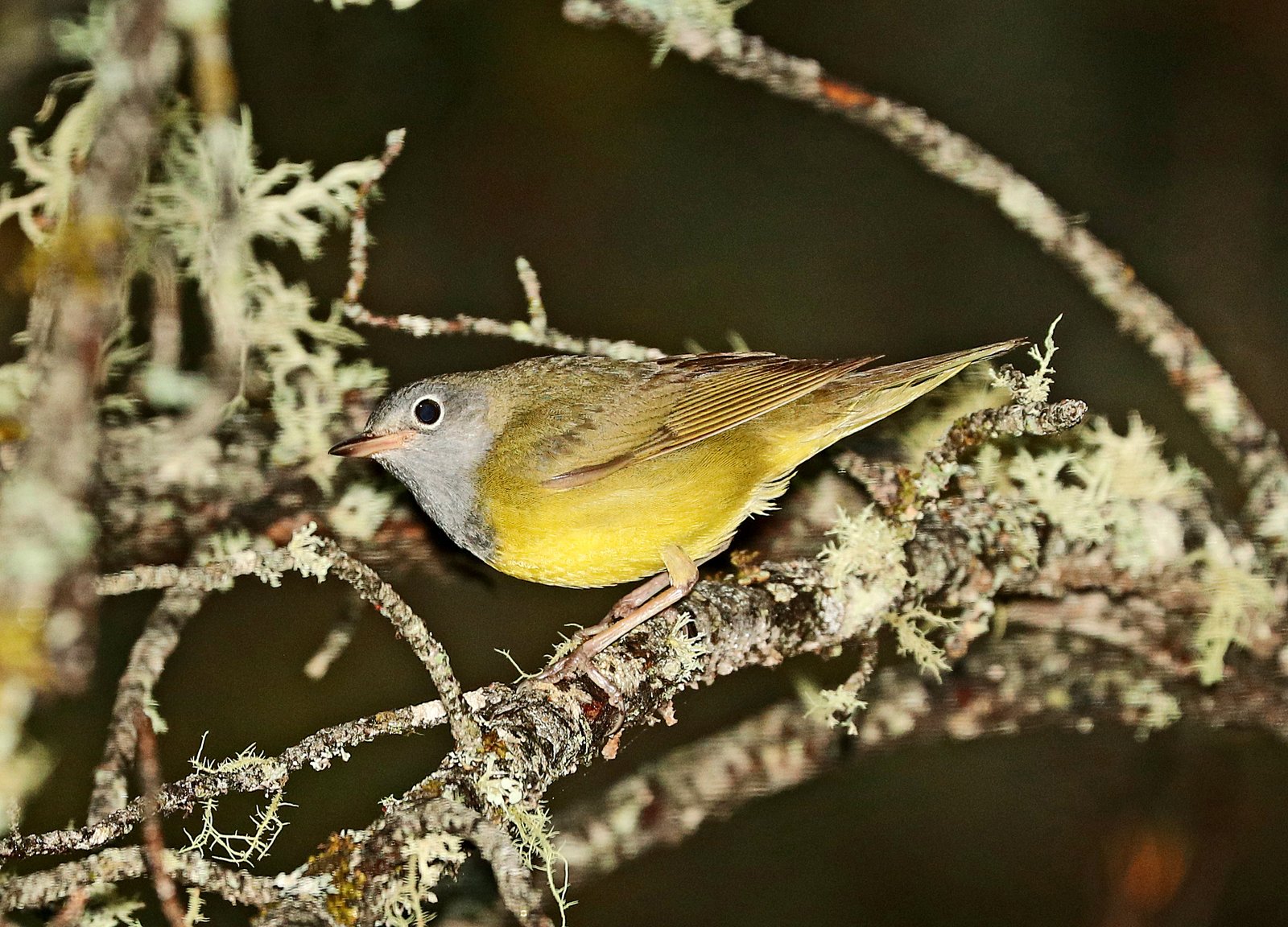
The Connecticut Warbler is a large, stocky wood-warbler with a grey hood and a white eye-ring, breeding in boreal bogs and aspen woodland in Canada and the northern United States and wintering in the Amazon basin. It is secretive and poorly known on migration. Geolocator research (McKinnon et al., 2017) showed that birds from Manitoba flew in autumn from the Atlantic coast non-stop over the sea for about two days to the Greater Antilles, probably Hispaniola, then continued to South America after a stopover. In spring the species takes a more westerly route.
Voice
Almost silent on migration. The call is a hard, metallic pleenk or chimp. The song, on the breeding grounds, is a loud, rhythmic series of repeated phrases, chipiteh-chipiteh-chipiteh.
Recording: Michael Collins — CC BY-NC-SA 4.0 · shortened to the first 60 s, mono · xeno-canto
Identification
13–15 cm, sturdily built, with a short-looking tail because the long undertail coverts reach far along it. The male has a plain slate-grey hood over head, throat and breast; females and immatures a brownish-grey to drab brown hood with a paler throat. In all plumages a complete white or yellowish-white eye-ring. Upperparts olive-green, belly and undertail yellow. The legs are pink.
Confusion species
Mourning Warbler Geothlypis philadelphia is smaller with shorter undertail coverts; adult males have a black breast patch and no eye-ring, while females and immatures show at most a thin, broken eye-ring and often a yellowish throat. Nashville Warbler Leiothlypis ruficapilla is much smaller, with a yellow throat and an active way of foraging in the foliage. Female Common Yellowthroats Geothlypis trichas are smaller and have a yellow throat without a hood.
Habitat
On migration in dense undergrowth of semi-evergreen and moist forest, limestone forest and thickets. It walks deliberately over the ground and low branches, bobbing its tail, and searches the leaves for insects and spiders.
Where the bird is most at home, classified by the vegetation types of the Caribbean.



Range and movements
A rare autumn passage migrant in the Bahamas, Cuba and Hispaniola (Haiti and the Dominican Republic) and a regular passage migrant on Bonaire and Curaçao, with further records from Jamaica, Puerto Rico, the Virgin Islands and Sint Maarten. Recorded as a vagrant from Aruba, Barbados, Guadeloupe and the Cayman Islands. Because of its secretive habits it is probably often overlooked. Breeds in Canada from Alberta to Quebec and in northern Minnesota, Wisconsin and Michigan, and winters in the Amazon basin, mainly in Colombia, Venezuela, Peru and Brazil.
How and when to look
A chance exists mainly from mid-September to late October in forest with dense undergrowth in the Greater Antilles, including Haiti and the Dominican Republic. A large, grey-headed warbler that walks rather than hops on the ground, with a complete eye-ring, is the key clue.
Conservation status
Not threatened. Its secretive habits and remote breeding range mean that numbers are incompletely known; counts suggest a slow decline.
Scientific name
Oporornis agilis | (Wilson, 1812)
Wilson described the species in 1812 as Sylvia agilis; because it was later moved to another genus, the author and year stand in brackets. The genus Oporornis was introduced in 1858 by Baird. Oporornis is Greek, from opōra 'late summer, autumn' and ornis 'bird', as the type species was mainly seen on autumn migration. agilis is Latin for 'nimble, agile'. The specimen the first description was based on came from Connecticut (USA).