All species › Passerines › Cardinals › Rose-breasted Grosbeak
Rose-breasted Grosbeak | Pheucticus ludovicianus
Roodborstkardinaal | Picogrueso pechirrosado
The Rose-breasted Grosbeak is a sturdy cardinal with a heavy, pale bill that breeds in deciduous forest in eastern North America and winters from Mexico to northern South America. The Caribbean lies on the eastern edge of its migration route; it passes regularly in the west but becomes rare further east. In Cuba it is called degollado, after the red patch on the breast.
Voice
The call is a sharp, squeaky eek, like a sneaker on a polished floor; often the first sign of a bird in a tree crown. The song is a long, flowing series of whistled notes, recalling a thrush but softer and faster; seldom heard in winter.
Recording: Sue Riffe — CC BY-NC-SA 4.0 · shortened to the first 60 s, mono · xeno-canto
Identification
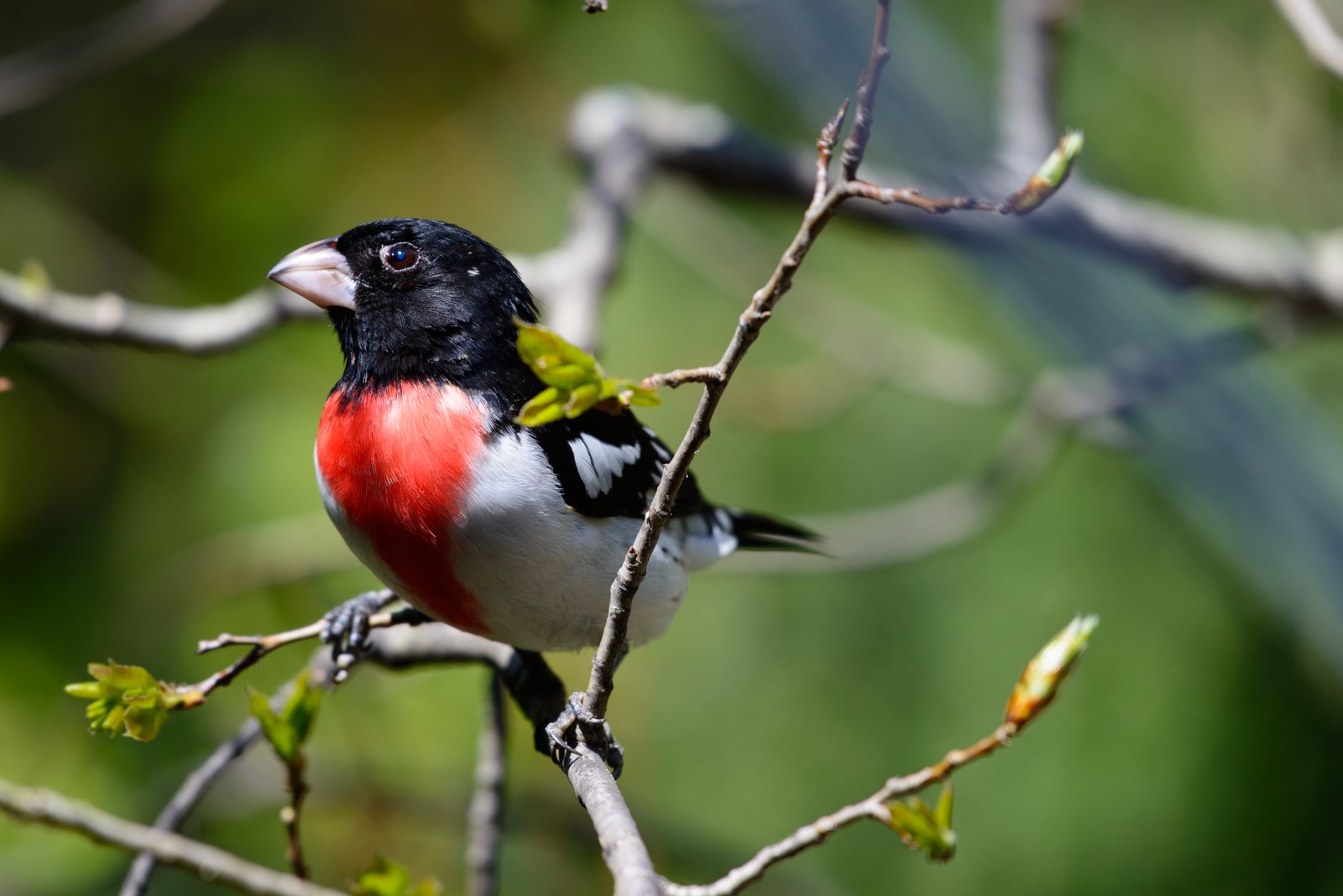
18–22 cm, with a large, conical, whitish bill. The breeding male is black on the head, back, wings and tail and white on the belly and rump, with a red triangle on the breast, a white wing patch and white tail spots; in flight the rose-red underwing coverts show. In autumn and winter the male is browner, with pale feather edges and a smaller, mottled breast patch. The female is streaked brown like a large sparrow, with a broad white supercilium, two white wing bars and a finely streaked pale breast; her underwing is yellow. Young males show a pink wash on the breast and pink underwings.
Confusion species
Black-headed Grosbeak Pheucticus melanocephalus, an extremely rare vagrant from western North America, has an orange-brown breast in the male and a warm ochre, barely streaked breast and darker upper mandible in the female. Females may also recall Blue Grosbeak Passerina caerulea, but that species is plain brown without breast streaks and has cinnamon wing bars. Sparrows and buntings are smaller with finer bills.
Habitat
On migration and in winter forest edges, semi-evergreen and moist forest, montane forest, coastal woodland and trees in gardens and parks. It feeds in the crowns of trees on fruit, seeds, buds and insects, on migration often in fruiting trees and sometimes in small groups.
Where the bird is most at home, classified by the vegetation types of the Caribbean.





Range and movements
A fairly common to scarce passage migrant in the Bahamas, Cuba, the Cayman Islands, Jamaica and San Andrés, with small numbers wintering. Rare on Hispaniola, Puerto Rico and the Virgin Islands; only a vagrant in the Lesser Antilles, the ABC Islands and Trinidad and Tobago. Breeds in southern Canada and the northern and eastern United States; winters from central Mexico through Central America to Colombia, Venezuela, Ecuador and Peru.
- Resident
- Summer visitor (c. Oct–Mar)
- Winter visitor (c. Apr–Sep)
- Passage (Mar–Apr, Oct–Nov)
- dark = core range, pale = thinly spread
How and when to look
The best chance is in October and April to early May in western Cuba and the Cayman Islands, in fruiting trees along forest edges and in gardens. Listening for the squeaky eek helps to locate birds in dense foliage.
Conservation status
Not threatened. The population is large, but a gradual decline has been measured in the breeding range since the 1960s. In Cuba grosbeaks and buntings are trapped for the cage-bird trade.
Scientific name
Pheucticus ludovicianus | (Linnaeus, 1766)
Linnaeus described the species in 1766 as Loxia ludoviciana; because it was later moved to another genus, the author and year stand in brackets. The genus Pheucticus was introduced in 1850 by Reichenbach. Pheucticus is Greek, from pheuktikos 'shy, inclined to avoid'. ludovicianus is Latin for 'of Louisiana', the territory named after King Louis (Ludovicus) XIV. The specimen the first description was based on came from Louisiana.