All species › Passerines › Tanagers › St. Lucia Black Finch
St. Lucia Black Finch | Melanospiza richardsoni
Sint-Luciagrondvink | Semillero de Santa Lucía
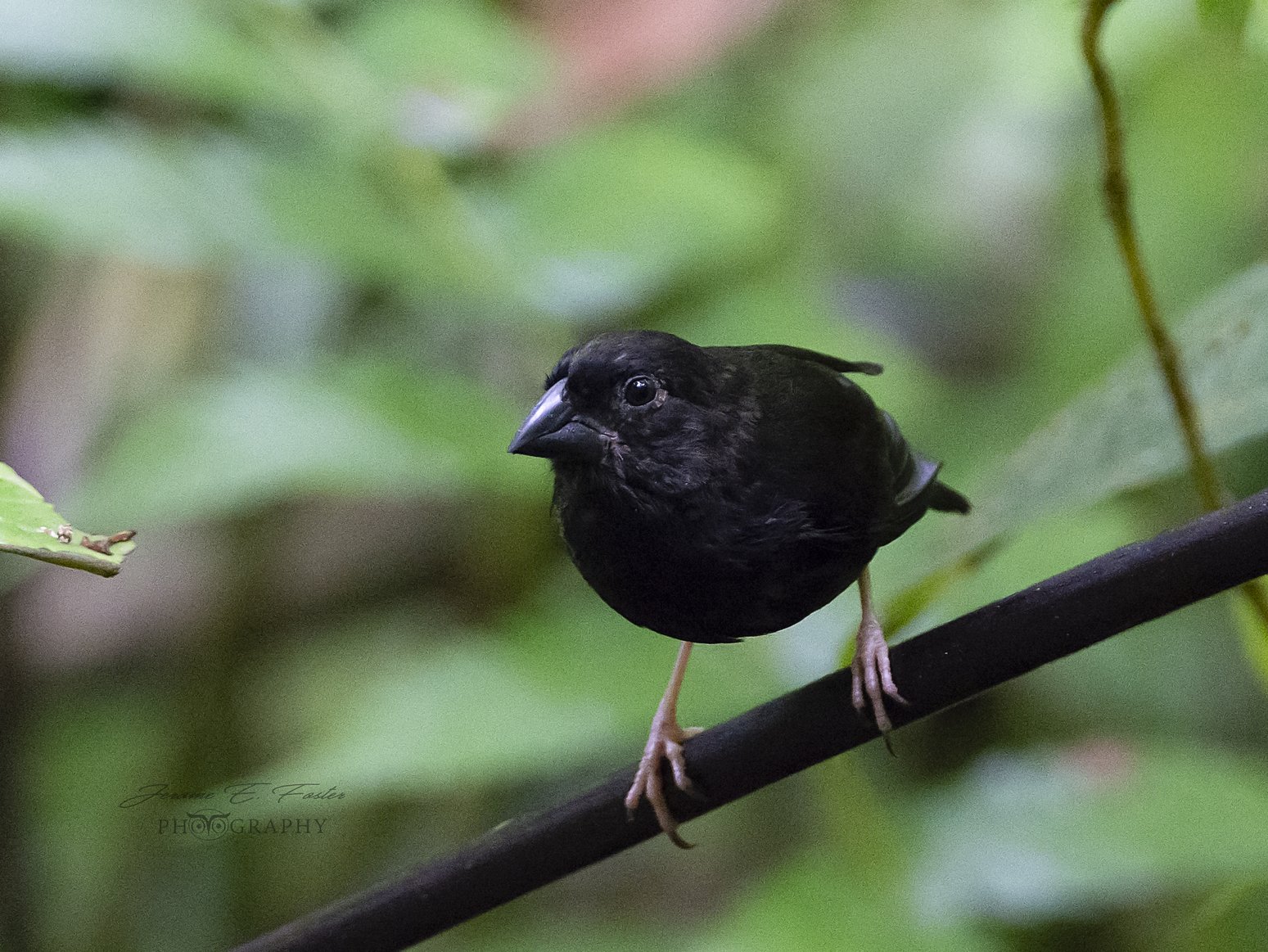
The St. Lucia Black Finch is a compact, blackish finch found only in Saint Lucia. It lives hidden in the forest understorey and takes much of its food on or just above the ground. Together with Black-faced Grassquit it forms the genus Melanospiza. It is one of the scarcer endemics of the island.
Voice
The song is a somewhat rasping short phrase, roughly tick-zwee-swisiwis-you, stressed on the second and last notes, slightly reminiscent of Bananaquit.
Recording: Paul Driver — CC BY-NC-SA 4.0 · converted to mono · xeno-canto
Identification
13–14 cm, with a heavy, black, conical bill and pink legs. The male is entirely black. The female is brown above, with a grey crown contrasting clearly with the back, and buff below. Juveniles resemble the female.
Confusion species
Lesser Antillean Bullfinch Loxigilla noctis is slightly larger, with a relatively smaller bill and dark legs; the male has a rufous throat, a rufous spot above the lores and rufous undertail coverts, while the female is olive-brown with an orange-brown undertail and no grey crown. The male Shiny Cowbird Molothrus bonariensis is glossy purplish black, with a more pointed bill and longer tail, and lives in open country.
Habitat
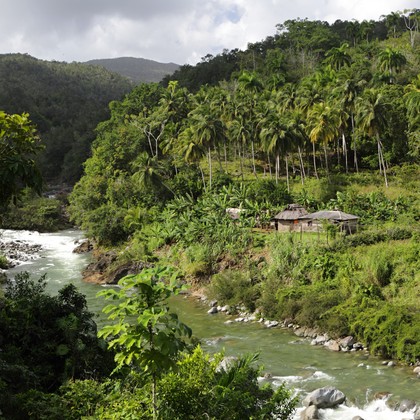
Moist evergreen and montane forest with dense undergrowth, secondary forest and, locally, dry forest and scrub, up to about 950 m. Its stronghold is the moister forest at higher elevations. It forages mainly low in the undergrowth and on the ground, on seeds, fruit and insects.
Where the bird is most at home, classified by the vegetation types of the Caribbean.



Range and movements
Only in Saint Lucia, mainly in the forested areas of the centre and south of the island and locally in the dry forest of the north-east. It does not occur outside Saint Lucia.
- Resident
- dark = core range, pale = thinly spread
How and when to look
Trails in the inland forest reserves, such as Edmund Forest Reserve and Des Cartiers, are the best places. The bird keeps low and quiet; the song and rustling in the leaf litter are the first clues. An all-black male with pink legs separates it from the common Lesser Antillean Bullfinch.
Conservation status
Endangered. The population is small and probably declining. Forest loss and predation by introduced animals such as rats and the mongoose are named as the main threats.
Scientific name
Melanospiza richardsoni | (Cory, 1886)
Cory described the species in 1886 as Loxigilla richardsoni; because it was later moved to another genus, the author and year stand in brackets. The genus Melanospiza was introduced in 1897 by Ridgway. Melanospiza is Greek, from melas 'black' and spiza 'finch': 'black finch'. richardsoni honours the American collector Richardson who obtained the type specimens on St Lucia; which Richardson (W.B. or W.E.) is meant is disputed. The specimen the first description was based on came from mountains of St Lucia.