All species › Passerines › Tanagers › Black-faced Grassquit
Black-faced Grassquit | Melanospiza bicolor
Maskergrondvink | Semillero bicolor
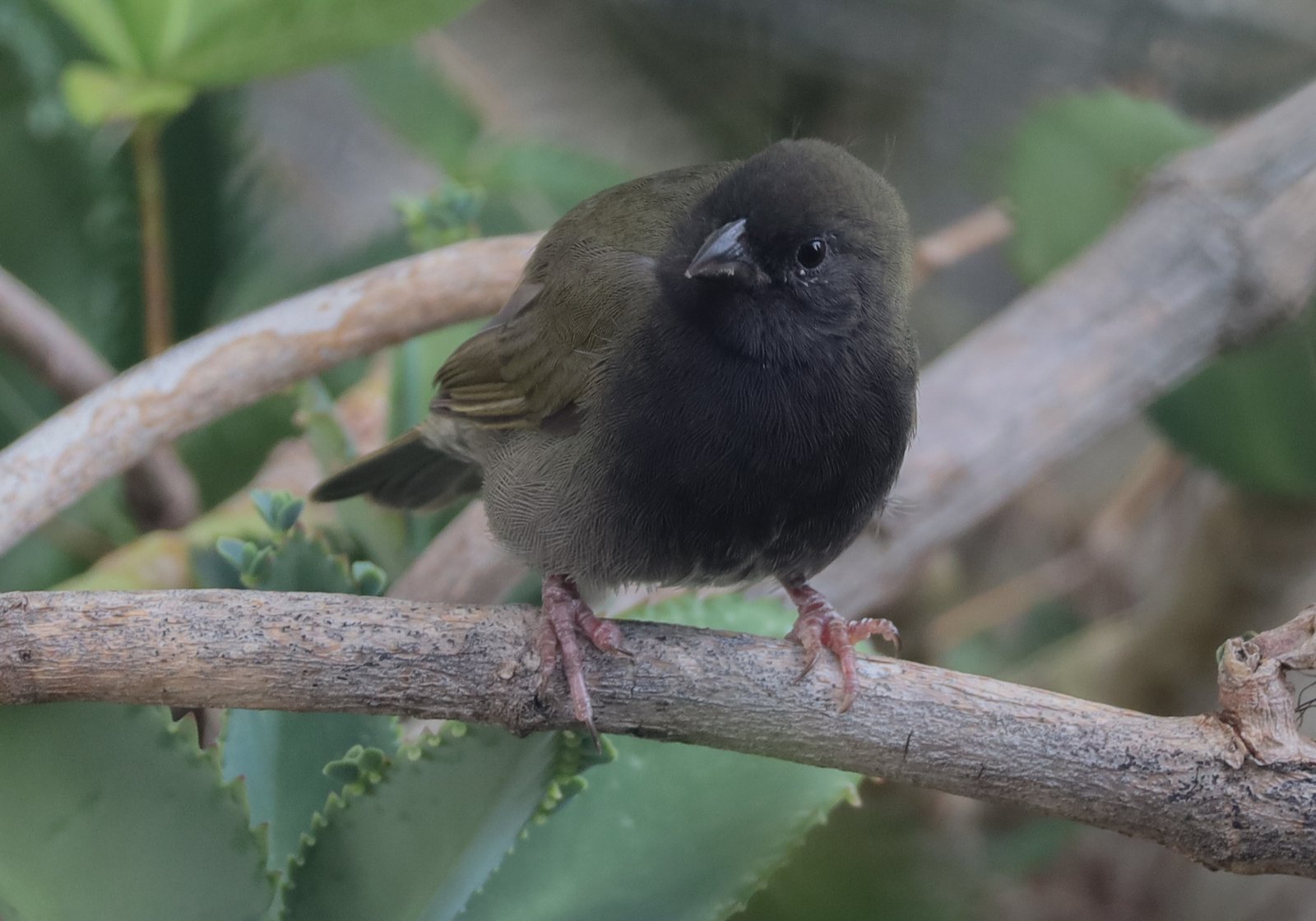
The Black-faced Grassquit is the most widespread grassquit in the Caribbean and on most islands one of the commonest birds of dry, open country, roadsides and gardens. In Puerto Rico it is called gorrión negro. Eight subspecies are recognised, most of them in the Caribbean. Together with St. Lucia Black Finch it forms the genus Melanospiza.
Voice
The call is an emphatic buzz, often followed by a second, louder effort, and a soft tsip. The song is a buzzy, variable series of notes ending in shorter, thinner notes. Males perform a display flight, drifting down while singing with vibrating wings.
Recording: Francisco contreras — CC BY-NC-SA 4.0 · converted to mono · xeno-canto
Identification
10–11.5 cm, with a short, conical bill and pinkish-grey legs. The male has a black head, throat and breast and olive-green upperparts, wings and tail; the belly is dark olive-grey. In Jamaica and Hispaniola males are smaller, with a whitish belly and undertail, and on San Andrés and Providencia the back is brighter olive-green. The female is plain dull olive-green, slightly browner or greyer below, with a dark upper and a paler lower mandible. Juveniles resemble the female.
Confusion species
The male Yellow-faced Grassquit Tiaris olivaceus has a yellow facial mask; the female shows a hint of yellow around the eye and throat. Yellow-shouldered Grassquit Loxipasser anoxanthus has a thicker bill, yellow shoulders and a rusty undertail. Female Blue-black Grassquits Volatinia jacarina are browner and streaked on the breast. In Trinidad the male Sooty Grassquit Asemospiza fuliginosa is entirely sooty black, including the back. Seedeaters of the genus Sporophila have a thicker, more rounded bill.
Habitat
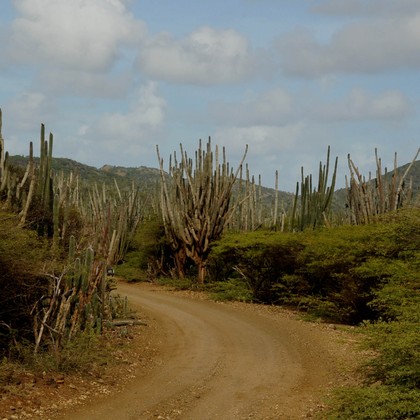
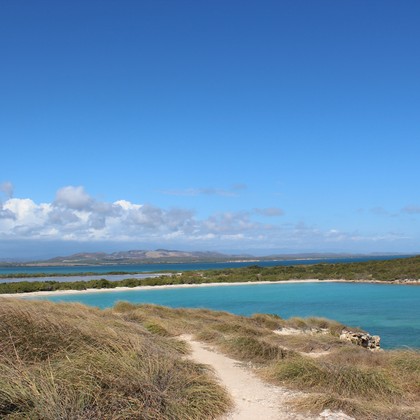
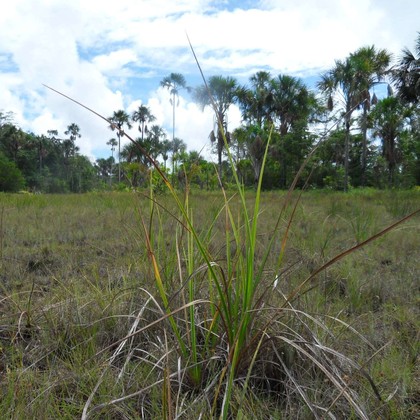
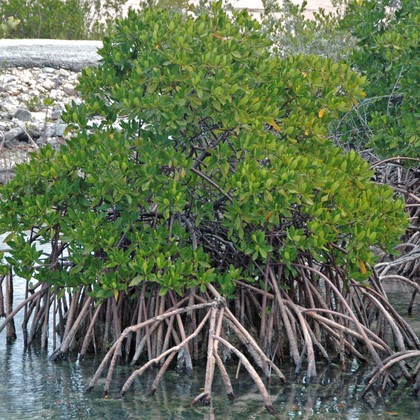
Open, dry to semi-arid country: thorn scrub and cactus scrub, coastal scrub, grassy places along roads and forest edges, clearings, plantations, pastures, gardens and villages; in the ABC Islands also mangroves. It eats mainly seeds, in the ABC Islands also cactus fruit, foraging singly, in pairs or in small groups on or near the ground. It breeds year-round, often in loose colonies. The nest is a globe of grass with a side or bottom entrance, on the ground among prickly pears or in a shrub up to about 2.5 m; the clutch is two to four eggs.
Where the bird is most at home, classified by the vegetation types of the Caribbean.



Range and movements
Resident in the Bahamas, the Turks and Caicos Islands, Jamaica, Hispaniola (Haiti and the Dominican Republic), Puerto Rico, the Virgin Islands, all islands of the Lesser Antilles south to Grenada, Barbados, the ABC Islands, San Andrés and Providencia, and Tobago and the islets off north-west Trinidad. Virtually absent from Trinidad itself. In Cuba only rare and very local on a few cays off the north coast; absent from the Cayman Islands. Outside the region in northern Colombia and Venezuela; a few vagrants in Florida.
- Resident
- dark = core range, pale = thinly spread
How and when to look
On most islands found on roadsides, in dry thickets and in gardens; in the ABC Islands, the Bahamas and Puerto Rico often in small flocks. For females: a plain olive-green grassquit without any yellow or streaking is usually this species.
Conservation status
Not threatened. The species has a very large range, is common on most islands and is probably increasing; no immediate threats are known.
Scientific name
Melanospiza bicolor | (Linnaeus, 1766)
Linnaeus described the species in 1766 as Fringilla bicolor; because it was later moved to another genus, the author and year stand in brackets. The genus Melanospiza was introduced in 1897 by Ridgway. Melanospiza is Greek, from melas 'black' and spiza 'finch': 'black finch'. bicolor is Latin for 'two-coloured', after the male's black and olive-green. The specimen the first description was based on came from the Bahamas.