All species › Cranes, rails and allies › Rails and crakes › Spotted Rail
Spotted Rail | Pardirallus maculatus
Gevlekte ral | Rascón pinto
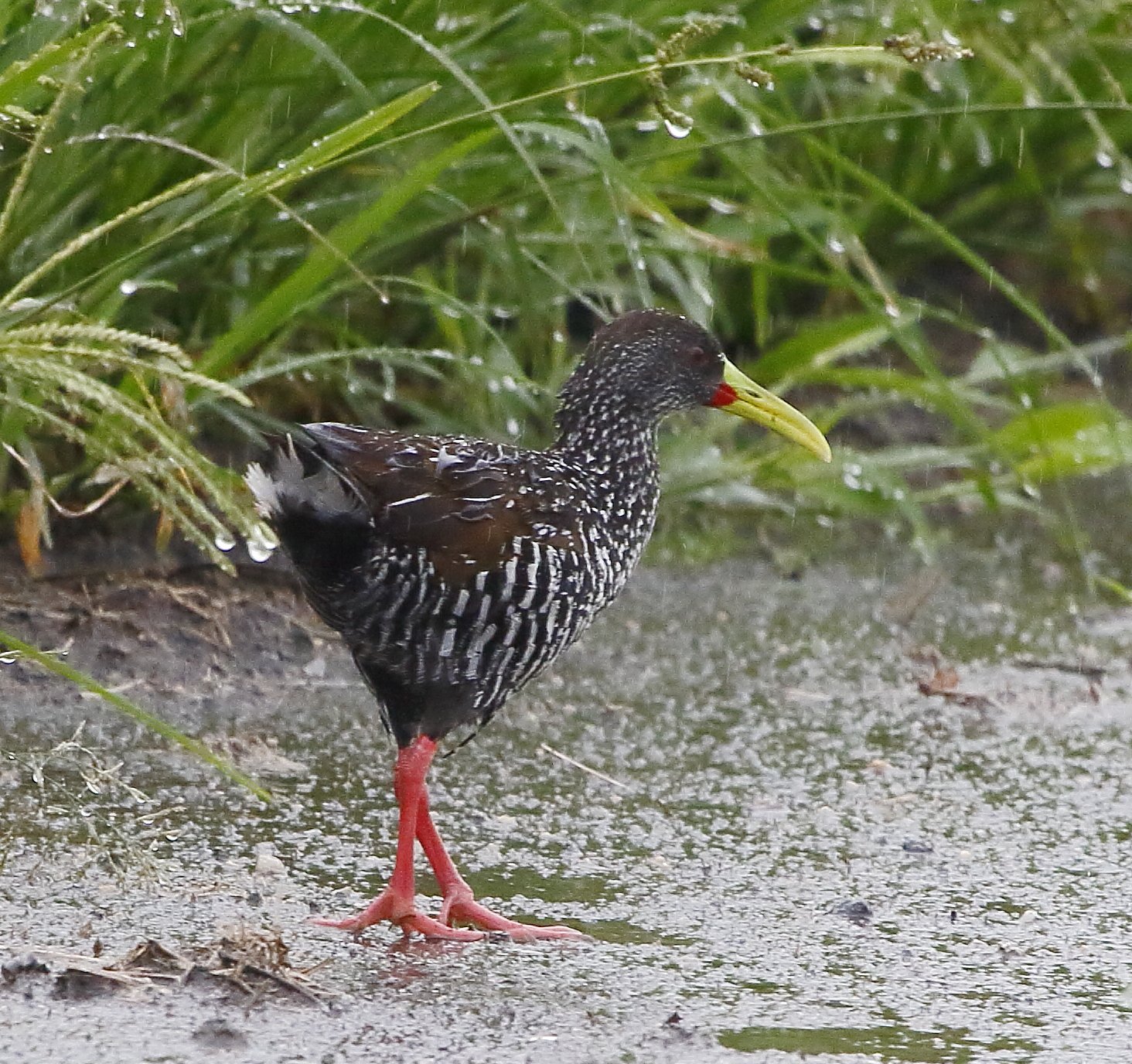
The Spotted Rail is a medium-sized rail with black-and-white spotted and streaked plumage, a long greenish-yellow bill and red eyes. It lives hidden in dense marsh vegetation and rice fields and is heard far more often than seen. In the Caribbean it is local and scarce in Cuba, Hispaniola and Jamaica, where it was long believed to have vanished.
Voice
A loud, rasping, groaning screech, usually preceded by a grunt or pop, and an accelerating series of deep, gruff, pumping notes. It also calls at night.
Recording: José Menéndez — CC BY-NC-SA 4.0 · converted to mono · xeno-canto
Identification
25–28 cm; the female is slightly smaller than the male. Head and neck are blackish with fine white dots. The upperparts are black and brown, with white streaks and spots. The underparts are blackish with dense white spots on the breast and white bars on the belly and flanks; the undertail coverts are white. The bill is long and greenish-yellow with a red spot at the base of the lower mandible; the eye is red, the legs pink to red. Juveniles are browner and less sharply marked, with a duller bill. It seldom flies, and then only briefly, with legs dangling.
Confusion species
No other rail in the region has this dotted black-and-white plumage. Zapata Rail Mustelirallus cerverai, found only in the Zapata Swamp, is slate-grey and olive-brown without spots. King Rail Rallus elegans and Clapper Rail Rallus crepitans are larger and browner, with barring only on the flanks. Sora Porzana carolina is smaller, with a short, thick yellow bill.
Habitat
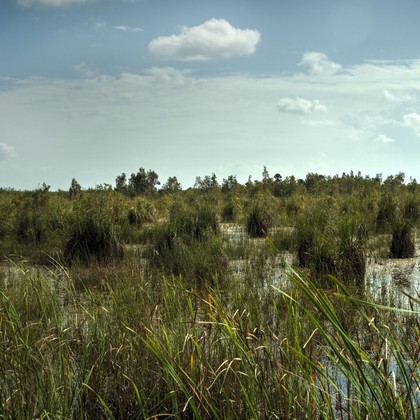
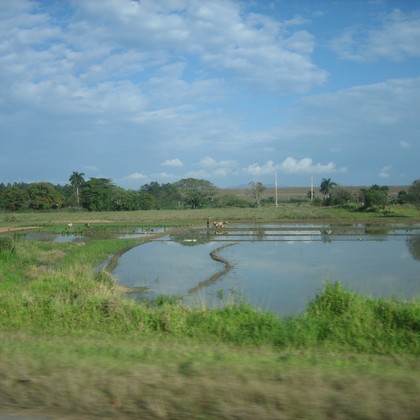
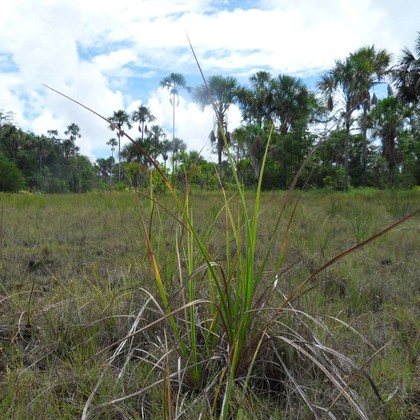
Freshwater marshes with dense tall vegetation, wet grassland, flooded pastures and rice fields; often where shallow water and cover meet. It feeds in shallow water and at the edge of vegetation on earthworms, insects, small fish and plant matter, mainly at dusk. It builds a grass nest close to the ground in marsh vegetation.
Where the bird is most at home, classified by the vegetation types of the Caribbean.
Range and movements
In Cuba locally in marshes and rice fields, including the Zapata Swamp and the lowlands. In Hispaniola rare and known from only a few sites, mainly in the Dominican Republic. In Jamaica first recorded in 1863, then not found for more than a century and rediscovered in 1977 in the Black River Morass, where breeding has been confirmed since 2012. In Trinidad a rare visitor with only a few records. Beyond the region in Mexico and Central America and much of South America, south to Argentina.
- Resident
- Summer visitor (c. Oct–Mar)
- Winter visitor (c. Apr–Sep)
- dark = core range, pale = thinly spread
How and when to look
The best chance is at dusk on the edges of rice fields and marshes, where birds may briefly leave cover. The call usually gives the first clue. In Cuba in and around the Zapata Swamp; in Jamaica in the Upper Morass of the Black River system. Patient waiting at an open patch in the vegetation yields more than walking around.
Conservation status
Not globally threatened. In the Caribbean rare and local, and probably often overlooked. The draining and conversion of marshes, burning and predation by introduced mongooses and rats are threats; rice fields locally provide substitute habitat.
Scientific name
Pardirallus maculatus | (Boddaert, 1783)
Boddaert described the species in 1783 as Rallus maculatus; because it was later moved to another genus, the author and year stand in brackets. The genus Pardirallus was introduced in 1856 by Bonaparte. Pardirallus combines Greek pardos 'leopard' with Rallus 'rail': a 'leopard rail', after the spotted plumage. maculatus is Latin for 'spotted', after the white spots and bars on the plumage. The specimen the first description was based on came from Cayenne, French Guiana.