All species › Cranes, rails and allies › Rails and crakes › Zapata Rail
Zapata Rail | Mustelirallus cerverai
Zapataral | Gallinuela de Santo Tomás
The Zapata Rail is a dark, medium-sized rail that lives only in the northern part of the Zapata Swamp in Cuba. It is one of the least-known birds of the Caribbean: since its discovery in 1927 near the village of Santo Tomás there have been very few certain records, and only one nest has ever been described. The Cuban name, gallinuela de Santo Tomás, refers to that locality; the scientific name honours the collector Fermín Cervera.
No photograph of a living wild bird of this species with a suitable Creative Commons licence exists. Do you have one that meets the rules? Send it in.
Voice
Insufficiently known. A bouncing cutucutu-cutucutu-cutucutu and a loud kuck kuck have been described, but it is not certain that these sounds come from the Zapata Rail rather than from Spotted Rail, which lives in the same swamp.
No recording with a suitable Creative Commons licence is available for this species yet.
Identification
29 cm, with short, rounded wings; as far as is known the bird hardly flies. The upperparts are olive-brown. Head, neck and breast are slate-grey; the belly is grey with white bars, the flanks grey-brown and the undertail coverts white. The bill is yellow with a red base; eye and legs are red. Juveniles are duller, with olive-toned legs and bill. The sexes are alike.
Confusion species
Spotted Rail Pardirallus maculatus, which also occurs in the Zapata Swamp, is densely spotted and barred with white and has a greenish-yellow bill with only a red spot. King Rail Rallus elegans is larger, with a rusty neck and breast and a long, slightly curved bill. Common Moorhen Gallinula chloropus also has a red bill base, but has a red frontal shield and a white flank stripe and swims a lot in open water.
Habitat
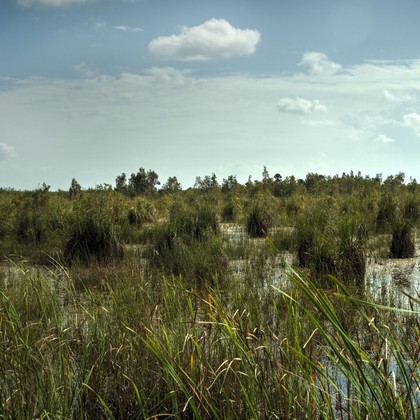
Flooded, almost impenetrable swamp with tall sawgrass, cattail and tangled bushes and low trees 1.5 to 2 metres tall, preferably near slightly higher ground. It lives hidden on the floor of this vegetation. Little is known about its diet and breeding.
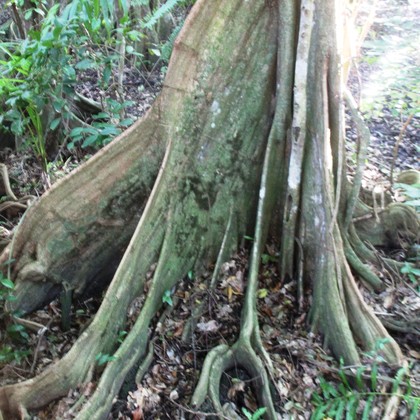
Where the bird is most at home, classified by the vegetation types of the Caribbean.
Range and movements
Endemic to Cuba and known only from the northern part of the Zapata Swamp in Matanzas province, with a range of at most about a thousand square kilometres. Fossil bones from around Havana, from Pinar del Río and from the Isla de la Juventud show that the species was once more widespread. It does not occur outside Cuba.
- Resident
- dark = core range, pale = thinly spread
How and when to look
The species is almost never seen, even by experienced birders in the Zapata Swamp. Records have mainly come from narrow mown rides through the sawgrass, where a bird may briefly step out of cover. The habitat is protected; in practice visits are made with a local national park guide, and walking off the rides damages the habitat and disturbs the birds.
Conservation status
Critically Endangered. Population estimates range from fewer than 250 to a few hundred birds, with a declining trend. The main threats are dry-season burning of the swamp, sawgrass cutting and predation by introduced mongooses, rats and African sharptooth catfish Clarias gariepinus. In the longer term sea-level rise and stronger hurricanes pose a risk. The habitat lies within the Ciénaga de Zapata National Park.
Scientific name
Mustelirallus cerverai | (Barbour & Peters, 1927) (GBIF: Cyanolimnas cerverai)
Barbour & Peters described the species in 1927 as Cyanolimnas cerverai; because it was later moved to another genus, the author and year stand in brackets. The genus Mustelirallus was introduced in 1858 by Bonaparte. Mustelirallus combines Latin mustela 'weasel' with Rallus 'rail', after the weasel-like colour and skulking habits. cerverai honours the Spanish collector Fermín Zanón Cervera (1875–1944), who discovered the species in the Zapata Swamp, Cuba, in 1927. The specimen the first description was based on came from Santo Tomás, Zapata Peninsula, Cuba.