All species › Waders, gulls and terns › Skuas › South Polar Skua
South Polar Skua | Stercorarius maccormicki
Zuidpooljager | Págalo polar
The South Polar Skua breeds along the coasts of Antarctica, making it the most southerly breeding bird in the world. In the southern winter part of the population moves north, far into the North Atlantic and North Pacific. In the Caribbean it is a very rare vagrant at sea.
Voice
Almost silent away from the breeding grounds. At the breeding site harsh, nasal calls, and a low, hard call when defending the nest.
Recording: steve — CC BY-SA 4.0 · converted to mono · xeno-canto
Identification
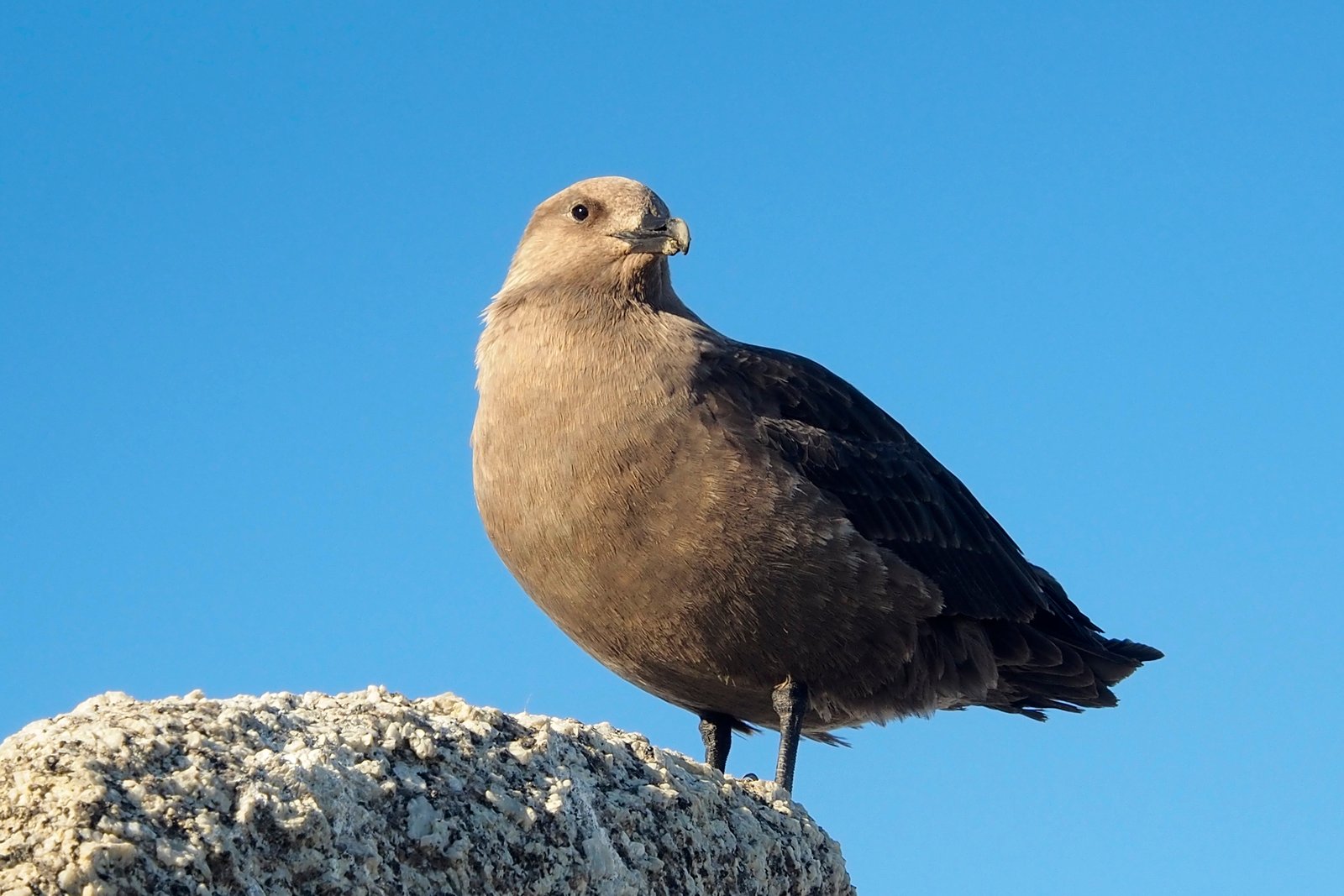
50–55 cm. Large, stocky and broad-winged, like a heavy gull, with a short, wedge-shaped tail with barely projecting central feathers and a strong, dark bill. The plumage is cold grey-brown, without warm or rusty streaks. There is a pale morph, with a pale, greyish or sandy head and underparts contrasting with the dark wings and back, and a dark morph that is almost uniformly blackish brown; intermediates occur. Fine pale streaks are sometimes visible around the hindneck. In flight there is a large white flash at the base of the primaries above and below.
Confusion species
Pomarine Jaeger Stercorarius pomarinus is smaller and slimmer, with narrower wings, a longer tail and, in pale birds, a black cap and breast band; juvenile Pomarines are barred on rump and undertail. Great Skua Stercorarius skua, also recorded a few times in the region, is warmer brown with pale streaks and spots on the back and wing coverts and lacks the contrast between a pale head and dark wings.
Habitat
Open ocean, well offshore, often behind fishing vessels and near flocks of shearwaters. At sea it feeds on fish and offal and steals food from shearwaters, boobies and gulls; on the breeding grounds it also takes penguin eggs and chicks.
Where the bird is most at home, classified by the vegetation types of the Caribbean.

Range and movements
A few records are known around the Bahamas, Cuba, Puerto Rico, Guadeloupe, Martinique, Barbados and Trinidad; there are no records from most islands. In the southern winter the birds migrate north mainly through the western Atlantic, past the coast of North America, and may reach Caribbean waters on the way. Beyond the region it breeds along the coasts of the Antarctic continent and nearby islands.
How and when to look
There is a chance almost only on pelagic trips. A large, dark skua in the northern summer months is more likely a South Polar Skua than a Great Skua, which is then breeding in the north. The cold grey tone without warm streaks and the contrast between head and wings are the best features; photographs help with assessment.
Conservation status
Not threatened. The Antarctic breeding population is small but stable, and the range is large. In the Caribbean a very rare visitor with no regular presence.
Scientific name
Stercorarius maccormicki | Saunders, 1893
Saunders described the species in 1893 and placed it straight away in the genus where it still stands. The genus Stercorarius was introduced in 1760 by Brisson. Stercorarius is Latin for 'of dung', from stercus 'dung': the food disgorged by seabirds when pursued by skuas was once taken for excrement. maccormicki honours the British naval surgeon and naturalist Robert McCormick (1800–1890), who sailed to Antarctica with James Clark Ross. The specimen the first description was based on came from Possession Island, Victoria Land, Antarctica.