All species › Passerines › New World blackbirds › Brown-headed Cowbird
Brown-headed Cowbird | Molothrus ater
Bruinkopkoevogel | Tordo cabeza café
The Brown-headed Cowbird is North America's brood parasite: the female lays her eggs in the nests of other songbirds, which raise the young. In the Caribbean it is a rare visitor that turns up mainly in winter and on passage in the northern Bahamas; no regular breeding population is known from the region.
Voice
The male's song is a short, liquid gurgle running into a thin, high whistle, roughly glug-glug-seee. Also a fine, high flight whistle and, from the female, a dry rattle chk-chk-chk.
Recording: Stanislas Wroza — CC BY-NC-SA 4.0 · converted to mono · xeno-canto
Identification
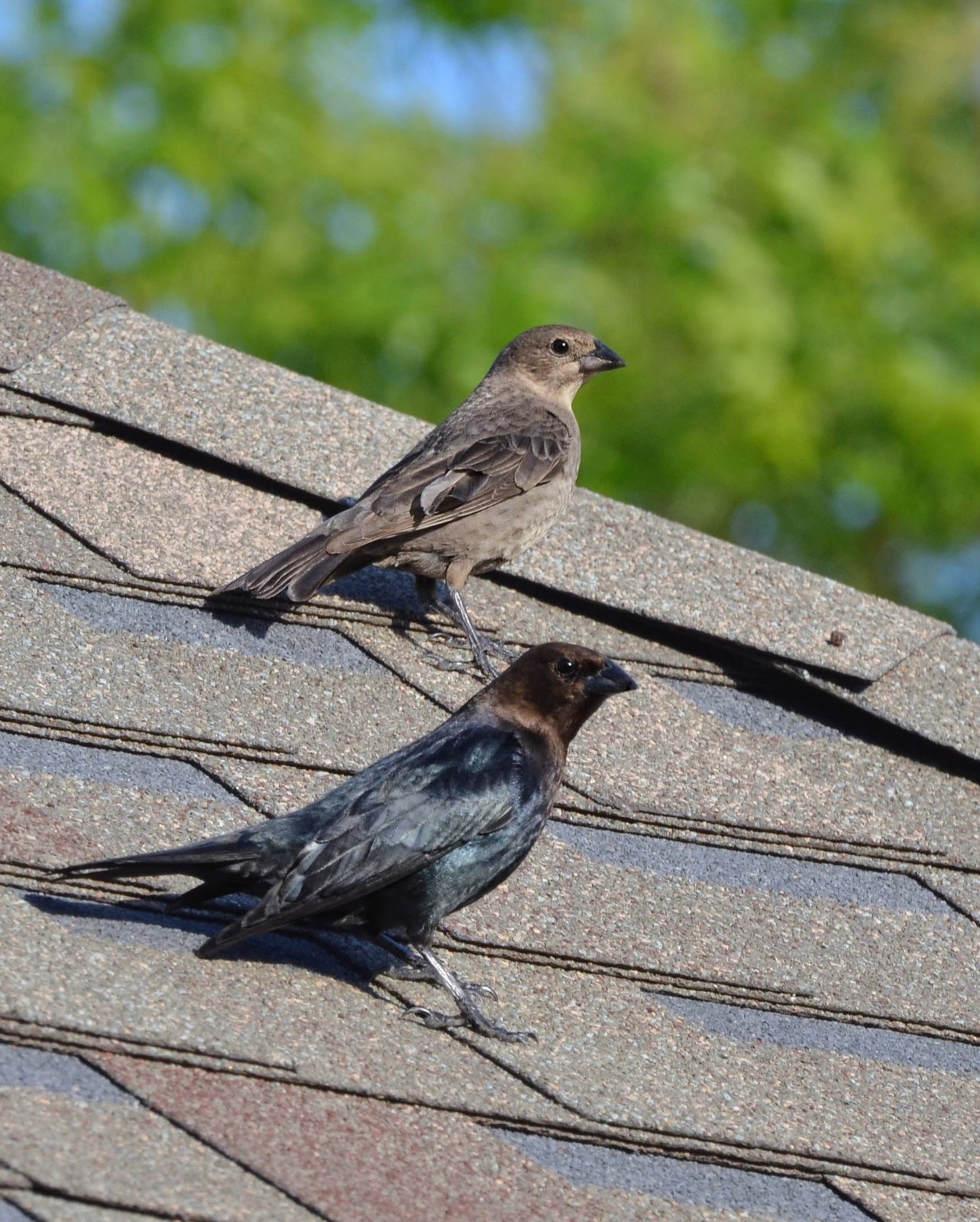
18–20 cm, stocky, with a short, thick, conical bill and a fairly short tail. The male is glossy black with a greenish sheen and a dull chocolate-brown head and neck. The female is plain grey-brown, with a paler throat and faint, fine streaking below. Juveniles resemble the female but are paler and more clearly streaked, with pale edges to the wing feathers giving a scaly look. It forages walking on the ground with the tail raised.
Confusion species
Shiny Cowbird Molothrus bonariensis is the cowbird found over most of the region; the male is entirely glossy purple-black, with no brown head, and has a slightly longer, more pointed bill. The female Shiny Cowbird is warmer brown, with a faint pale supercilium and a less contrasting throat; females are very similar in the field and are separated mainly by bill shape. Tawny-shouldered Blackbird Agelaius humeralis is all black with a tawny shoulder patch and a longer, pointed bill.
Habitat
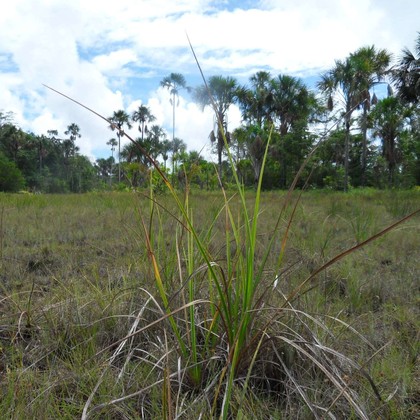
Open country with short grass and scattered trees: pastures, playing fields, golf courses, yards and parks, also at garden feeders. It takes seeds and insects on the ground, often with other blackbirds. On its breeding grounds it parasitises more than two hundred other bird species.
Where the bird is most at home, classified by the vegetation types of the Caribbean.



Range and movements
A rare visitor to the northern Bahamas, most often on Grand Bahama, also on Abaco and New Providence and occasionally farther south, to Cat Island and San Salvador. Most reports fall between October and April, with a peak in spring; there are odd summer reports from Grand Bahama, but breeding has not been proven. A vagrant to Cuba, mainly around Havana, and there is a single report from Barbados. Outside the region it breeds across most of North America and Mexico and winters in the southern United States and Mexico.
- Resident
- Summer visitor (c. Oct–Mar)
- Winter visitor (c. Apr–Sep)
- Passage (Mar–Apr, Oct–Nov)
- dark = core range, pale = thinly spread
How and when to look
The best chance is in winter on Grand Bahama, at lawns, feeders and golf courses, often among Shiny Cowbirds or grackles. A male is identified by its brown head; in a female the short, thick bill and pale throat are the best features.
Conservation status
Not threatened. Numerous in North America, although the population has declined since the 1960s. As it parasitises other birds' nests, any colonisation of the Bahamas is watched closely because of the vulnerable island species there.
Scientific name
Molothrus ater | (Boddaert, 1783)
Boddaert described the species in 1783 as Oriolus ater; because it was later moved to another genus, the author and year stand in brackets. The genus Molothrus was introduced in 1832 by Swainson. Molothrus is Greek, from mōlos 'struggle' and thrōskō 'to impregnate', perhaps after the brood parasitism or the males' courtship contests. ater is Latin for 'dull black', after the male's black plumage. The specimen the first description was based on came from Carolina (USA).