All species › Passerines › New World warblers › Semper's Warbler
Semper's Warbler | Leucopeza semperi
Sempers zanger | Reinita de Semper
Semper's Warbler is a grey, long-legged wood-warbler of the understorey of Saint Lucia's montane forests and the only member of the genus Leucopeza. It is among the least known birds of the Caribbean: the last confirmed record dates from 1961, and later reports remain unconfirmed. The species may be extinct, but parts of the suitable forest on the island have never been thoroughly surveyed. The name honours John E. Semper, who sent the first specimen to Philip Sclater in 1876.
No photograph of a living wild bird of this species with a suitable Creative Commons licence exists. Do you have one that meets the rules? Send it in.
Voice
The song has never been documented. Alarmed birds gave a tuck-tick-tick-tuck and a chattering sound.
No recording with a suitable Creative Commons licence is available for this species yet.
Identification
About 14.5 cm, with a long, pointed, dark grey bill and long, pale yellowish to flesh-coloured legs. Adults are dark grey above, with a pale supercilium, and greyish white below, with an olive-brown wash on the flanks; wings and tail are brownish. First-year birds are brownish grey above and pale buffy brown below, with a whiter throat. Juvenile plumage is undescribed.
Confusion species
Grey Trembler Cinclocerthia gutturalis is much larger, with a long, decurved bill, a pale eye and a habit of quivering its wings. Rufous-throated Solitaire Myadestes genibarbis has a short bill and a rufous throat. Wintering Northern Waterthrushes Parkesia noveboracensis and Ovenbirds Seiurus aurocapilla are olive-brown with streaked underparts. The pale legs and plain grey colour are the key features of Semper's Warbler.
Habitat
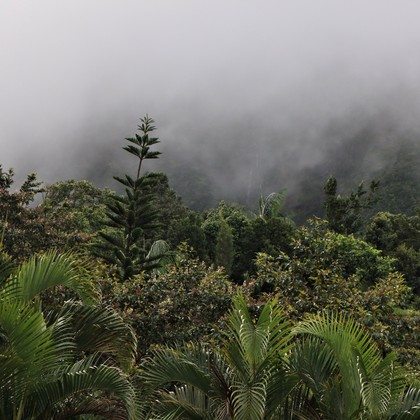
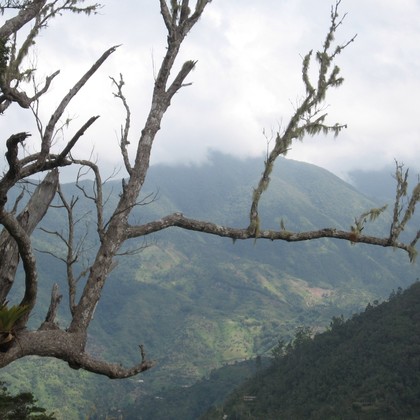
Undisturbed understorey of lower montane rainforest and elfin woodland, especially on the Barre de l'Isle ridge between Piton Flore and Piton Canaries. It foraged low in the understorey and on the ground; the nest may also have been on or near the ground.
Where the bird is most at home, classified by the vegetation types of the Caribbean.
Range and movements
Endemic to Saint Lucia in the Lesser Antilles. Nearly all historical records come from the uplands in the centre of the island; a specimen was collected on the summit of Piton Flore in 1934. After the last confirmed record in 1961 there were unconfirmed reports in 1965, 1989, 1995 and 2003.
- Resident
- dark = core range, pale = thinly spread
How and when to look
Any sighting of a grey, long-legged warbler in the understorey of Saint Lucia's montane forests is of great importance and merits the fullest possible documentation with photographs or sound recordings, and a report to the island's conservation authorities.
Conservation status
Critically Endangered, possibly extinct. The main cause of the decline is thought to be the mongoose, introduced to Saint Lucia in 1884 to control the fer-de-lance snake and devastating for birds nesting on or near the ground. Forest has also been lost to agriculture and road building. Because not all suitable forest has been surveyed, a small population may survive.
Scientific name
Leucopeza semperi | Sclater, 1876
Sclater described the species in 1876 and placed it straight away in the genus where it still stands. He introduced the genus Leucopeza in that same work. Leucopeza is Greek, from leukos 'white' and peza 'foot', after the pale legs. semperi honours the Revd John E. Semper, a naturalist resident on St Lucia who sent the type specimen to Sclater (1876). The specimen the first description was based on came from Saint Lucia.