All species › Passerines › New World warblers › Mourning Warbler
Mourning Warbler | Geothlypis philadelphia
Grijskopzanger | Reinita plañidera
The Mourning Warbler is a skulking wood-warbler with a grey hood, breeding in thickets, clearcuts and young second growth in Canada and the north-eastern United States. It migrates mainly overland through Mexico and Central America to its wintering range from Nicaragua to Ecuador and Venezuela. The Caribbean therefore lies outside the main migration route, and the species is seen there only rarely.
Voice
The call is a low, rasping chek. The song, on the breeding grounds and sometimes on spring migration, has two parts of clear, rolling notes, churree-churree-churree, chorry-chorry.
Recording: Stanislas Wroza — CC BY-NC-SA 4.0 · converted to mono · xeno-canto
Identification
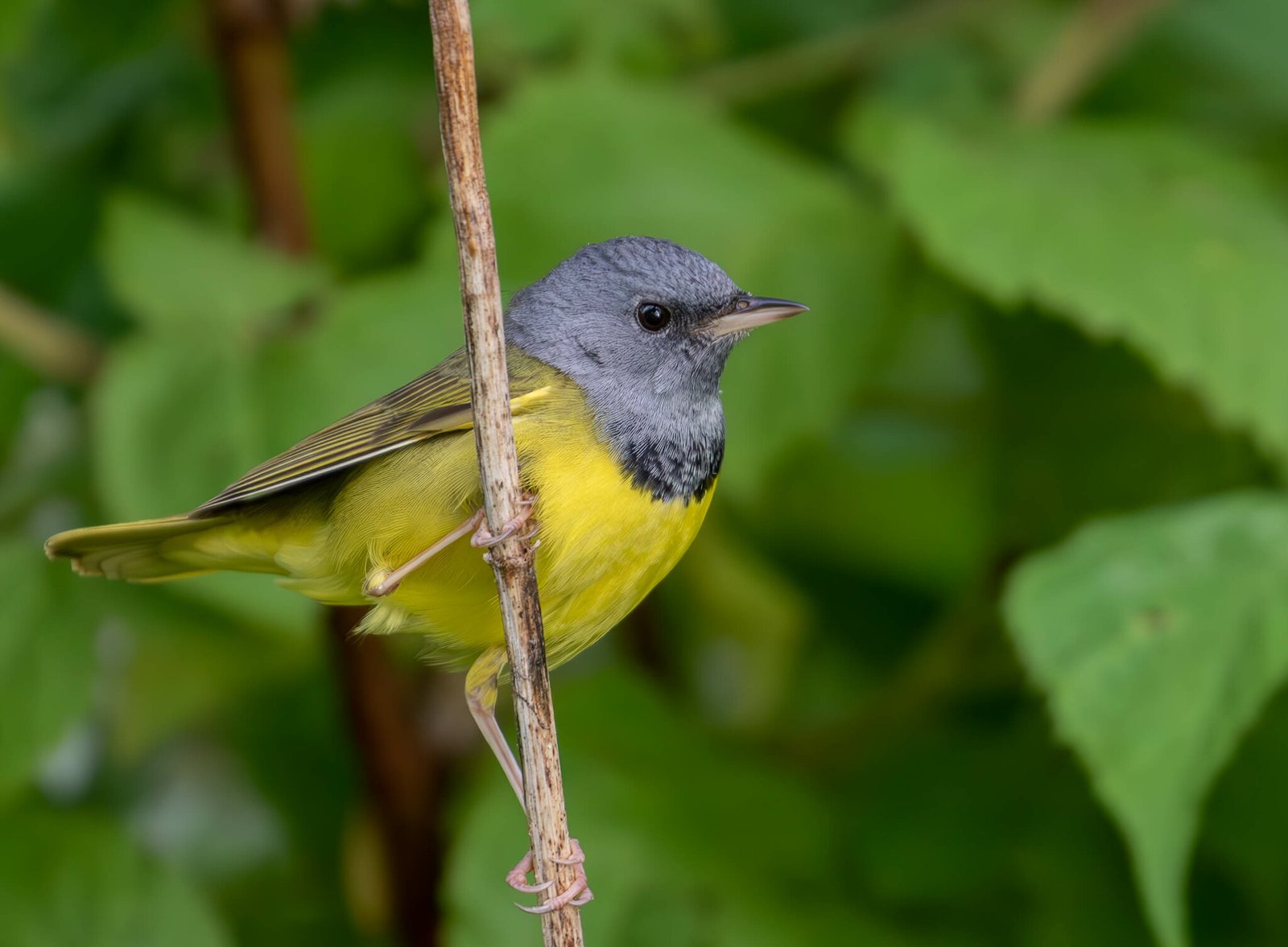
12–13 cm, with pink legs. The male has a blue-grey hood over head, throat and breast, with a black, scaly patch on the lower throat and upper breast, and no eye-ring. Upperparts olive-green, belly and undertail bright yellow. The female has a paler grey hood without black and often a thin, broken eye-ring. Immatures have an olive-grey, sometimes incomplete hood, a yellowish throat and a narrow, broken pale eye-ring.
Confusion species
Connecticut Warbler Oporornis agilis is larger, with longer undertail coverts, a complete, broad white eye-ring in all plumages and a habit of walking rather than hopping on the ground. Nashville Warbler Leiothlypis ruficapilla is smaller, with a yellow throat and a complete eye-ring. Kentucky Warbler Geothlypis formosa has a yellow supercilium and a black cheek; female Common Yellowthroats Geothlypis trichas lack a grey hood and have a paler belly.
Habitat
Dense undergrowth at forest edges, clearings in semi-evergreen and limestone forest, thickets and overgrown fields. It forages low in vegetation and on the ground for insects, hopping as it goes, and rarely shows itself in the open.
Where the bird is most at home, classified by the vegetation types of the Caribbean.



Range and movements
A rare passage migrant in Cuba. A vagrant to the Bahamas, Jamaica, the Cayman Islands, Hispaniola (mainly the Dominican Republic) and Puerto Rico. Breeds in Canada and the north-eastern United States, and winters from Nicaragua to Ecuador, Venezuela and northern Brazil.
- Resident
- Winter visitor (c. Apr–Sep)
- Passage (Mar–Apr, Oct–Nov)
- dark = core range, pale = thinly spread
How and when to look
The best chance is in Cuba in September–October and May, in dense thickets and undergrowth along forest edges. On hearing a low, rasping chek from cover, patient waiting usually brings the bird briefly into view; hood, throat and eye-ring are then the key features for identification.
Conservation status
Not threatened. The population is large, with a slight long-term decline. In the breeding range the species benefits from clearings and young growth after logging.
Scientific name
Geothlypis philadelphia | (Wilson, 1810)
Wilson described the species in 1810 as Sylvia Philadelphia; because it was later moved to another genus, the author and year stand in brackets. The genus Geothlypis was introduced in 1847 by Cabanis. Geothlypis is Greek, from gē 'ground' and thlupis, an unidentified small bird: 'ground warbler', after its life low in dense cover. philadelphia refers to Philadelphia, Pennsylvania, where Alexander Wilson collected the first specimen. The specimen the first description was based on came from near Philadelphia, Pennsylvania (USA).