All species › Passerines › New World warblers › Nashville Warbler
Nashville Warbler | Leiothlypis ruficapilla
Nashvillezanger | Reinita de Nashville
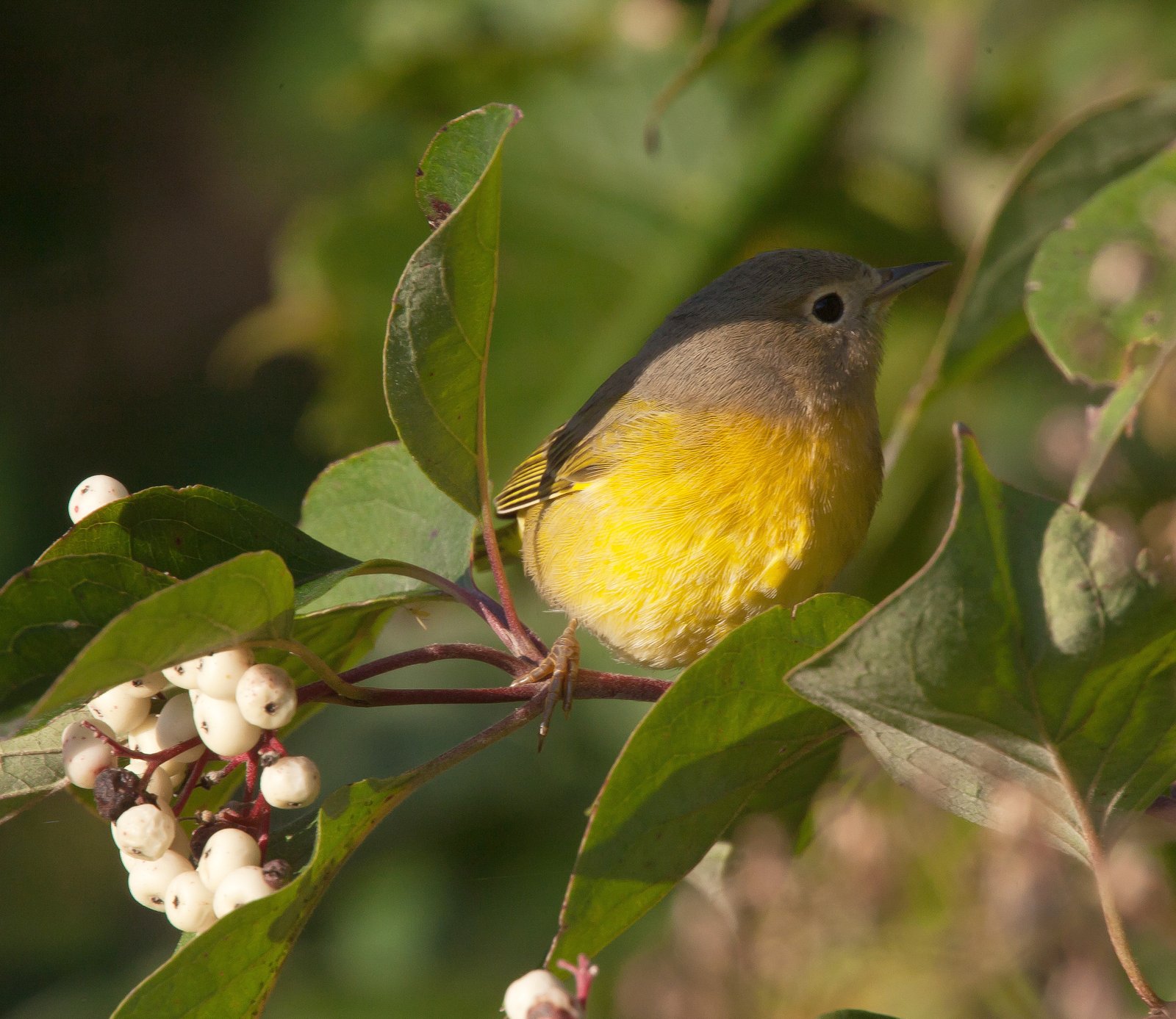
The Nashville Warbler is a small wood-warbler with a grey head, a white eye-ring and a yellow throat, breeding in open, young woodland in southern Canada and in the north-eastern and western United States. It winters mainly in Mexico and northern Central America. In the Caribbean it is a rare visitor, most often on the northern islands.
Voice
The call is a sharp, metallic tsip or spik. The song has two parts: a series of clear double notes followed by a faster, lower trill, see-bit see-bit see-bit, tititititi.
Recording: Ray Cooke — CC BY-NC 4.0 · shortened to the first 60 s, mono · xeno-canto
Identification
11–13 cm, with a fine, pointed bill. Head and neck blue-grey with a complete white eye-ring; back and wings olive-green, without wing bars. Throat, breast and flanks bright yellow, with a whitish patch between the legs. The male has a rufous crown patch that is usually hidden. Females and immatures are duller, with a brownish-grey head, a less sharp eye-ring and a pale yellow throat. It moves actively and often bobs its tail.
Confusion species
Connecticut Warbler Oporornis agilis is larger, with a grey or brownish-grey hood that also covers the throat, a yellow belly and long undertail coverts; it stays low and walks on the ground. Mourning Warbler Geothlypis philadelphia also has a grey hood extending over the throat and, as an adult male, lacks an eye-ring. Female Common Yellowthroats Geothlypis trichas have an olive head, a faint eye-ring and a paler belly.
Habitat
Forest edges, open dry and semi-evergreen forest, coastal woodland, scrub and gardens. It forages low to mid-level for insects at the tips of branches, often with mixed flocks.
Where the bird is most at home, classified by the vegetation types of the Caribbean.





Range and movements
A rare winter visitor and passage migrant in the Bahamas, Cuba and the Cayman Islands. A vagrant to Jamaica, Hispaniola, Puerto Rico and the Virgin Islands. Breeds in southern Canada, the north-eastern United States and western North America, and winters from southern Texas and California through Mexico to Guatemala and El Salvador.
- Winter visitor (c. Apr–Sep)
- Passage (Mar–Apr, Oct–Nov)
- dark = core range, pale = thinly spread
How and when to look
The best chance is in winter in the Bahamas and western Cuba, when checking mixed flocks along forest edges and in gardens. The combination of grey head, white eye-ring and yellow throat is diagnostic; a yellow throat rules out Connecticut and Mourning Warblers.
Conservation status
Not threatened. The population is large and fairly stable. Young growth after logging or fire is an important habitat in the breeding range.
Scientific name
Leiothlypis ruficapilla | (Wilson, 1811)
Wilson described the species in 1811 as Sylvia ruficapilla; because it was later moved to another genus, the author and year stand in brackets. The genus Leiothlypis was introduced in 2008 by Sangster. Leiothlypis is Ancient Greek, from leios 'plain, smooth' and thlypis, an unidentified small bird mentioned by Aristotle. ruficapilla is Latin, from rufus 'red' and capillus 'hair of the head', after the rufous crown patch. The specimen the first description was based on came from near Nashville, Tennessee (USA).