All species › Pigeons and doves › Pigeons and doves › Scaly-naped Pigeon
Scaly-naped Pigeon | Patagioenas squamosa
Roodhalsduif | Paloma turca
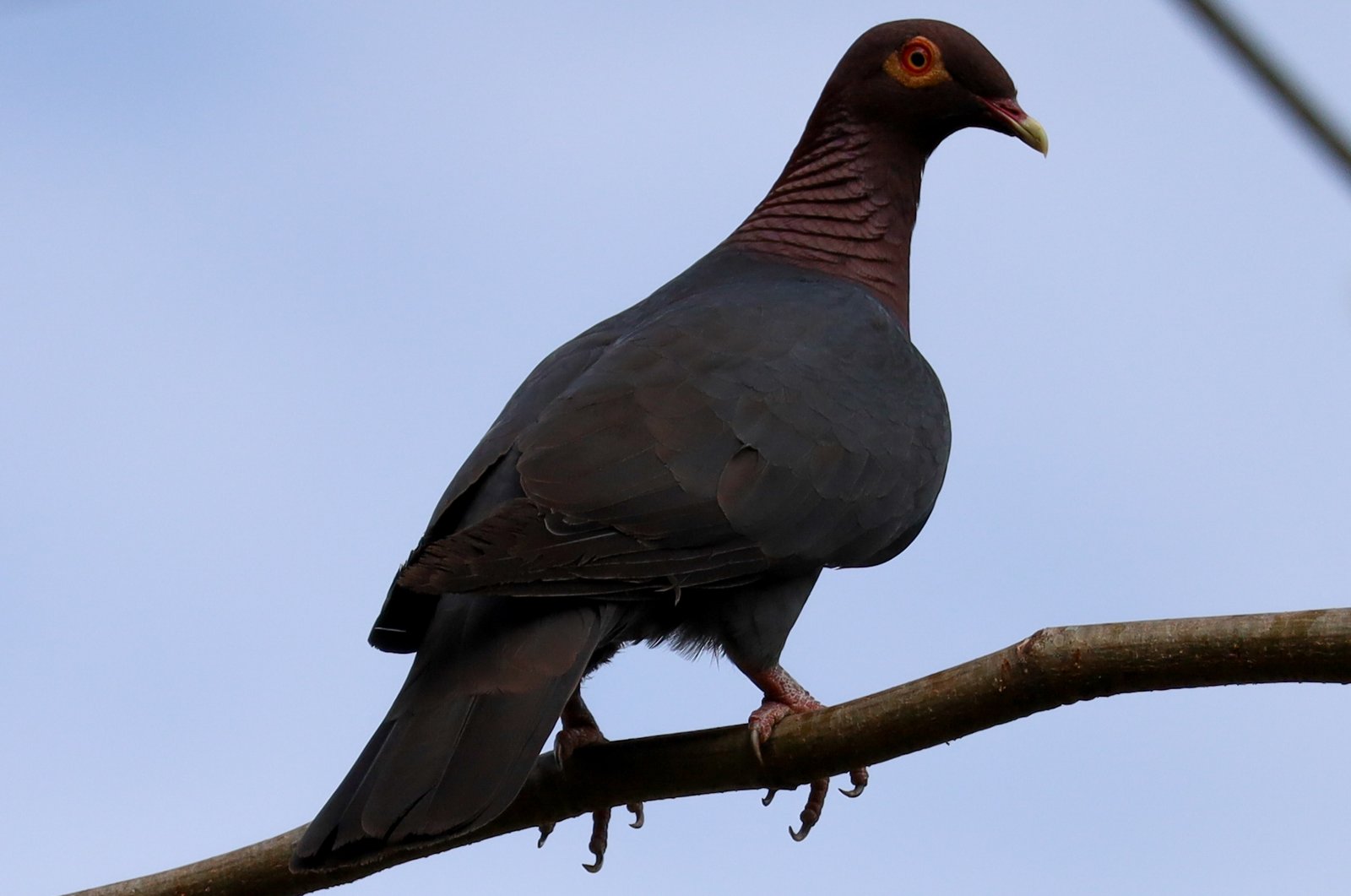
The Scaly-naped Pigeon is a large dark pigeon found on almost every island of the Antilles, from Cuba to Grenada and the ABC Islands. At close range the purplish-red head and neck stand out, with a finely scaled nape. It lives in forest from sea level to the mountains, but also visits gardens and town parks. In Puerto Rico, where it is called paloma turca, it is one of the most frequently seen birds.
Voice
A deep, emphatic cooing in a series, roughly who-coo-oo, who-coo-oo, who-who-coo-oo, often kept up for a long time from a tall tree. The wings clap loudly on take-off.
Recording: Terry Davis — CC BY-NC-SA 4.0 · converted to mono · xeno-canto
Identification
36–40 cm, a large, heavily built pigeon. The body is slate-grey, the flight feathers and tail darker. Head, neck and upper breast are wine-red to purplish-red; on the hindneck the dark-edged, glossy feathers form a scaly pattern. The bare skin around the eye is red in the male and yellower in the female; the eye is orange. The bill is red at the base with a pale tip, the legs red. In flight the bird looks entirely dark, with no white in wing or tail. Juveniles are browner and duller, with a less obviously scaled nape.
Confusion species
White-crowned Pigeon Patagioenas leucocephala is darker, almost black, with a white crown. Plain Pigeon Patagioenas inornata is paler grey and reddish-brown, with a white edge along the wing and no scaled nape. Rock Dove Columba livia has a pale rump and black wing bars. On the ABC Islands Bare-eyed Pigeon Patagioenas corensis is paler, with a white wing patch and a large area of bare skin around the eye; on Tobago Pale-vented Pigeon P. cayennensis is smaller and vinous, with a blue-grey rump.
Habitat
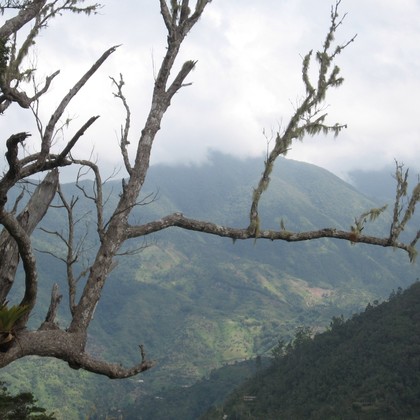
Almost every type of forest, from dry deciduous and semi-evergreen lowland forest to montane rainforest and cloud forest, as well as coffee plantations, gardens, parks and villages with tall trees. It lives mainly in the canopy but also comes to the ground. It eats fruit, berries, seeds and buds and moves locally to trees in fruit. The nest is a platform of twigs in a tree, with one or two eggs.
Where the bird is most at home, classified by the vegetation types of the Caribbean.





Range and movements
On Cuba, most numerous in the east, on Hispaniola (Haiti and the Dominican Republic), Puerto Rico and the Virgin Islands, and throughout the Lesser Antilles from Anguilla and Saint Martin to Grenada and Barbados. Also on Curaçao and Bonaire; rare on Aruba. There are records from the Bahamas, but it is rare there. On Tobago it appeared after a major hurricane in 2004 and is spreading in the north-east. It is absent from Jamaica, the Cayman Islands and San Andrés. Beyond the region only on a few islands off the coast of Venezuela.
- Resident
- dark = core range, pale = thinly spread
How and when to look
In Puerto Rico and the Lesser Antilles seen on power lines, in tall trees near houses and in forest, where the deep cooing is heard a great deal. A flock flying low over the forest is recognisable by its dark, heavy silhouette.
Conservation status
Not threatened globally. Common on many islands, but heavily hunted on several, including Puerto Rico. Hurricanes can cause sharp temporary declines by destroying trees and fruit.
Scientific name
Patagioenas squamosa | (Bonnaterre, 1792)
Bonnaterre described the species in 1792 as Columba Squamosa; because it was later moved to another genus, the author and year stand in brackets. The genus Patagioenas was introduced in 1853 by Reichenbach. Patagioenas is Greek, from patageō 'to clatter' and oinas 'pigeon', after the clattering wings on take-off. squamosa is Latin for 'scaly', after the scaly pattern on the neck. The specimen the first description was based on came from Guadeloupe.