All species › Pigeons and doves › Pigeons and doves › Scaled Pigeon
Scaled Pigeon | Patagioenas speciosa
Geschubde duif | Paloma escamosa
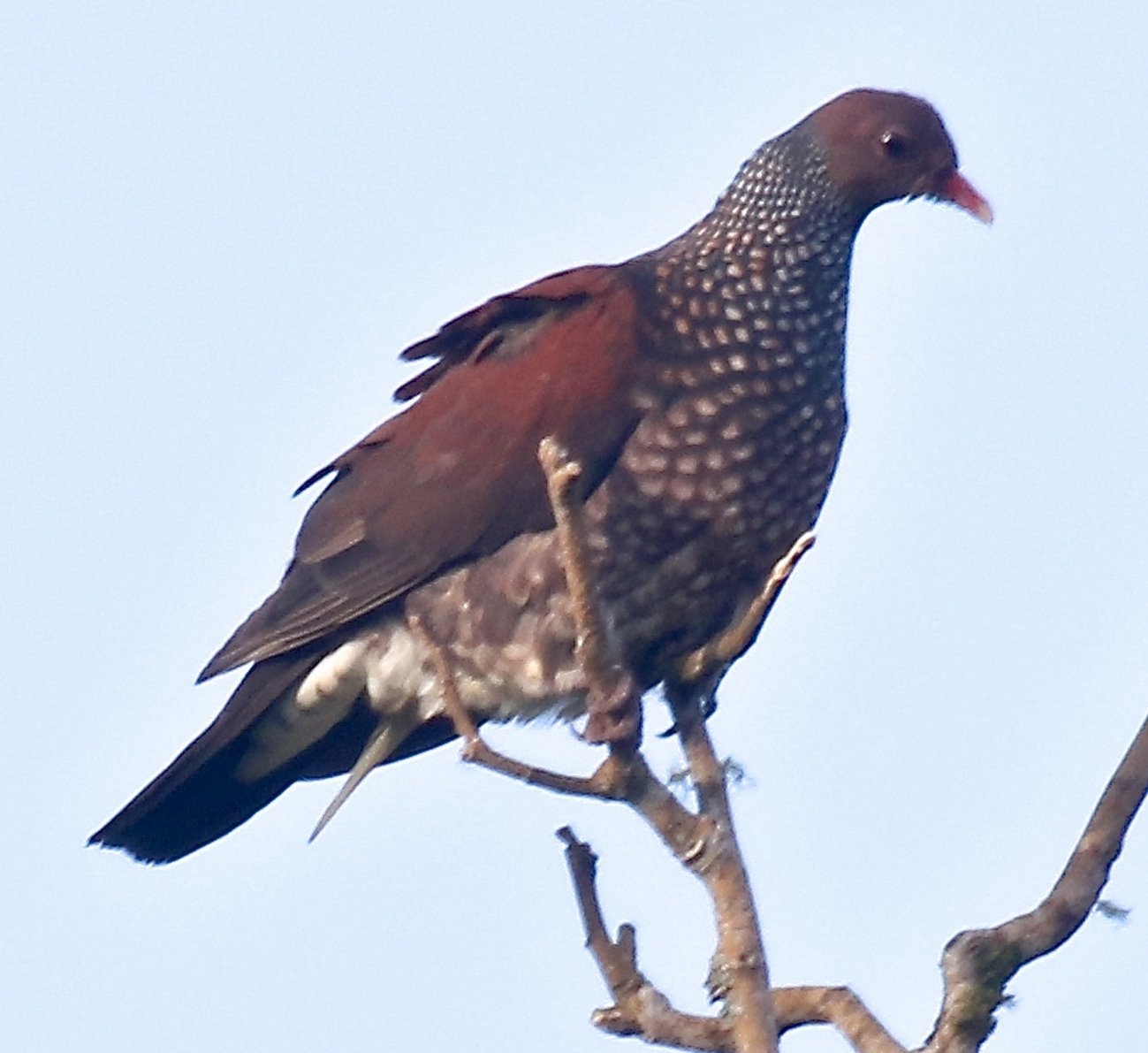
The Scaled Pigeon is a large, reddish-brown forest pigeon with a scaled neck and breast and a bright red bill with a white tip. It ranges from Mexico to Argentina, but within the Caribbean it occurs only on Trinidad, mainly in the forests of the Northern Range. It is absent from Tobago. It is a canopy bird that rarely comes to the ground and usually draws attention only when it flies over the forest.
Voice
A deep, powerful cooing in a repeated series, roughly croo kuk-kuk, clearly different from the calls of related pigeons. Often from a tall canopy tree and heard mainly in the morning.
Recording: Jacob Wijpkema — CC BY-NC-SA 4.0 · converted to mono · xeno-canto
Identification
28–34 cm. The male is chestnut with a purple gloss on the back and wing coverts; head and crown are purplish-brown. Neck, breast and upper back are heavily scaled: the feathers are pale with dark purple to green-glossed edges, giving a fine scaly pattern. The belly is paler and also scaled, the undertail coverts white. Flight feathers and tail are dark brown. The bill is red with a white tip, the eye dark with a red eye-ring, the legs coral-red. The female is duller and browner, with less crisp scaling; juveniles are plainer brown.
Confusion species
Pale-vented Pigeon Patagioenas cayennensis is plain vinous without scaling, with a black bill and a blue-grey rump. Rock Dove Columba livia is grey with black wing bars and lives in and around buildings. The Leptotila doves, White-tipped Dove Leptotila verreauxi and Grey-fronted Dove L. rufaxilla, are smaller, plain brown with a pale belly, and walk mainly on the forest floor.
Habitat
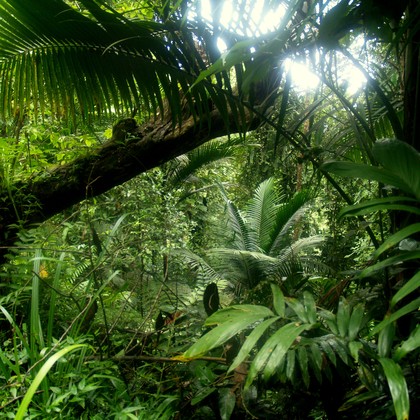
Humid forest in the lowlands and in the hills and mountains: forest edges, open forest and tall trees in semi-open country. It lives mainly in the canopy and seldom descends to the ground; by day it also flies over open country with scattered trees. It eats mainly fruit and berries. The nest is a thin platform of twigs 1–18 m above the ground, usually with a single egg.
Where the bird is most at home, classified by the vegetation types of the Caribbean.


Range and movements
On Trinidad, most numerous in the Northern Range; the species is absent from Tobago. There are no records from the other islands in the region. Beyond the region from southern Mexico through Central America to western Ecuador, and east of the Andes over much of tropical South America to southern Brazil and north-eastern Argentina.
- Resident
- dark = core range, pale = thinly spread
How and when to look
On Trinidad best seen from a lookout above the forest in the Northern Range, where in the morning the birds fly over the canopy or perch in a bare treetop. The red, white-tipped bill is a good feature through a telescope.
Conservation status
Not threatened globally, with a large range. On Trinidad the species is hunted and suffers from forest loss, but it is still seen regularly in the forested parts of the Northern Range.
Scientific name
Patagioenas speciosa | (Gmelin, 1789)
Gmelin described the species in 1789 as Columba speciosa; because it was later moved to another genus, the author and year stand in brackets. The genus Patagioenas was introduced in 1853 by Reichenbach. Patagioenas is Greek, from patageō 'to clatter' and oinas 'pigeon', after the clattering wings on take-off. speciosa is Latin for 'beautiful, splendid', after the scaly, glossy plumage of neck and breast. The specimen the first description was based on came from Cayenne, French Guiana.