All species › Birds of prey › Hawks, eagles and kites › Savanna Hawk
Savanna Hawk | Buteogallus meridionalis
Savannebuizerd | Gavilán sabanero
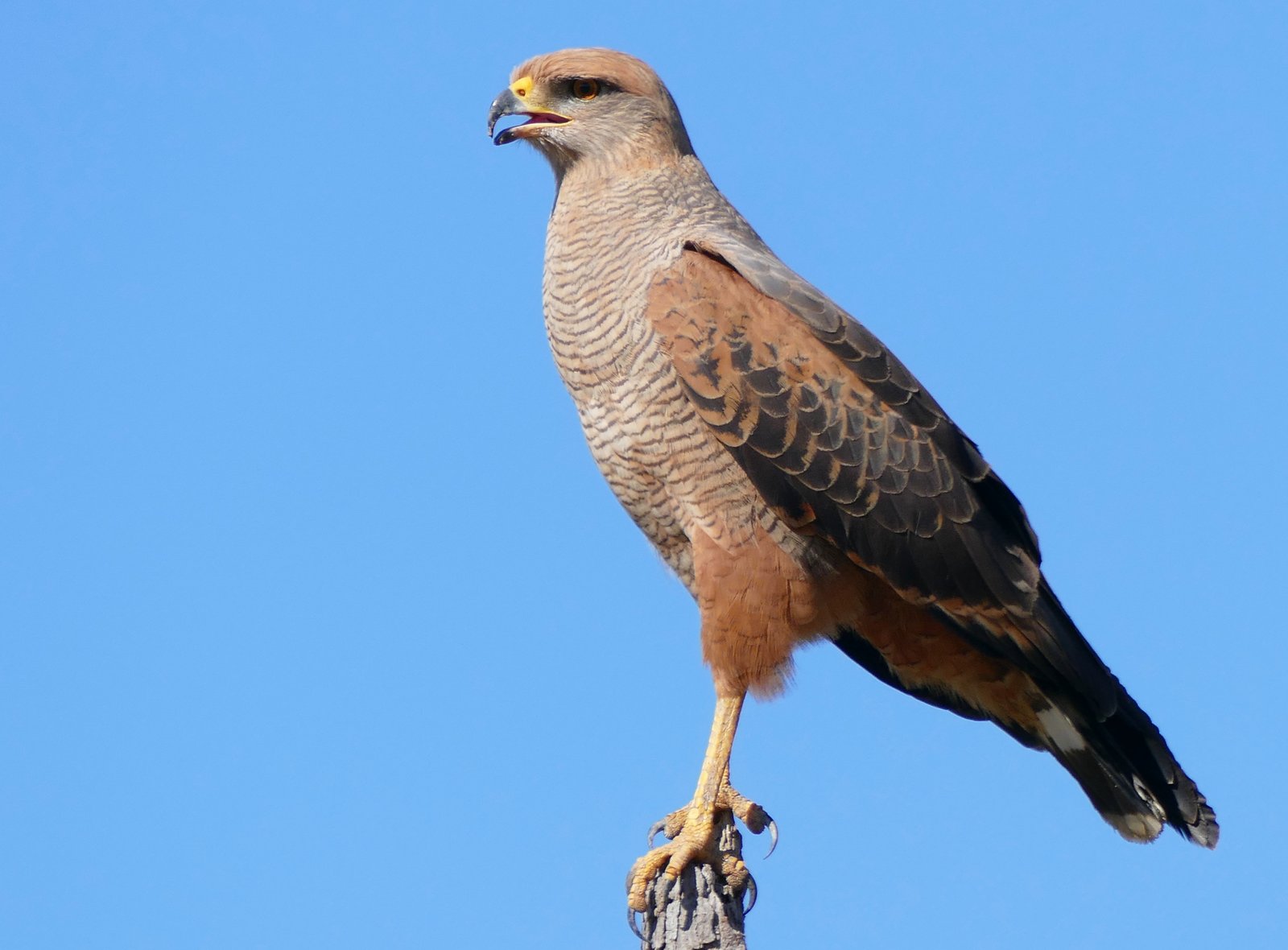
The Savanna Hawk is a large, long-legged, rufous hawk of open grassland and marshy savanna. It often perches upright on a post, dead tree or termite mound and also hunts on foot. Within the region it occurs only in Trinidad.
Voice
A hoarse, drawn-out cry keeeeeroo, mainly in flight and near the nest.
Recording: JAYRSON ARAUJO DE OLIVEIRA — CC BY-NC-SA 4.0 · converted to mono · xeno-canto
Identification
46–61 cm, with very broad, long wings, long yellow legs and a short tail. Adults are largely rufous; the back and scapulars are mottled grey and the underparts finely barred black. The flight feathers are rufous with a broad black trailing edge, giving wings that are rusty above and below with a dark border in flight. The tail is black with a single broad white band across the middle and a white tip. Juveniles are darker and duller above, paler below with coarser barring, and have a whitish supercilium.
Confusion species
Rufous Crab Hawk Buteogallus aequinoctialis is smaller, with shorter legs and a black head, and lives in mangroves. White-tailed Hawk Geranoaetus albicaudatus has rufous shoulders but is otherwise grey and white, with a white tail with a black terminal band. Young Savanna Hawks can recall young Common Black Hawks Buteogallus anthracinus, but show rufous in the wings.
Habitat
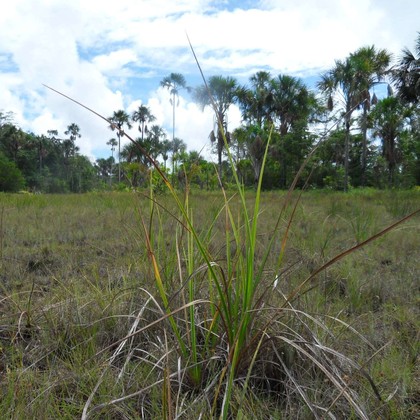
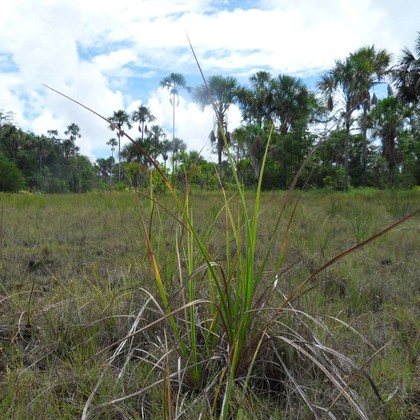
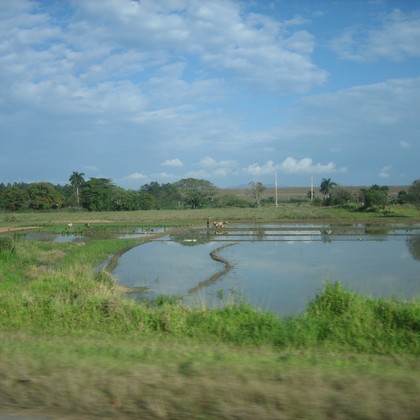
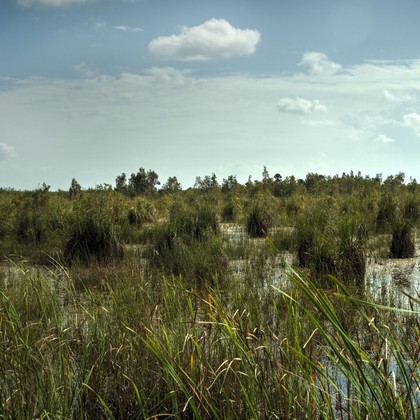
Open savanna, wet and seasonally flooded grassland, pasture with scattered trees, rice fields and marsh edges. It hunts from a high, open perch or by walking through the grass for small mammals, lizards, snakes, frogs, crabs and large insects. Several birds may gather at grass and reed fires to catch fleeing prey.
Where the bird is most at home, classified by the vegetation types of the Caribbean.

Range and movements
In Trinidad in open lowland country, especially Aripo Savannas, the rice fields and grasslands of the centre and west and the marsh edges of the east and south. Only a few records from Tobago. Outside the region from Panama through South America to Bolivia, Uruguay and central Argentina.
- Resident
- dark = core range, pale = thinly spread
How and when to look
Aripo Savannas and the rice fields and pastures of lowland Trinidad, where birds perch on posts, dead trees and pylons. At a grass or cane fire it is worth checking for raptors over and beside the flames. In flight the combination of rusty wings with a black trailing edge and a single white tail band is distinctive.
Conservation status
Not threatened. The species benefits locally from deforestation and the creation of pasture. In Trinidad grassland and marsh edges are being lost to building and intensive agriculture.
Scientific name
Buteogallus meridionalis | (Latham, 1790)
Latham described the species in 1790 as Falco meridionalis; because it was later moved to another genus, the author and year stand in brackets. The genus Buteogallus was introduced in 1830 by Lesson. Buteogallus is Latin, from buteo 'buzzard' and gallus 'cock, fowl'; the reason for the second part is unclear. meridionalis is Latin for 'southern', after its range in South America. The specimen the first description was based on came from Cayenne, French Guiana.