All species › Birds of prey › Hawks, eagles and kites › Great Black Hawk
Great Black Hawk | Buteogallus urubitinga
Zwarte arendbuizerd | Aguililla-negra mayor
The Great Black Hawk is the largest of the black hawks: a powerful, long-legged raptor of forest, forest edge and coast. Within the region it is a familiar sight on Tobago, while in Trinidad it is seen only infrequently.
Voice
A long, high whistle with a soft lead-in, oo-wheeeeee, often given in flight or from a perch.
Recording: Guillermo Menéndez (gmmv80) — CC BY-NC-SA 4.0 · shortened to the first 60 s, mono · xeno-canto
Identification
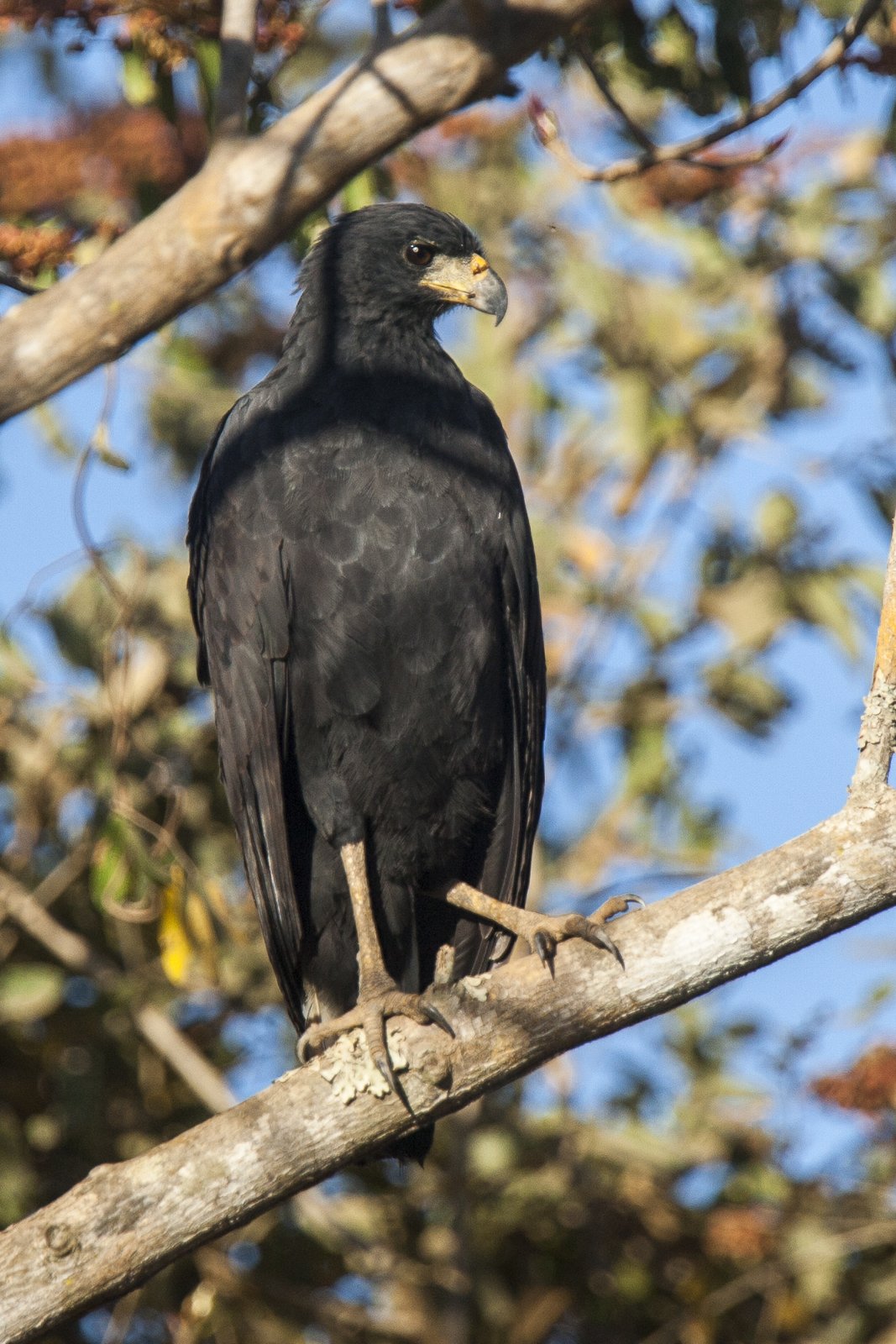
56–64 cm, with broad wings, a fairly long tail and long yellow legs. Adults are entirely black, sometimes with fine white barring on the thighs. The bill is black, cere and lores yellow. The tail is white at the base and well beyond the middle, with a broad black terminal band and a narrow white tip; the uppertail coverts are also white. Juveniles are dark brown above with pale spots, buff below with dark teardrops, and have a tail with many narrow, irregular dark bars. Adult plumage is reached only after several years.
Confusion species
Common Black Hawk Buteogallus anthracinus is smaller and stockier, with shorter legs, broader wings, a short tail with one white band across the middle and a pale patch at the base of the primaries. Black Hawk-Eagle Spizaetus tyrannus has a crest, feathered legs and a tail with several grey bands. Zone-tailed Hawk Buteo albonotatus is slimmer, with two-toned underwings and more tail bands.
Habitat
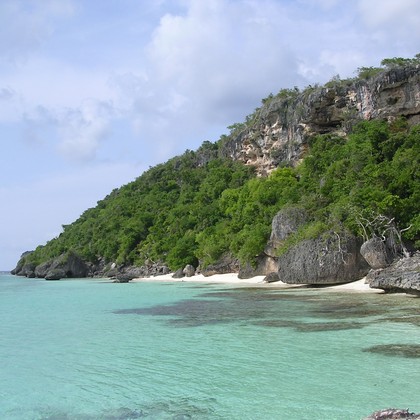
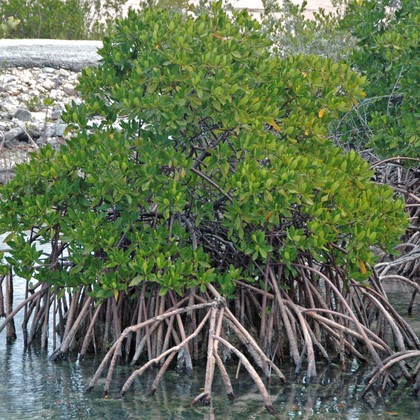
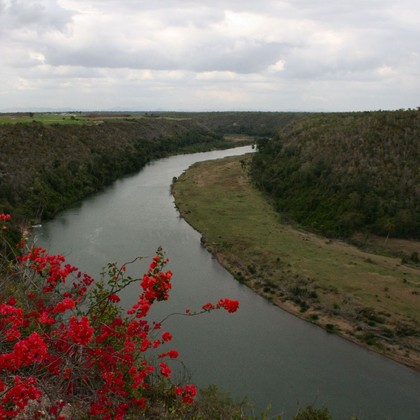
Forest, forest edge and open woodland, often near water, also river banks, coastal woodland, mangroves and semi-open farmland with trees, from sea level into the hills. It hunts from a perch or on foot for lizards, snakes, frogs, crabs, small mammals, birds, large insects and carrion.
Where the bird is most at home, classified by the vegetation types of the Caribbean.



Range and movements
On Tobago a common resident over the whole island, from the forested ridge to the coast. Scarce in Trinidad, where most records come from the north and east. Outside the region from Mexico through Central and South America to northern Argentina.
- Resident
- dark = core range, pale = thinly spread
How and when to look
On Tobago along the roads through the Main Ridge forest and along the coast, where birds perch on branches at the forest edge or circle in pairs. In flight the white tail base with a broad black terminal band is the best feature; Common Black Hawk is rare on Tobago.
Conservation status
Not threatened. The species has a large range and tolerates some disturbance of forest, but declines locally through deforestation and persecution.
Scientific name
Buteogallus urubitinga | (Gmelin, 1788)
Gmelin described the species in 1788 as Falco Urubitinga; because it was later moved to another genus, the author and year stand in brackets. The genus Buteogallus was introduced in 1830 by Lesson. Buteogallus is Latin, from buteo 'buzzard' and gallus 'cock, fowl'; the reason for the second part is unclear. urubitinga is a Tupi name for a bird of prey, via Georg Marcgrave's Brazilian descriptions (1648). The specimen the first description was based on came from northeastern Brazil.