All species › Passerines › Tyrant flycatchers › Rufous-tailed Flycatcher
Rufous-tailed Flycatcher | Myiarchus validus
Oranjestaarttiran | Copetón colirrufo
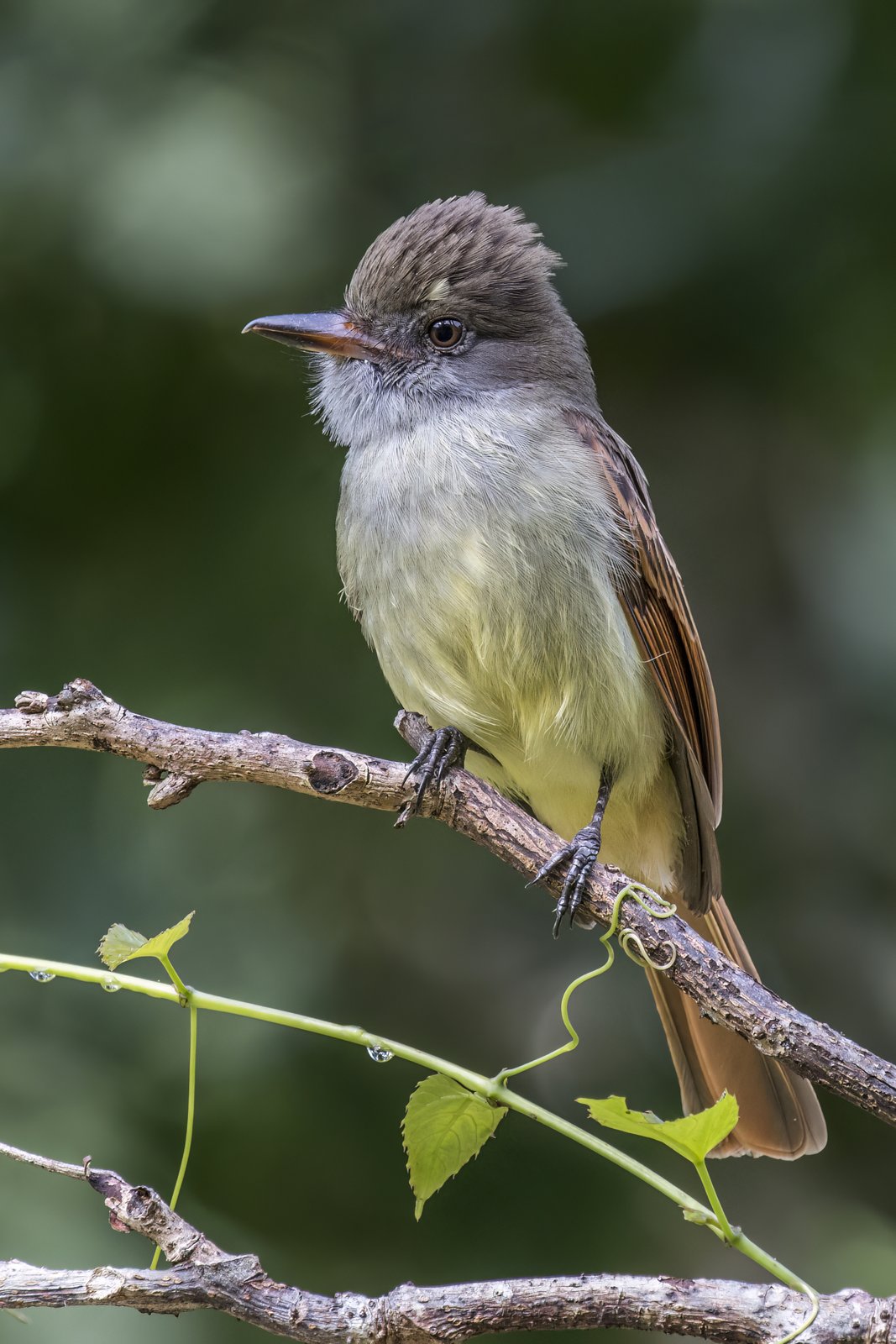
The Rufous-tailed Flycatcher is the largest of Jamaica's three Myiarchus species and occurs only on that island. The extensive rufous in its wings and tail distinguishes it from the other two. It lives mainly in forest in the hills and mountains.
Voice
A fast, rolling, descending pree-ee-ee-ee-ee, reminiscent of a horse's whinny; also shorter calls.
Recording: Peter de Rouw — CC BY-NC-SA 4.0 · converted to mono · xeno-canto
Identification
23–25 cm, large and long-tailed, with a crest and a heavy dark bill. The crown is smoky brown, the face slate grey, the back dull olive. Wings and tail have so much rufous on the feather edges and inner webs that the closed wing and the tail look almost entirely rufous. Throat and breast are dark grey, the belly yellow. The sexes are alike.
Confusion species
Stolid Flycatcher Myiarchus stolidus is clearly smaller, with a paler grey breast, pale edges to the secondaries forming wing bars and less rufous. Sad Flycatcher Myiarchus barbirostris is much smaller, with a dark cap and yellower underparts. Loggerhead Kingbird Tyrannus caudifasciatus has a blackish cap, white underparts and no rufous.
Habitat
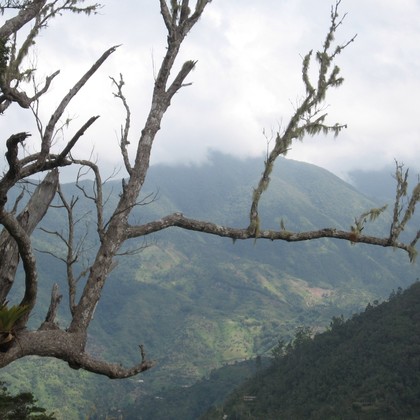
Moist and drier forest, montane rainforest, cloud forest, the limestone forest of Cockpit Country, secondary growth and forest edges, at all elevations but mainly between about 300 and 2,000 m. It forages in the middle storey and canopy for insects and fruit. It nests in tree cavities.
Where the bird is most at home, classified by the vegetation types of the Caribbean.




Range and movements
Only on Jamaica, throughout the island wherever there is enough forest, commonest in the hills and mountains. It occurs nowhere else.
- Resident
- dark = core range, pale = thinly spread
How and when to look
Forest trails in the Blue Mountains, the John Crow Mountains and Cockpit Country. The whinnying call gives the bird away; in flight the rufous in wings and tail stands out.
Conservation status
Not threatened and fairly common. Clearance of forest for farming and timber reduces its habitat locally.
Scientific name
Myiarchus validus | Cabanis, 1847
Cabanis described the species in 1847 and placed it straight away in the genus where it still stands. The genus Myiarchus was introduced in 1844 by Cabanis. Myiarchus is Greek, from muia 'fly' and arkhos 'ruler': 'fly-ruler'. validus is Latin for 'strong, robust', after its size: the largest Myiarchus on Jamaica. The specimen the first description was based on came from Jamaica.