All species › Waders, gulls and terns › Sandpipers and snipes › Ruddy Turnstone
Ruddy Turnstone | Arenaria interpres
Steenloper | Vuelvepiedras común
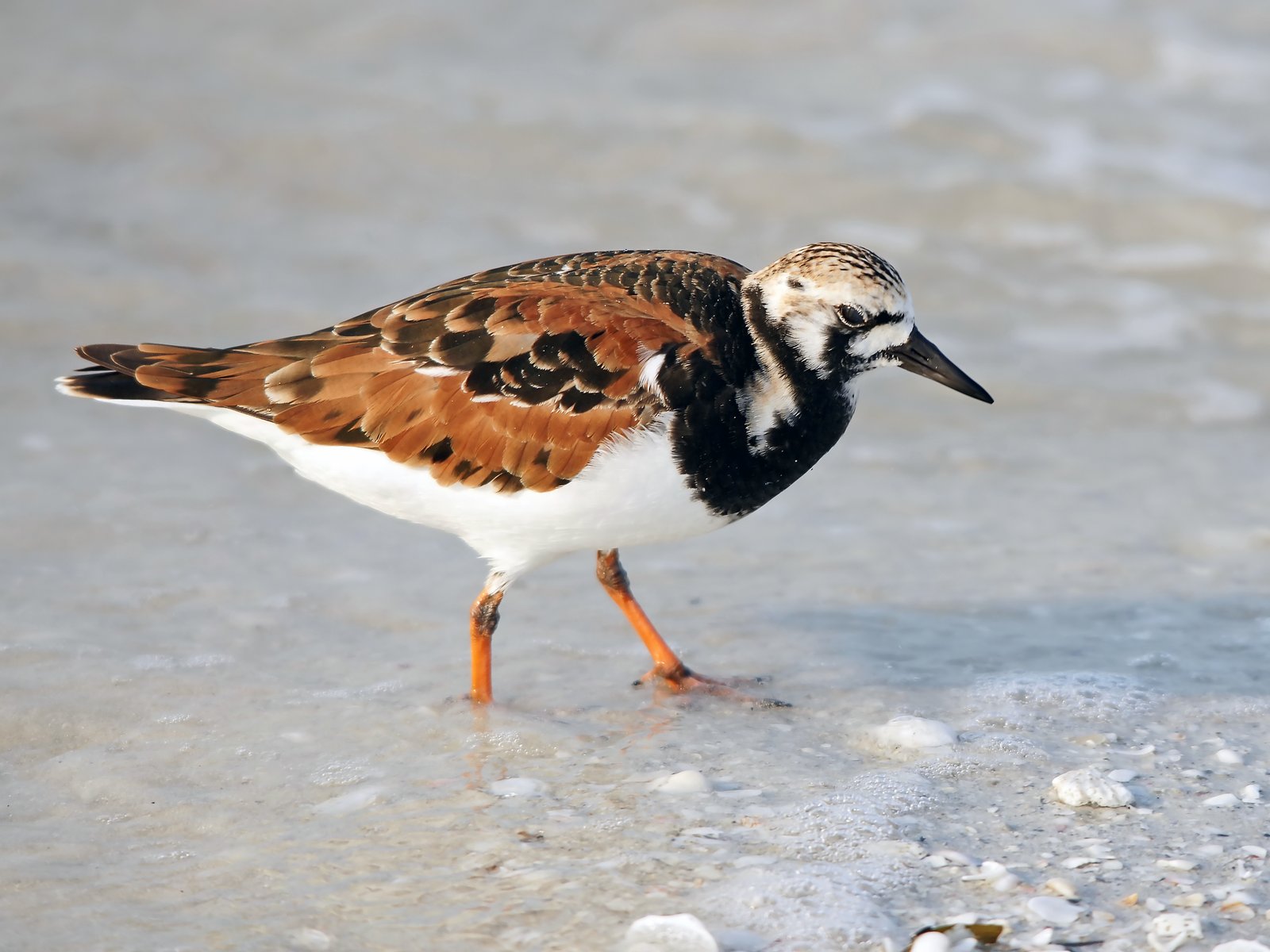
The Ruddy Turnstone is a stocky, short-legged wader with a contrastingly patterned head and breast, found throughout the Caribbean on beaches, rocky shores and harbour quays. It breeds on the Arctic tundra and is a common winter visitor here; because many immature birds remain in the south, it is also present almost everywhere in summer. With its short, wedge-shaped bill it flips over stones, seaweed and flotsam in search of food. In Puerto Rico it is called playero turco.
Voice
A dry, rattling tuk-a-tuk-tuk or kut-a-kut, often on take-off, and a short kyuk. Flocks call frequently while feeding.
Recording: David Darrell-Lambert — CC BY-NC-SA 4.0 · converted to mono · xeno-canto
Identification
22–24 cm, with a short, slightly upturned black bill and short orange legs. In winter plumage the upperparts are dark grey-brown, with a blackish, irregular breast band extending to the throat and side of the neck, and white throat and belly. In spring birds acquire breeding plumage: a rufous back spotted with black and a black-and-white patterned head. Juveniles are somewhat paler, with pale-fringed back feathers and duller legs. In flight a distinctive pattern of white shows: a white wing bar, white patches on back and shoulder, a white rump and a black tail band.
Confusion species
Little risk of confusion. Other waders of rocky shores and beaches, such as Sanderling Calidris alba, are much paler and lack the black breast markings and orange legs. Red Knot Calidris canutus is plainer grey, with a longer, straight bill. In flight the pied pattern of the turnstone is unique among the sandpipers.
Habitat
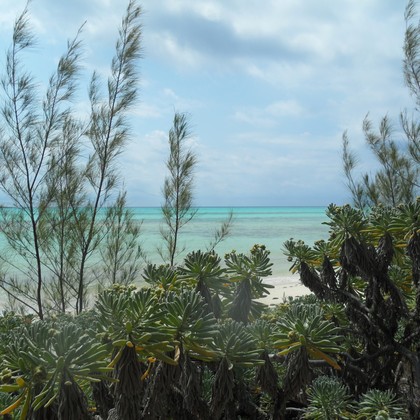
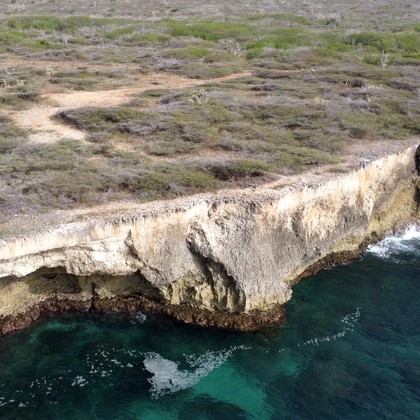
Sand and shingle beaches with stranded seaweed, rocky shores, coral cays, breakwaters, piers and harbour quays, also tidal flats and the edges of salt pans. It takes crustaceans, molluscs, insects and carrion, turning over stones and weed, and is opportunistic, also eating fish scraps, food waste and tern eggs. At high tide flocks roost on rocks, jetties and low roofs by the water.
Where the bird is most at home, classified by the vegetation types of the Caribbean.


Range and movements
Winter visitor and passage migrant on every island in the region: the Bahamas, the Turks and Caicos Islands, Cuba, the Cayman Islands, Jamaica, Hispaniola, Puerto Rico, the Virgin Islands, the entire Lesser Antilles chain, the ABC Islands, San Andrés and Trinidad and Tobago. Common on most coasts; summering birds are scattered throughout. Beyond the region it breeds around the Arctic and winters along coasts over almost the entire world.
- Resident
- Winter visitor (c. Apr–Sep)
- Passage (Mar–Apr, Oct–Nov)
- dark = core range, pale = thinly spread
How and when to look
Harbours, fish landing sites, rocky headlands and beaches with stranded seaweed are the most productive; at fish markets and on hotel beaches the birds are often quite tame. The low, stocky silhouette with short orange legs is recognisable even at a distance.
Conservation status
Near Threatened globally: numbers are declining, mainly through loss of roosting and feeding sites along the flyways. In the region undisturbed beaches and cays are being lost to coastal development and recreation, and shorebirds are hunted locally.
Scientific name
Arenaria interpres | (Linnaeus, 1758)
Linnaeus described the species in 1758 as Tringa Interpres; because it was later moved to another genus, the author and year stand in brackets. The genus Arenaria was introduced in 1760 by Brisson. Arenaria is from Latin arenarius 'inhabiting sand', from arena 'sand'. interpres is Latin for 'messenger' or 'interpreter': on Gotland Linnaeus took the Swedish word tolk to apply to this bird, but in the local dialect it means 'legs' and refers to the redshank. The specimen the first description was based on came from Gotland, Sweden.