All species › Pigeons and doves › Pigeons and doves › Ruddy Ground Dove
Ruddy Ground Dove | Columbina talpacoti
Steenduif | Tortolita rojiza
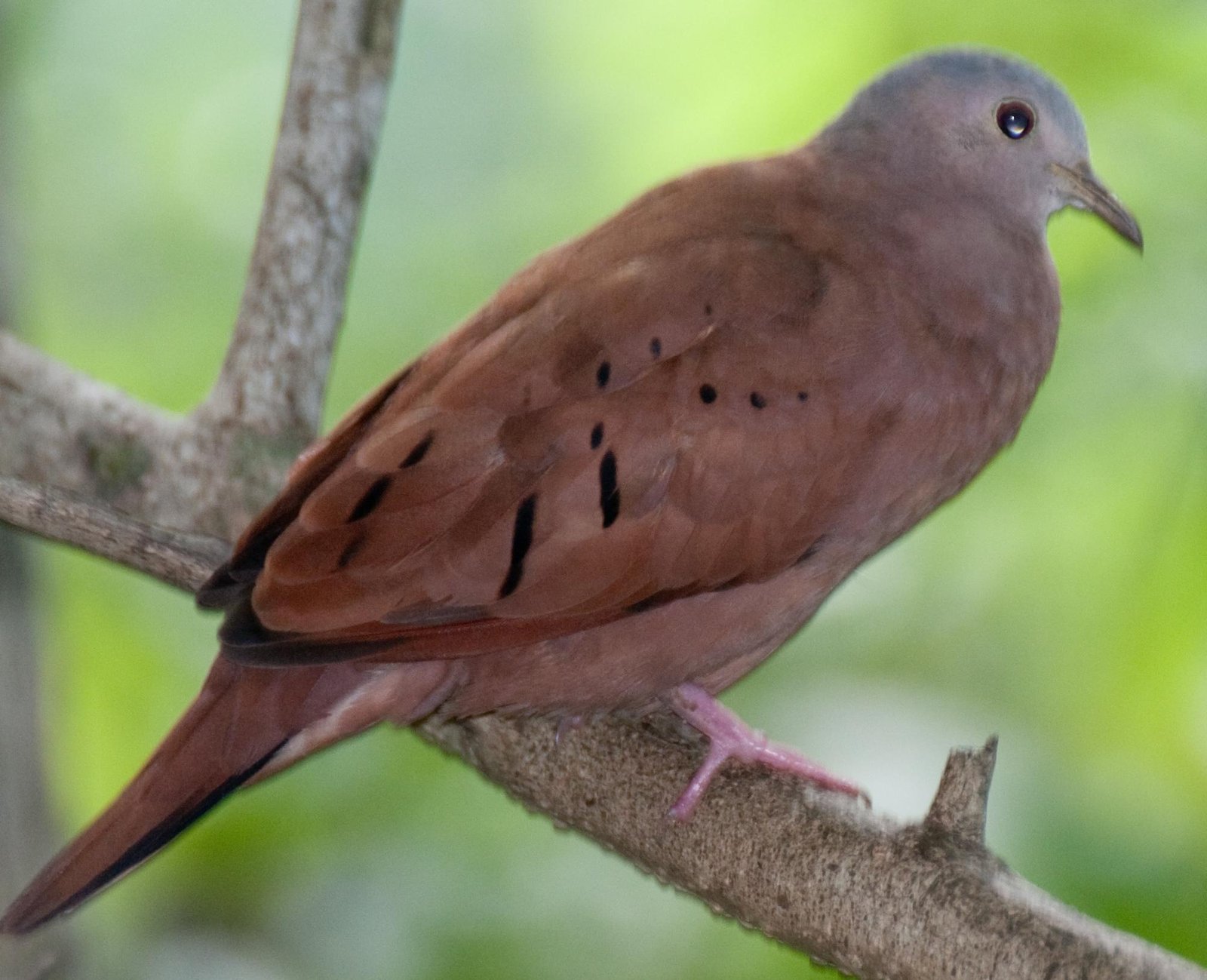
The Ruddy Ground Dove is a small ground dove of the warm lowlands of tropical America, the male warm cinnamon with a grey head. Within the region it occurs only in Trinidad and Tobago, but there it is the ordinary small dove of villages, towns, yards and pastures. On the mainland it has spread widely as forest gave way to pasture and cropland, and it is at home on squares, in parks and in the street.
Voice
The call is a soft, two-syllable cur-WOO, repeated at an even pace many times in a row. In addition the male gives a monotonous series of short, low cooing notes. Everything sounds slightly higher and faster than in Common Ground Dove. It calls from a low branch, a wire or a roof edge, all year round and most in the morning.
Recording: Juan Freile — CC BY-NC-SA 4.0 · converted to mono · xeno-canto
Identification
16.5–18 cm, small and compact, with a short tail and a proportionately small head. The male is warm cinnamon to rufous on back, wings and underparts, with a pale blue-grey crown and nape; the wing coverts carry small black spots and streaks. The female is grey-brown, much duller and with less contrast between head and body, but with the same black wing markings. The breast is plain in both sexes, without scaling. The bill is grey to dark, the legs pink. In flight the primaries flash rufous and the underwing is black; the tail is dark with rufous central feathers.
Confusion species
Common Ground Dove Columbina passerina is slightly smaller, has finely scaled head, neck and breast and a pinkish-red or orange-red base to the bill; it is scarce in Trinidad and absent from Tobago. Plain-breasted Ground Dove Columbina minuta is smaller and drabber, with purplish wing spots and a largely rufous underwing. Female Blue Ground Dove Claravis pretiosa is larger, with chestnut wing spots and a rufous rump. Scaled Dove Columbina squammata is scaled over the whole body and has a long tail with white sides.
Habitat
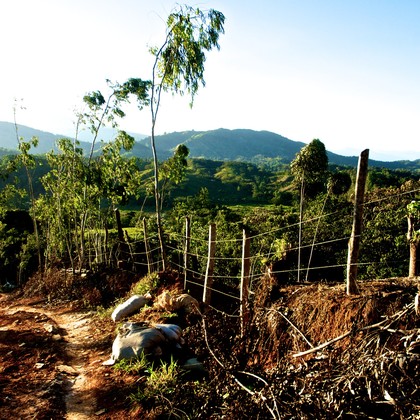
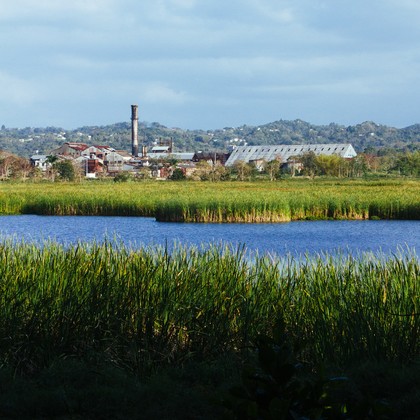
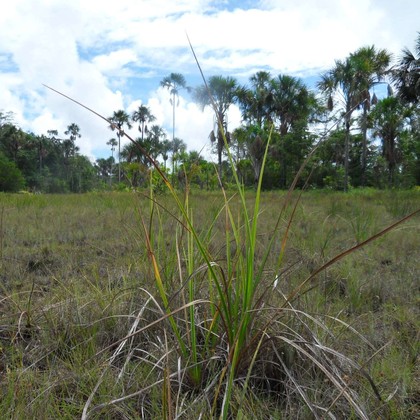
Open and half-open country: pastures, fields and cane fields, fallow land, yards, road verges, gardens, parks and town squares, and the open banks of rivers and pools. Away from settlement it keeps to low scrub and clearings; it avoids closed forest. It forages walking on the ground, often in small groups, on seeds of grasses and herbs and on grain. The nest is a sturdy but sparsely lined cup of twigs, low to medium height in a tree or shrub, with two white eggs; several broods may follow in a year.
Where the bird is most at home, classified by the vegetation types of the Caribbean.

Range and movements
Within the region only in Trinidad and Tobago, where it is common on both islands, from the towns to the countryside. Elsewhere in the region at most a rare vagrant. Beyond the region it is a resident from northern Mexico through Central America and in South America to Peru, Paraguay, southern Brazil and northern Argentina.
- Resident
- Summer visitor (c. Oct–Mar)
- Winter visitor (c. Apr–Sep)
- Passage (Mar–Apr, Oct–Nov)
- dark = core range, pale = thinly spread
How and when to look
In Trinidad and Tobago in almost every village, yard and country road; small groups often walk in the street and on lawns and flush only just ahead of a pedestrian or car. The cinnamon of the male is distinctive; in females and young birds the plain breast, the grey bill and the black underwing in flight are the best features for ruling out Common and Plain-breasted Ground Doves.
Conservation status
Not threatened. Across almost its entire range the species is numerous, and it benefits from deforestation, cattle farming and urban growth. In Trinidad and Tobago too it is one of the commonest birds of open country. No threats of any consequence are known.
Scientific name
Columbina talpacoti | (Temminck, 1810)
Temminck described the species in 1810 as Columba Talpacoti; because it was later moved to another genus, the author and year stand in brackets. The genus Columbina was introduced in 1825 by Spix. Columbina is Latin for 'little dove', a diminutive of columba 'dove'. talpacoti comes from the Nahuatl name Tlapalcocotli, from tlapalli 'red' and cocotli 'dove'. The specimen the first description was based on came from South America (not specified).