All species › Passerines › Mockingbirds and thrashers › Pearly-eyed Thrasher
Pearly-eyed Thrasher | Margarops fuscatus
Witoogspotlijster | Zorzal pardo
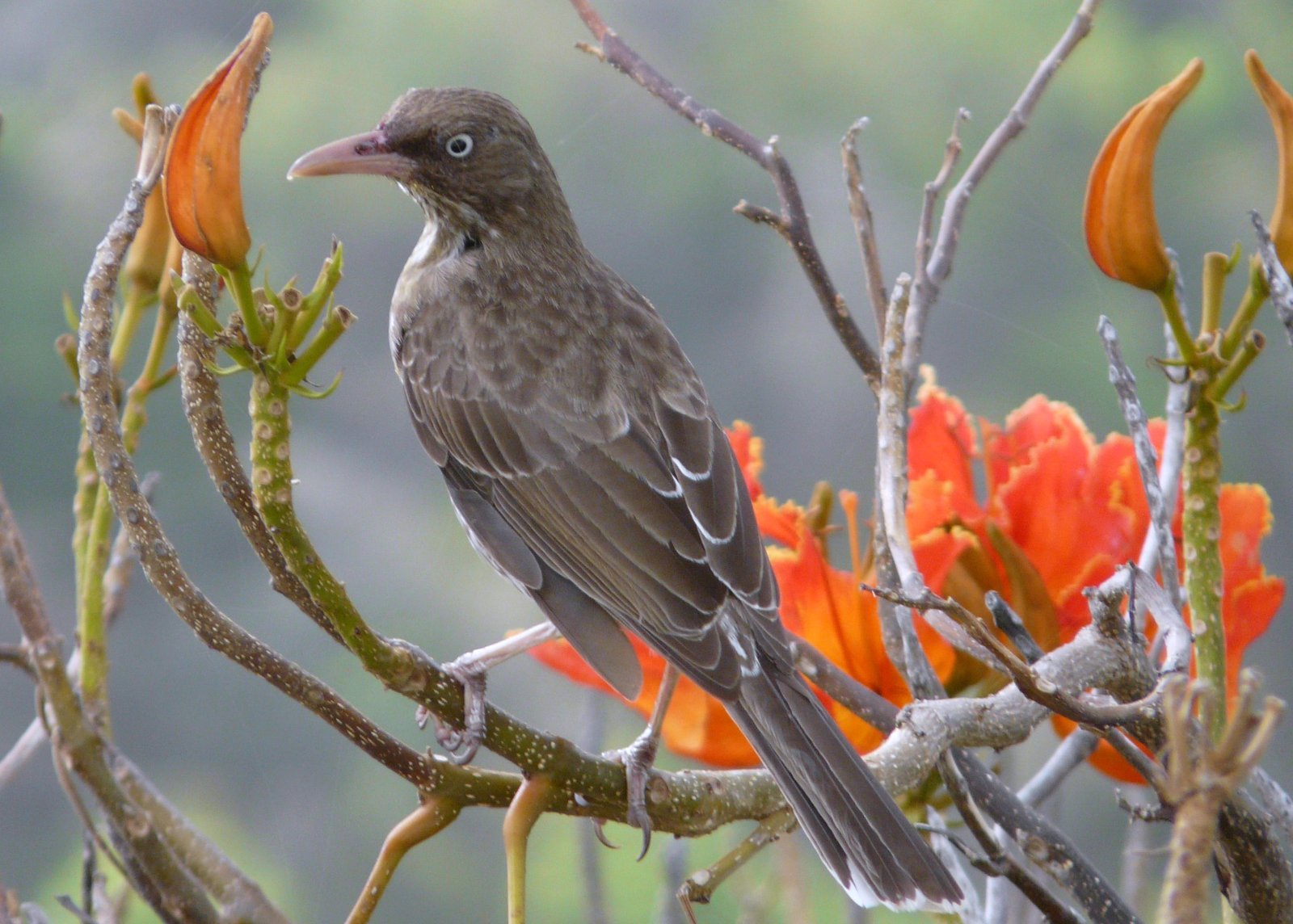
The Pearly-eyed Thrasher is the largest member of the mockingbird family in the region and a forest bird of Puerto Rico, the Virgin Islands and much of the Lesser Antilles. It is bold, noisy and eats almost anything, from fruit to lizards, eggs and nestlings. Its white iris gives it a staring look. On Puerto Rico it is a well-known problem for the conservation of the Puerto Rican Amazon.
Voice
A series of slow, whistled phrases of one to three notes with long pauses between them, often before dawn and sometimes at night. Also rough, hoarse calls such as craw-craw and chook-chook.
Recording: Shelby M Palmer — CC BY-NC-SA 4.0 · converted to mono · xeno-canto
Identification
28–30 cm, large and sturdy, with a long tail and a heavy, slightly curved bill that is yellowish to horn-coloured with a darker tip. The upperparts are plain brown, the underparts white with broad brown streaks and scales on throat, breast and flanks. The tail is brown with broad white tips to the outer feathers. The iris is white. The sexes are alike; females average slightly larger.
Confusion species
Scaly-breasted Thrasher Allenia fusca is smaller and slimmer, with a shorter, blackish bill, a white wing bar, a pale yellow iris and a more densely spotted breast. Forest Thrush Turdus lherminieri has a yellow bill, yellow legs and a yellow eye-ring. The tremblers Cinclocerthia have a long, thin bill and unspotted underparts. The mockingbirds Mimus are grey and paler, without streaks.
Habitat
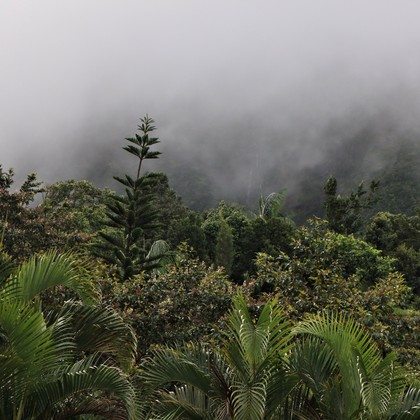
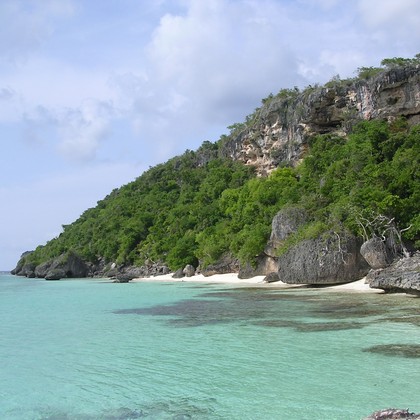
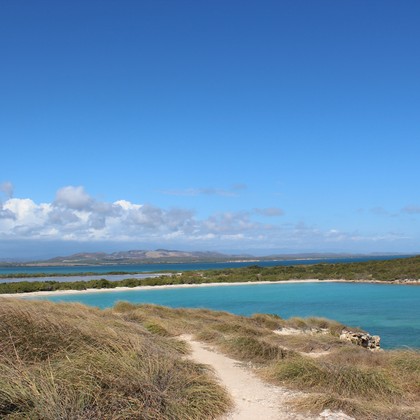
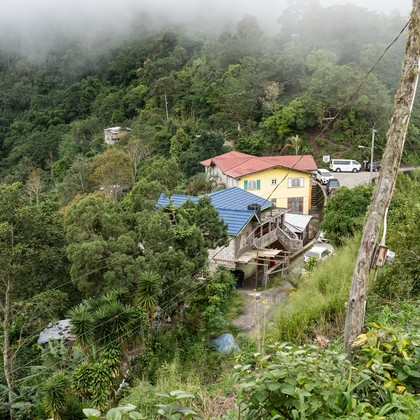
Almost all forest types, from dry coastal woodland and coastal scrub to moist and montane forest, as well as coffee plantations, gardens, hotel grounds and built-up areas with trees. It nests in tree cavities, nest boxes, holes in rocks and buildings. Omnivorous: it eats insects, fruit and berries, but also lizards, frogs and the eggs and young of other birds.
Where the bird is most at home, classified by the vegetation types of the Caribbean.



Range and movements
Resident in the southern Bahamas (including San Salvador, the Exumas and Long Island; on some more northerly islands mainly in winter), the Turks and Caicos Islands, eastern Dominican Republic and Isla Beata, Puerto Rico with Mona, Vieques and Culebra, the Virgin Islands and the Lesser Antilles from Saba to Saint Vincent and the Grenadines. Gone from Barbados and Grenada. An isolated population lives on Bonaire; that on the islands off Venezuela is extinct. It is absent from Haiti, Cuba, Jamaica, the Cayman Islands, Aruba, Curaçao and Trinidad and Tobago.
- Resident
- dark = core range, pale = thinly spread
How and when to look
On Puerto Rico, the Virgin Islands and islands such as Dominica and Guadeloupe it is frequently seen, including at hotels and picnic sites, where it boldly comes for food. The white iris and heavy pale bill separate it from Scaly-breasted Thrasher.
Conservation status
Not threatened. The species benefits from disturbed and inhabited areas and has spread on several islands. By raiding nests and occupying tree cavities it threatens the broods of the Puerto Rican Amazon on Puerto Rico, which requires special measures at the nest boxes.
Scientific name
Margarops fuscatus | (Vieillot, 1808)
Vieillot described the species in 1808 as Turdus fuscatus; because it was later moved to another genus, the author and year stand in brackets. The genus Margarops was introduced in 1859 by Sclater. Margarops is Greek, from margaron 'pearl' and ōps 'eye', after the white, pearly iris. fuscatus is Latin for 'darkened, dusky', after the dark brown plumage. The specimen the first description was based on came from Greater Antilles, especially Puerto Rico and Hispaniola.