All species › Passerines › Mockingbirds and thrashers › Grey Trembler
Grey Trembler | Cinclocerthia gutturalis
Grijze sidderspotlijster | Cocobino gris
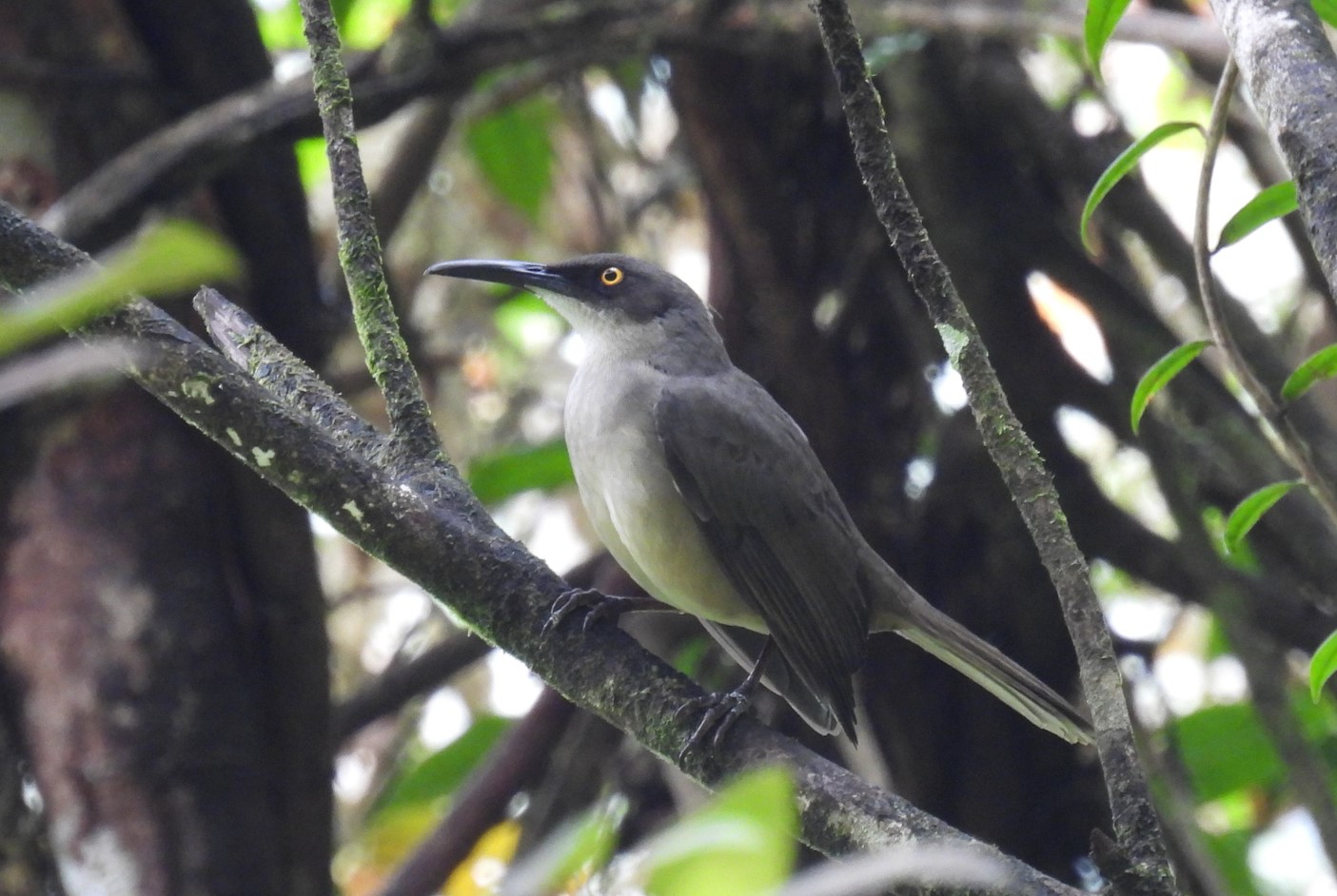
The Grey Trembler is one of the two tremblers, a genus found only in the Lesser Antilles. They owe their name to quivering their half-open, drooped wings, behaviour often seen in this species. It lives only on Martinique and Saint Lucia and was formerly treated as a subspecies of the Brown Trembler.
Voice
Repeated notes and wavering, whistled phrases, from harsh to melodious, as well as rough scolding notes and quavering whistles.
Recording: Arne Thelin — CC BY-NC-SA 4.0 · shortened to the first 60 s, mono · xeno-canto
Identification
23–26 cm, with a long, slightly curved, blackish bill and a tail often held cocked. The upperparts are grey-brown, the sides of the head darker, forming a mask. Throat and centre of the breast are off-white to buffy white; breast sides, flanks and thighs grey-brown, the flanks darkest. The underparts are unspotted. The iris is yellow. The sexes are alike, but females have a distinctly longer bill. Juveniles are browner, with a mottled breast.
Confusion species
No other trembler occurs on Martinique and Saint Lucia; Brown Trembler Cinclocerthia ruficauda lives on the islands to the north and south and is browner, with a rufous tone. Scaly-breasted Thrasher Allenia fusca and Pearly-eyed Thrasher Margarops fuscatus have shorter bills and heavily spotted or streaked underparts. Martinique Thrasher Ramphocinclus brachyurus is dark chocolate brown with sharply contrasting white underparts and a red iris.
Habitat
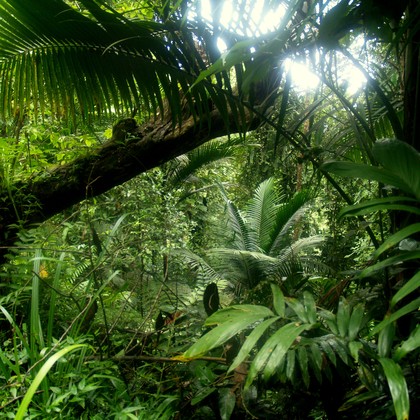
Mainly mature moist forest, in both lowlands and mountains; less strictly tied to moist forest than Brown Trembler and also found in drier scrub, open woodland and older secondary forest. It forages at all levels and also on the ground, probing its long bill into leaf clusters, epiphytes, moss and dead leaves. It eats mainly invertebrates, supplemented with small fruits, including those of palms. The nest is domed, with a side entrance, in a palm or tree cavity.
Where the bird is most at home, classified by the vegetation types of the Caribbean.



Range and movements
Only on Martinique (nominate gutturalis) and Saint Lucia (macrorhyncha), on both islands mainly in the forested interior. The species does not occur outside these two islands.
- Resident
- dark = core range, pale = thinly spread
How and when to look
Best along forest trails in the moist interior, for example in the rainforest of Saint Lucia and the forests of northern Martinique. A bird perched on a branch or liana with cocked tail and quivering wings is instantly this species; the call is often the first clue.
Conservation status
Not threatened. The species is fairly common and the population appears stable, but the range is small and vulnerable to deforestation and hurricane damage.
Scientific name
Cinclocerthia gutturalis | (de Lafresnaye, 1843)
De Lafresnaye described the species in 1843 as R[amphocinclus] gutturalis; because it was later moved to another genus, the author and year stand in brackets. The genus Cinclocerthia was introduced in 1840 by Gray. Cinclocerthia combines Cinclus (from Greek kinklos 'thrush') and Certhia 'treecreeper': a thrush-like bird that clambers about trunks like a treecreeper. gutturalis is Latin for 'of the throat', after the grey throat that separates it from the Brown Trembler. The specimen the first description was based on came from Martinique.