All species › Passerines › Mockingbirds and thrashers › Scaly-breasted Thrasher
Scaly-breasted Thrasher | Allenia fusca
Geschubde spotlijster | Cuitlacoche oscuro
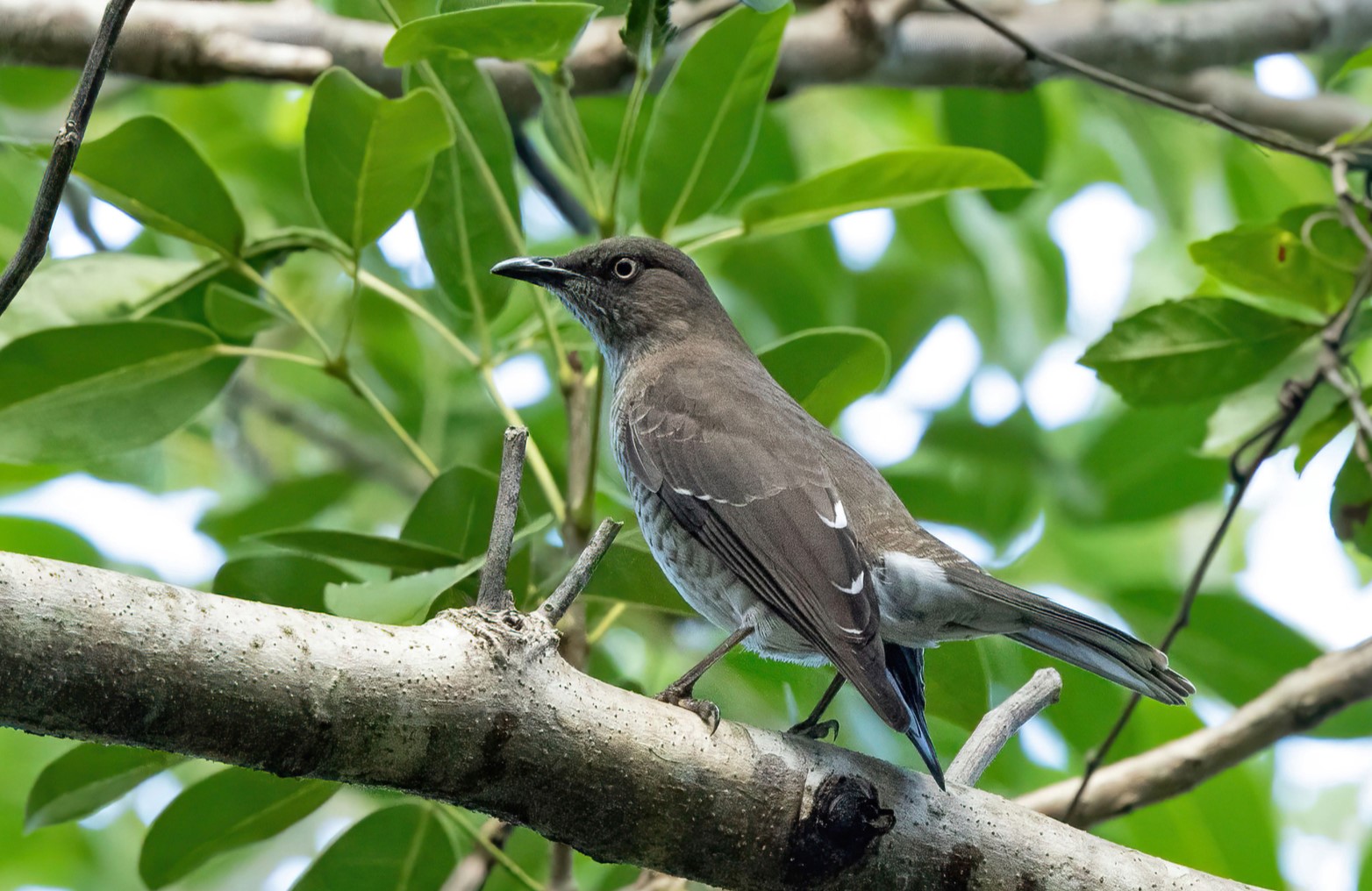
The Scaly-breasted Thrasher is a dark, spotted thrasher of the forests of the Lesser Antilles. It is shyer and more tied to forest than the larger Pearly-eyed Thrasher, with which it shares many islands, and often forages high in the canopy. Five subspecies are recognised; the one on Barbados is probably extinct.
Voice
When foraging a full dew-quip. The song, mainly in the morning, is a series of varied, partly repeated notes and phrases, like a mockingbird but softer and slower.
Recording: Denis Dujardin — CC BY-NC-SA 4.0 · converted to mono · xeno-canto
Identification
23 cm, with a fairly short, slightly curved, blackish bill. Head and upperparts are dark grey-brown, the rump tinged reddish and the tail blackish-brown with white tips to the outer feathers, visible mainly in flight. A single narrow white wing bar is formed by the white tips of the greater coverts. Throat and underparts are white, densely spotted and scaled grey-brown, most heavily on the breast; the belly is paler. The iris is pale yellow. The sexes are alike.
Confusion species
Pearly-eyed Thrasher Margarops fuscatus is larger and heavier, with a white iris, a thick pale bill with a horn-coloured tip and no obvious wing bar. Forest Thrush Turdus lherminieri has a yellow bill, yellow legs and a yellow eye-ring and forages more on the forest floor. The tremblers Cinclocerthia have a much longer bill and unspotted underparts.
Habitat
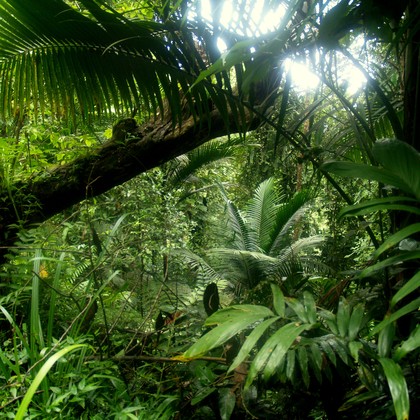
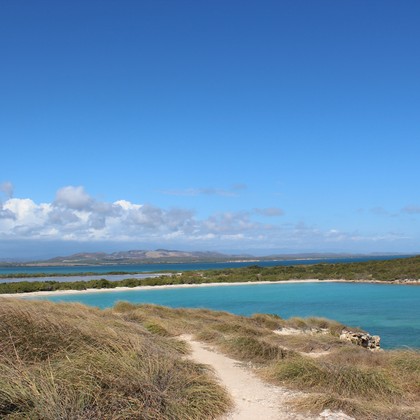
Moist and semi-evergreen forest, lowland rainforest and montane forest, also semi-open woodland, and on some islands dry forest, coastal scrub and mangroves. It sometimes enters gardens near houses. It searches trees at all heights for arthropods and eats much fruit and many berries; it often runs short distances rather than flying. The nest is an open cup in a tree; breeding is mainly in May and June, with two or three eggs.
Where the bird is most at home, classified by the vegetation types of the Caribbean.




Range and movements
Resident in the Lesser Antilles from Sint Maarten and Saba south through Saint Kitts, Nevis, Antigua, Montserrat, Guadeloupe, Dominica, Martinique, Saint Lucia and Saint Vincent to Grenada; a vagrant to the Grenadines. Possibly gone from Sint Eustatius and Barbuda, and probably extinct on Barbados. The species does not occur outside the Lesser Antilles.
- Resident
- dark = core range, pale = thinly spread
How and when to look
Best early in the morning in moist forest, for example on Dominica, Guadeloupe and Saint Lucia, when the birds are singing. A thrasher with a dark, spotted breast and a slim black bill keeping to the canopy is this species; the Pearly-eyed Thrasher is bolder and more often seen in the open.
Conservation status
Not threatened. On the larger, well-forested islands the species is fairly common. On some smaller, heavily deforested islands it has disappeared or become very rare; deforestation, hurricanes and possibly competition with the Pearly-eyed Thrasher play a part.
Scientific name
Allenia fusca | (Müller, 1776)
Müller described the species in 1776 as Muscicapa fusca; because it was later moved to another genus, the author and year stand in brackets. The genus Allenia was introduced in 1891 by Cory. Allenia is named after the American zoologist Joel Asaph Allen (1838–1921), curator at the American Museum of Natural History. fusca is Latin for 'dusky, dark', after the mainly dark brown plumage. The specimen the first description was based on came from Martinique.