All species › Hummingbirds and swifts › Hummingbirds › Long-billed Starthroat
Long-billed Starthroat | Heliomaster longirostris
Langsnavelsterkeelkolibrie | Colibrí pico largo
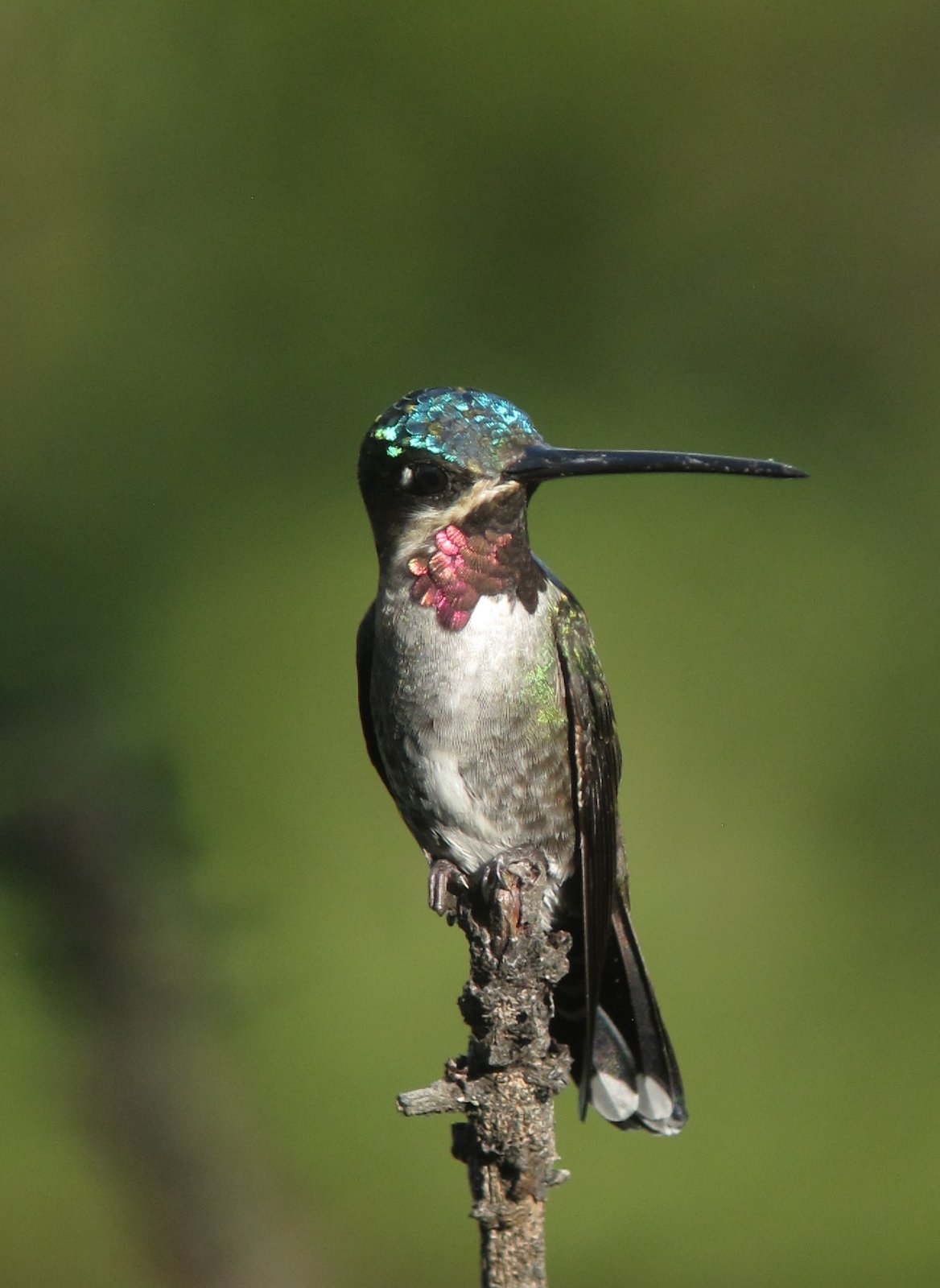
The Long-billed Starthroat is a medium-sized hummingbird with a long, almost straight bill. Within the region it occurs only in Trinidad, where it is scarce. It often perches high on an exposed bare twig, sallying out to catch insects, and visits flowering trees and feeders.
Voice
A rich, liquid tseep or tsew; squeaky twitters during chases.
Recording: JAYRSON ARAUJO DE OLIVEIRA — CC BY-NC-SA 4.0 · converted to mono · xeno-canto
Identification
11–12 cm, with a black bill of more than 3 cm, longer than in any other straight-billed hummingbird on the island. The male has a glittering blue to blue-green crown, a blackish face with a white malar stripe and a dark metallic purple gorget. The upperparts are dark bronze-green with a white stripe across the rump; the underparts are grey, with white tufts on the flanks and a small white spot behind the eye. The female lacks the blue crown and has a smaller, duller gorget.
Confusion species
The long straight bill, white malar stripe and white rump stripe together make a distinctive combination. Hermits such as Green Hermit Phaethornis guy have a curved bill and a long, pointed, white-tipped tail. Black-throated Mango Anthracothorax nigricollis and Green-throated Mango Anthracothorax viridigula are larger, with a curved bill and a purplish-red tail. White-necked Jacobin Florisuga mellivora has a short bill and much white in the tail.
Habitat
Semi-open humid country: forest edges, clearings, secondary forest, pastures with scattered trees, plantations and gardens; it avoids closed forest. In Trinidad mainly in the Northern Range. It follows flowering trees and therefore makes poorly understood movements; it may defend a food source or follow a regular route along scattered flowers.
Where the bird is most at home, classified by the vegetation types of the Caribbean.





Range and movements
Within the region only in Trinidad, where it is scarce but regular, mainly in and at the foot of the Northern Range; absent from Tobago. Elsewhere from southern Mexico through Central America into South America, east to the Guianas and Brazil.
- Resident
- dark = core range, pale = thinly spread
How and when to look
Most sightings come from lodges and hummingbird gardens in the Northern Range, such as the Asa Wright Nature Centre and Yerettê. Look for a hummingbird perched high on a bare twig with a long bill pointing forward.
Conservation status
Not threatened. Widespread in the Neotropics with a large population, which according to IUCN is declining; scarce in Trinidad.
Scientific name
Heliomaster longirostris | (Audebert & Vieillot, 1801)
Audebert & Vieillot described the species in 1801 as Trochilus longirostris; because it was later moved to another genus, the author and year stand in brackets. The genus Heliomaster was introduced in 1850 by Bonaparte. Heliomaster is Greek, from hēlios 'sun' and mastēr 'seeker': 'sun-seeker'. longirostris is Latin, from longus 'long' and rostrum 'bill', after the long bill. The specimen the first description was based on came from Trinidad.