All species › Hummingbirds and swifts › Hummingbirds › Amethyst Woodstar
Amethyst Woodstar | Calliphlox amethystina
Amethistboself | Estrellita amatista
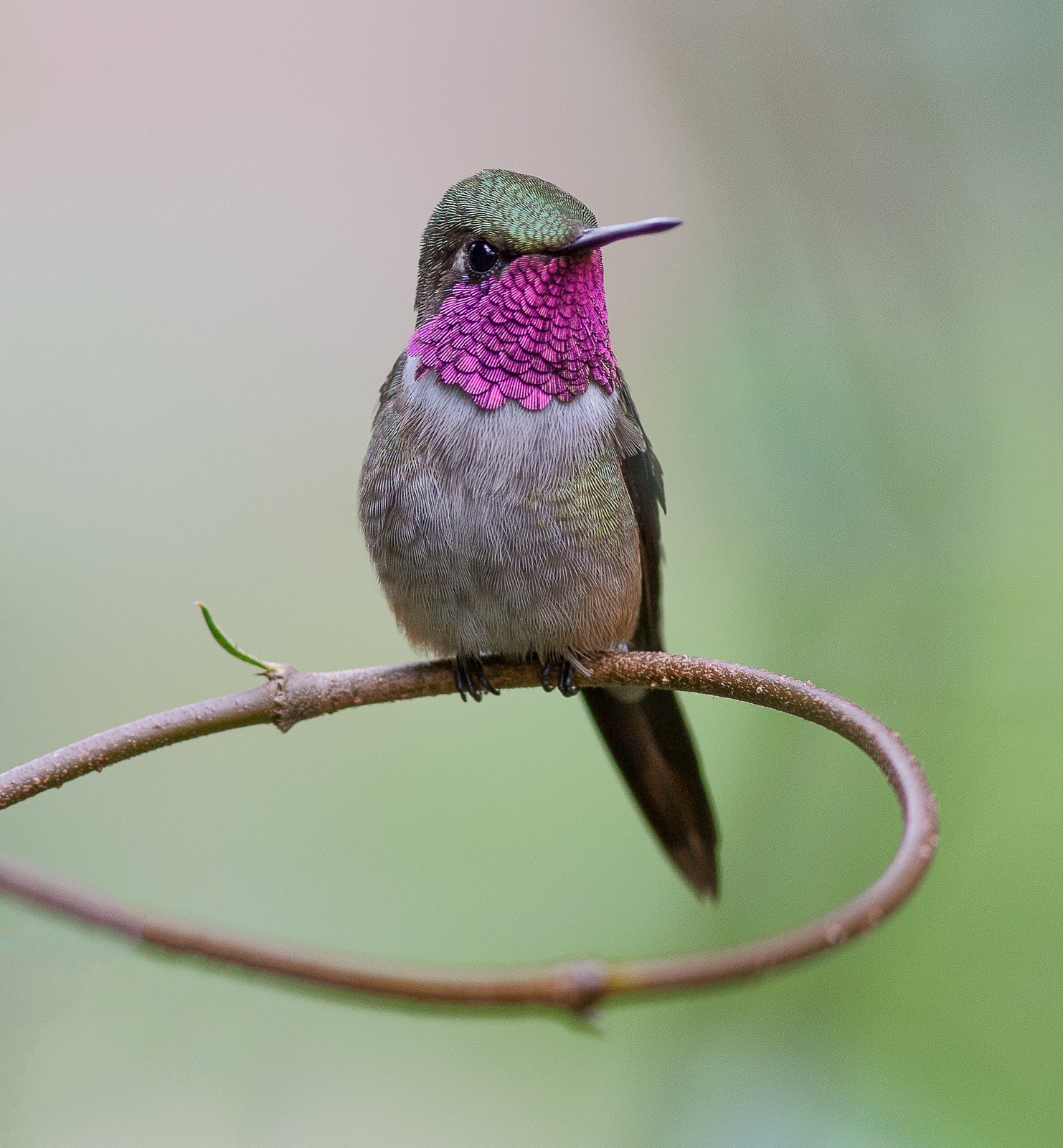
The Amethyst Woodstar is a very small South American hummingbird that has been recorded in the region only as a rare visitor to Trinidad. The male has an amethyst gorget with a white band below it and a deeply forked tail. Because of its size and humming flight it is often overlooked or confused with other small hummingbirds.
Voice
The call is a low, sharp rattle, trr. The song has not been described.
Recording: GABRIEL LEITE — CC BY-NC-SA 4.0 · converted to mono · xeno-canto
Identification
6–8 cm, with a short, straight black bill. Both sexes are dark bronze-green above, with a white patch on each side of the rump. The male has a glittering amethyst-purple gorget, a whitish breast band below it, greenish-grey underparts with rufous flanks and a long, deeply forked dark tail. The female has a whitish throat with small green spots, a white breast, rufous flanks and a short, rounded tail with rufous and a black band.
Confusion species
In Trinidad the main pitfall is Tufted Coquette Lophornis ornatus, which is also minute and shows white on the rump; but the female has a rufous throat and forehead and the male a crest and neck plumes. Ruby-topaz Hummingbird Chrysolampis mosquitus is larger and lacks white on the rump. A white breast band, rufous flanks and, in the male, a purple gorget with a forked tail point to Amethyst Woodstar.
Habitat
Within its own range semi-open to open landscapes: edges of humid forest, clearings, savanna and scrubby woodland, from sea level to about 1,500 m. In Trinidad reported at hummingbird gardens and forest edges in the Northern Range.
Where the bird is most at home, classified by the vegetation types of the Caribbean.



Range and movements
A rare visitor to Trinidad: there are old museum specimens, and since 2015 scattered reports have come from hummingbird gardens and lodges in the Northern Range and near Matura; whether these involve wanderers or a small, overlooked population is unclear. Not recorded from Tobago. Elsewhere widespread in South America east of the Andes, from Venezuela and the Guianas to northern Argentina.
- Resident
- dark = core range, pale = thinly spread
How and when to look
A sighting in Trinidad deserves documentation with photographs, especially of throat, breast band, flanks and tail shape. At hummingbird gardens in the Northern Range it pays to check the coquettes for a small bird with a white breast band.
Conservation status
Not globally threatened; the population size is unknown and thought to be declining. In the region a rare visitor with no established breeding population.
Scientific name
Calliphlox amethystina | (Boddaert, 1783)
Boddaert described the species in 1783 as Trochilus amethystinus; because it was later moved to another genus, the author and year stand in brackets. The genus Calliphlox was introduced in 1831 by Boie. Calliphlox is Greek, from kallos 'beauty' and phlox 'flame': 'beautifully blazing', after the glowing throat. amethystina is Latin for 'amethyst-coloured', after the male's purple throat. The specimen the first description was based on came from Cayenne, French Guiana.