All species › Hummingbirds and swifts › Hummingbirds › Tufted Coquette
Tufted Coquette | Lophornis ornatus
Gekuifde koketkolibrie | Coqueta adornada
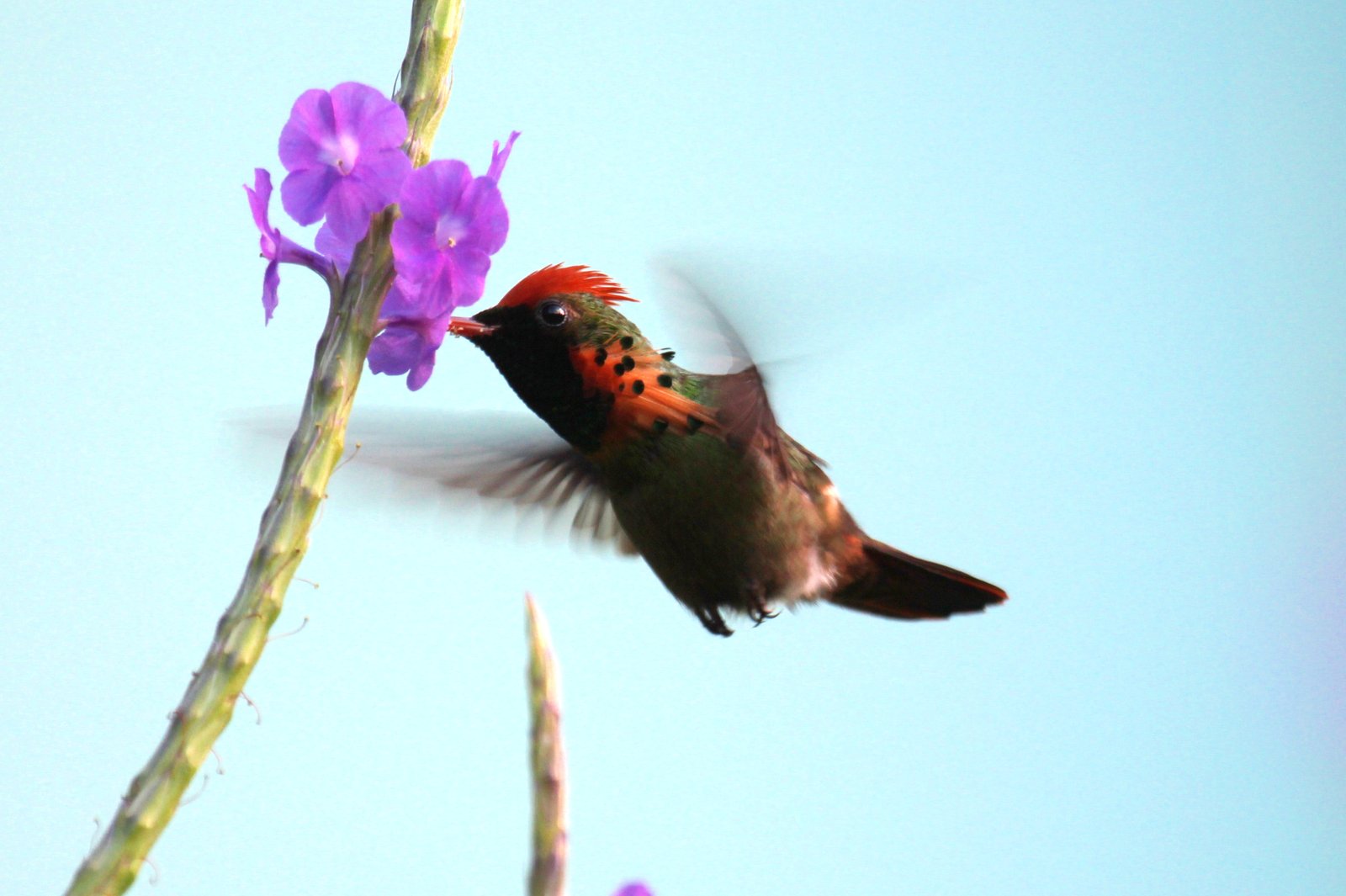
The Tufted Coquette is one of the smallest birds of Trinidad and within the region occurs only there. The male wears a rufous crest and a fan of long rufous neck plumes tipped with green spots. Between flowers it flies slowly and with a hum, recalling a large bee or hawk-moth more than a bird.
Voice
Mostly silent. A light chik is given while feeding.
Recording: Geoffrey Monchaux — CC BY-NC-SA 4.0 · converted to mono · xeno-canto
Identification
6.5–7 cm, with a short, straight red bill with a black tip. The male has a pointed rufous crest, a glittering green forehead and throat, and on each side of the neck long rufous plumes with dark green spots at the tips. The back is bronze-green with a white band across the rump; the tail is golden rufous. The female lacks crest and plumes; she is bronze-green above with the same white rump band, a rufous forehead, rufous throat and breast fading on the belly, and a rufous tail with a dark band.
Confusion species
The white rump band combined with the tiny size is distinctive. The female Ruby-topaz Hummingbird Chrysolampis mosquitus is larger, pale grey below and lacks a rump band. The rare Amethyst Woodstar Calliphlox amethystina also shows white rump patches, but has a white breast band and, in the female, a whitish, green-spotted throat. Little Hermit Phaethornis longuemareus has a long curved bill and a pointed tail.
Habitat
Open and semi-open country at forest edges, gardens, yards and farmland with flowering shrubs and hedges, mainly in the lower parts of the Northern Range. It takes nectar from small flowers close to the ground and catches small arthropods. It is fairly tame.
Where the bird is most at home, classified by the vegetation types of the Caribbean.




Range and movements
Within the region only in Trinidad, where it is scarce and local, mainly along the foot and lower slopes of the Northern Range; absent from Tobago. Elsewhere in eastern Venezuela, the Guianas and northern Brazil; its movements are poorly known.
- Resident
- dark = core range, pale = thinly spread
How and when to look
Best seen at low flowering hedges and flower beds at hummingbird gardens and lodges in the Northern Range, such as the Asa Wright Nature Centre. A humming ‘insect’ low over the flowers with a white band across the rump deserves a second look.
Conservation status
Not threatened. Widespread in north-eastern South America but rather scarce everywhere; in Trinidad it uses gardens and farmland.
Scientific name
Lophornis ornatus | (Boddaert, 1783)
Boddaert described the species in 1783 as Trochilus ornatus; because it was later moved to another genus, the author and year stand in brackets. The genus Lophornis was introduced in 1829 by Lesson. Lophornis is Greek, from lophos 'crest' and ornis 'bird', after the males' crests. ornatus is Latin for 'adorned', after the male's crest and fan-like cheek plumes. The specimen the first description was based on came from Cayenne, French Guiana.