All species › Passerines › Tanagers › Lesser Antillean Saltator
Lesser Antillean Saltator | Saltator albicollis
Antillensaltator | Pepitero antillano
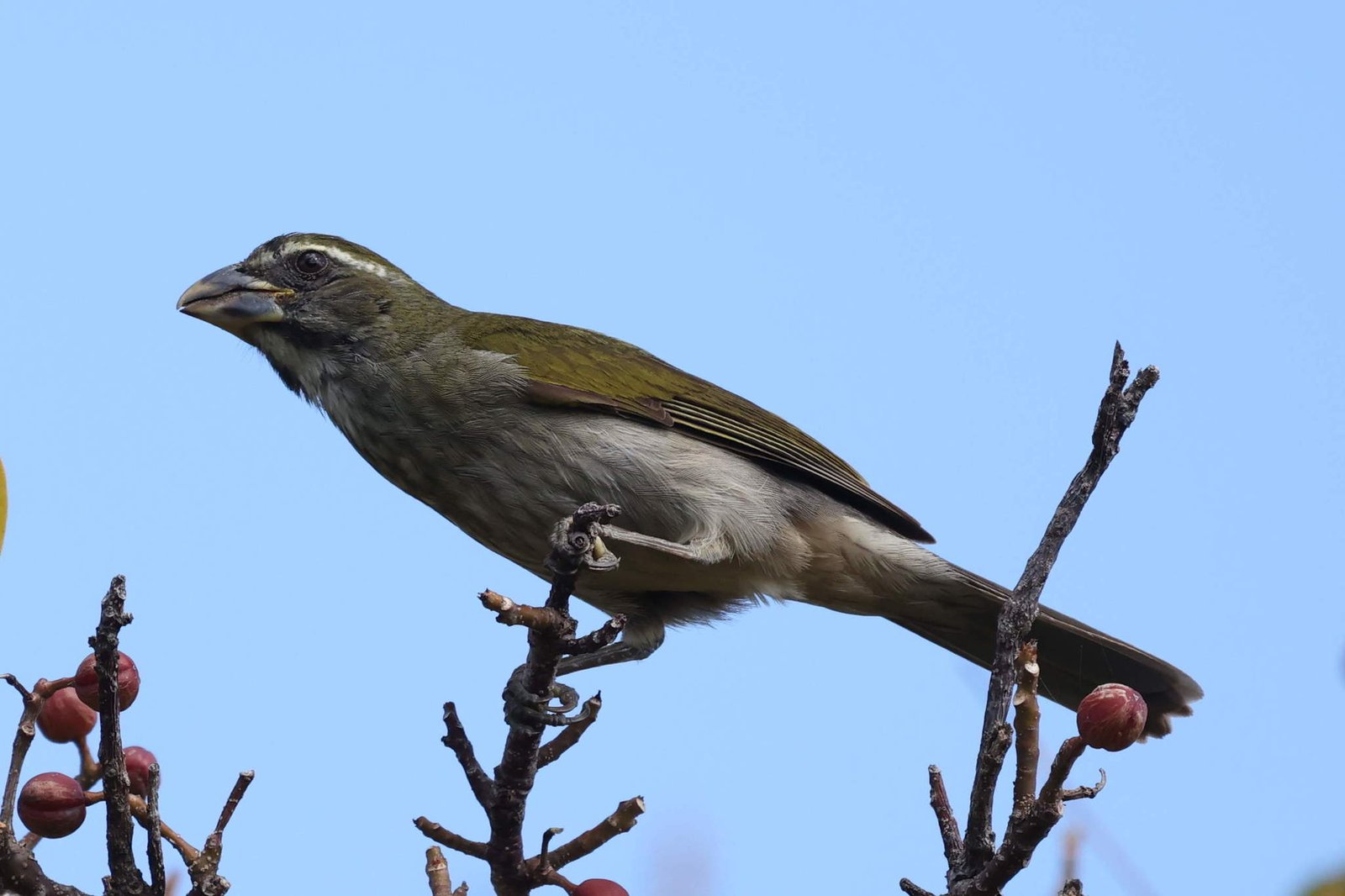
The Lesser Antillean Saltator is a large, olive-toned seed-eater found on only four islands of the Lesser Antilles: Guadeloupe, Dominica, Martinique and Saint Lucia. For a long time it was treated as one species with Streaked Saltator Saltator striatipectus of Central and South America; it is now regarded as a separate, endemic species. Saltators belong to the tanager family and, besides seeds, eat many fruits, flowers and buds.
Voice
The song is a series of rather loud, somewhat harsh notes that rise and fall in turn, usually given from an exposed perch at the top of a bush or tree.
Recording: Denis Dujardin — CC BY-NC-SA 4.0 · converted to mono · xeno-canto
Identification
21–22 cm, with a fairly long tail and a heavy, conical, dark bill. The upperparts are olive-green, the lower back and rump greyer. The throat is greenish white, bordered on each side by a dark malar stripe. Breast and belly are dull olive with diffuse dark streaks. The sexes are alike. Birds from Guadeloupe (subspecies guadelupensis) are often darker and more yellowish-tawny below.
Confusion species
On its four islands there is little to confuse it with. Female and young Lesser Antillean Bullfinches Loxigilla noctis are much smaller, plain brown to olive-brown, without breast streaks and with a shorter tail. Scaly-breasted Thrasher Allenia fusca and the larger Pearly-eyed Thrasher Margarops fuscatus are brown, with a longer, slimmer bill and a scaled or spotted breast. Streaked Saltator and Olive-grey Saltator Saltator olivascens occur in the region only on Trinidad.
Habitat
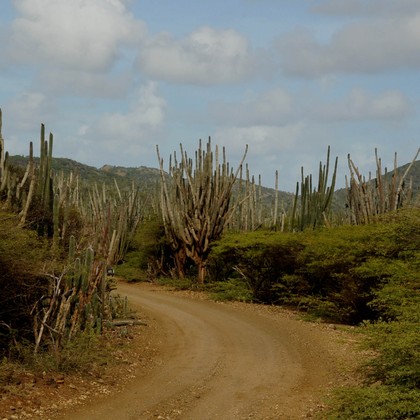
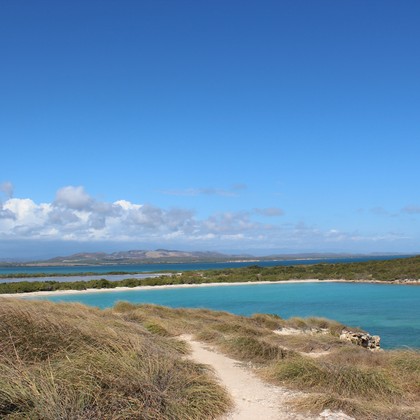
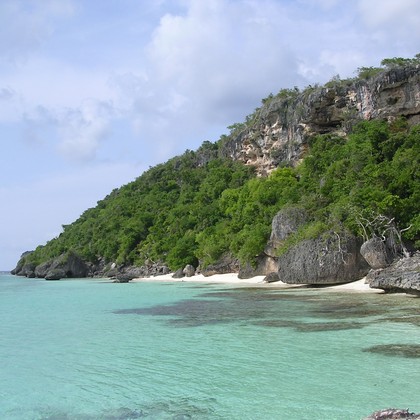
Mainly dry scrub and the edges of dry and semi-evergreen forest in the lowlands, but also mangroves, moister forest, gardens and rough farmland with bushes and trees, from sea level to about 500 m. It forages from the shrub layer to the canopy, usually singly or in pairs, on fruit, flowers, buds, seeds and a few insects.
Where the bird is most at home, classified by the vegetation types of the Caribbean.




Range and movements
Endemic to the Lesser Antilles: resident on Guadeloupe, Dominica, Martinique and Saint Lucia, and common on each of these islands. There is a single record from Nevis, possibly of a bird from captivity. The species does not occur outside these islands.
- Resident
- dark = core range, pale = thinly spread
How and when to look
Best looked for in dry scrub and forest edges on the leeward side of the islands, but also in gardens and around villages. The loud song gives the bird away; singing birds often sit in view at the top of a bush or tree.
Conservation status
Not threatened. The range is small, but the species is common and also uses secondary growth, gardens and farmland; the population is thought to be stable and no immediate threats are known.
Scientific name
Saltator albicollis | Vieillot, 1817
Vieillot described the species in 1817 and placed it straight away in the genus where it still stands. The genus Saltator was introduced in 1816 by Vieillot. Saltator is Latin for 'dancer, leaper', after the birds' hopping movements. albicollis is Latin, from albus 'white' and collum 'neck', after the white throat. The specimen the first description was based on came from Martinique.