All species › Passerines › Tanagers › Lesson's Seedeater
Lesson's Seedeater | Sporophila bouvronides
Lessons dikbekje | Semillero de Lesson
Lesson's Seedeater is a small seedeater of grasslands in northern South America that, within the Caribbean, occurs only on Trinidad. It is a migrant: it breeds in the wet season in the north of the continent and on Trinidad, then moves to Amazonia. It was long treated as a subspecies of Lined Seedeater Sporophila lineola; since 2007 it has again been recognised as a separate species.
Voice
The song starts with a few harsh notes and then becomes melodious; on Trinidad it has been described as a long rolling trill followed by chattering.
Recording: JAYRSON ARAUJO DE OLIVEIRA — CC BY-NC-SA 4.0 · converted to mono · xeno-canto
Identification
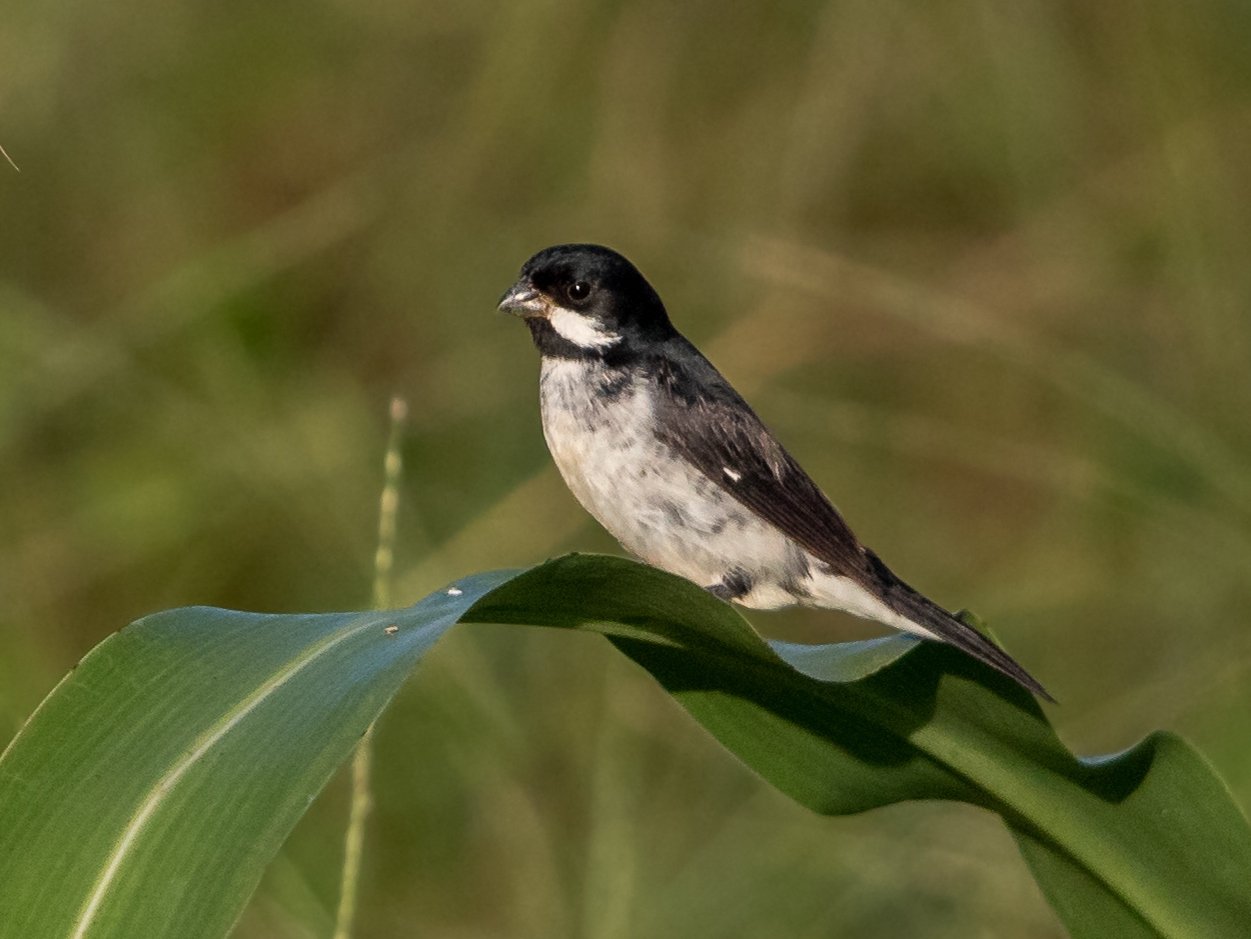
10–11 cm, with a short, thick, rounded bill. The male is matt black on the head, back, wings and tail, with a large triangular white patch on the cheek and lower ear coverts, a narrow white rump band and white at the base of the primaries. The throat is black, the breast white with diffuse black marks, the belly whitish. Bill and legs are black. The female is olive-brown above, with a creamy buff throat, buffy breast and paler belly; the upper mandible is dark, the lower horn-coloured.
Confusion species
Male Lined Seedeater is almost identical but has a narrow white median stripe on the black crown, which Lesson's lacks. Females of the two species are barely separable in the field. Females of Yellow-bellied Seedeater Sporophila nigricollis and Ruddy-breasted Seedeater Sporophila minuta are also similar. Female Blue-black Grassquit Volatinia jacarina has a more pointed bill and a streaked breast.
Habitat
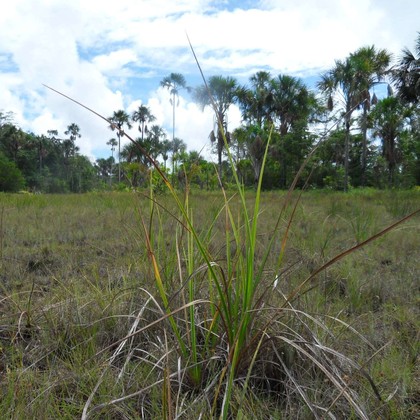
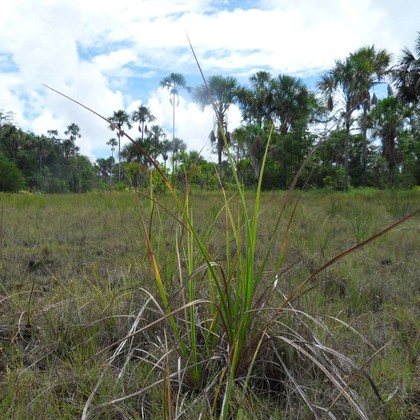
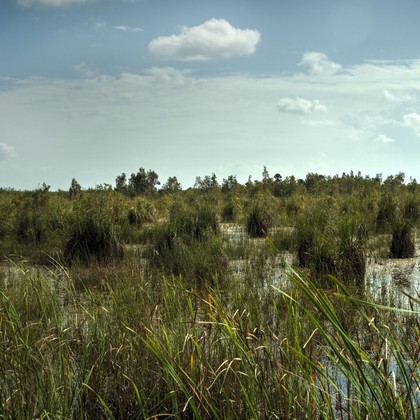
Grassland, pasture and shrubby open country, usually near water; in the breeding season also forest edges and clearings. It feeds mainly on grass seeds picked from the seed heads, often together with other seedeaters.
Where the bird is most at home, classified by the vegetation types of the Caribbean.

Range and movements
On Trinidad a wet-season breeder that apparently leaves entirely in the dry season; its exact status on the island is poorly known. Not known from Tobago or the other islands. Elsewhere it breeds from north-eastern Colombia across northern Venezuela to the northern Guianas and winters in Amazonian Colombia, Ecuador, Peru, Bolivia and Brazil. Vagrants have been recorded in Panama and Costa Rica.
- Summer visitor (c. Oct–Mar)
- Passage (Mar–Apr, Oct–Nov)
- dark = core range, pale = thinly spread
How and when to look
Between May and November in moist grassland and pasture in the lowlands of Trinidad. Singing males sit on top of a grass stem or bush, where the white cheek patch shows from afar. Each male is worth checking for a white crown stripe, the mark of Lined Seedeater.
Conservation status
Not threatened. A fairly common species of open country that benefits from the conversion of forest to pasture. Its migration is still poorly understood.
Scientific name
Sporophila bouvronides | (Lesson, 1831)
Lesson described the species in 1831 as Pyrrhula bouvronides; because it was later moved to another genus, the author and year stand in brackets. The genus Sporophila was introduced in 1844 by Cabanis. Sporophila is Greek, from sporos 'seed' and philos 'lover': 'seed-lover'. bouvronides refers to 'Bouvreuil bouvron', the French name for the Lined Seedeater, with Greek -idēs 'resembling', as the two look much alike. The specimen the first description was based on came from Trinidad (designated later).