All species › Passerines › Tyrant flycatchers › Least Flycatcher
Least Flycatcher | Empidonax minimus
Kleine feetiran | Mosquero mínimo
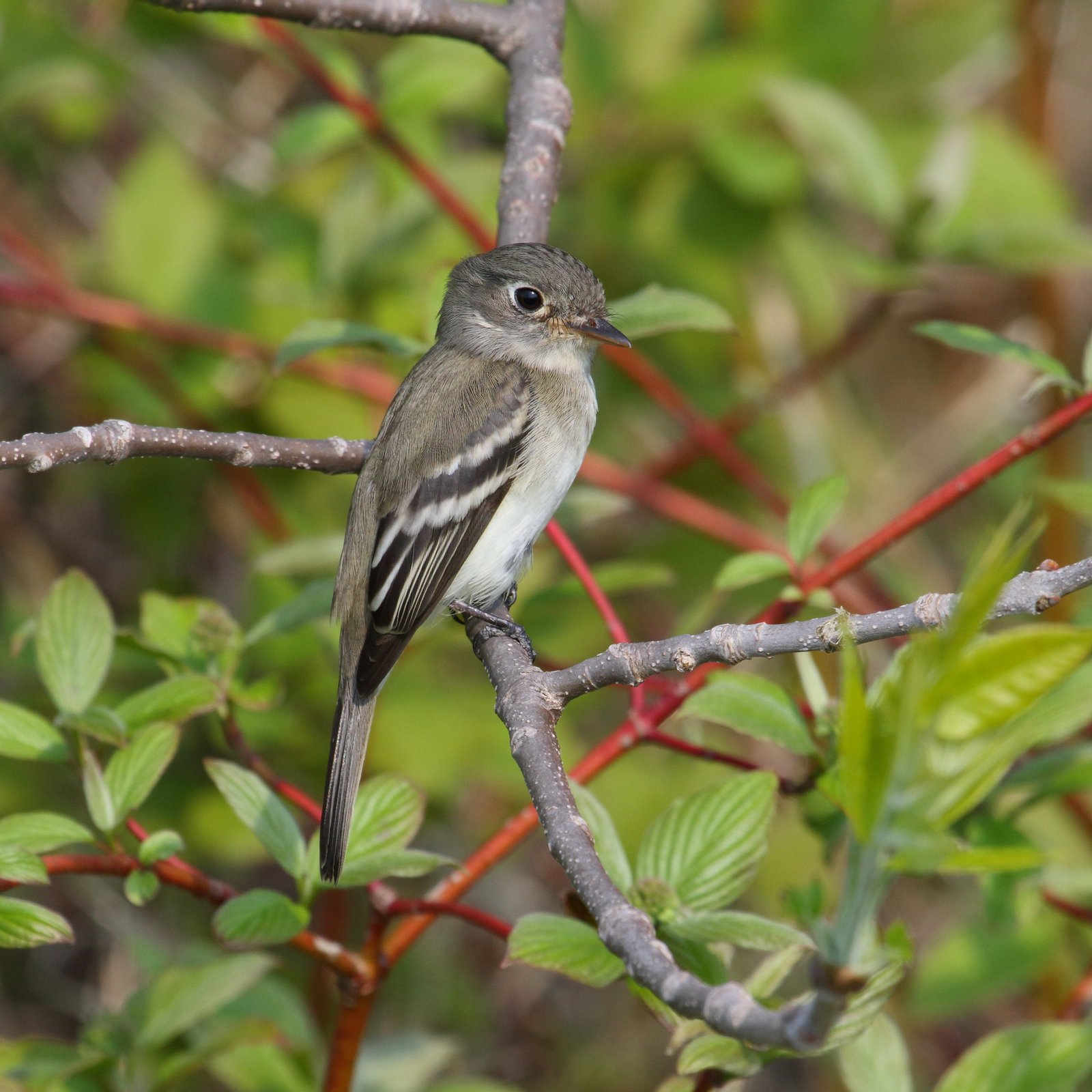
The Least Flycatcher is the smallest and greyest of the eastern North American Empidonax flycatchers. It breeds in deciduous and mixed woodland in Canada and the northern United States and winters mainly from Mexico to Panama. The Caribbean lies outside its usual migration route; it is recorded occasionally on passage and in winter, mainly in the Cayman Islands and Cuba.
Voice
The call is a short, dry whit. The song, the familiar che-BEK with the stress on the second syllable, is seldom heard away from the breeding grounds, though sometimes in spring.
Recording: Stanislas Wroza — CC BY-NC-SA 4.0 · shortened to the first 60 s, mono · xeno-canto
Identification
12–14 cm, small and compact, with a relatively large, round head and a short bill. The upperparts are greyish olive, the head often greyer than the back. A complete white eye-ring gives the bird a ‘spectacled’ look. The underparts are greyish white, with a grey wash across the breast and sometimes a faint yellow tinge to the belly. The dark wings show two distinct whitish wing bars and pale tertial edges; the primary projection is short. The upper mandible is dark, the lower mostly yellowish. It frequently flicks its tail and wings.
Confusion species
Willow Flycatcher Empidonax traillii is larger and browner, with a faint or absent eye-ring and a longer, broader bill. Yellow-bellied Flycatcher Empidonax flaviventris is greener, with a yellow throat and belly. Acadian Flycatcher Empidonax virescens is larger and greener above, with a long primary projection and a long, broad bill. Pewees (Contopus) are larger and longer-winged, lack a distinct eye-ring and do not flick the tail. Away from the breeding grounds many Empidonax can be identified reliably only by call or from photographs.
Habitat
In the region scrub and woodland edges, dry and moist broadleaf forest, coastal woodland and well-vegetated gardens. It sallies from low to mid-level perches in the lower layers of the woodland after flying insects and also gleans insects from leaves. On the breeding grounds it uses open deciduous and mixed woodland, orchards and parks.
Where the bird is most at home, classified by the vegetation types of the Caribbean.





Range and movements
A rare passage migrant and winter visitor in the Cayman Islands, with most records from Grand Cayman, and rare in Cuba and the Bahamas. There are no documented records from the other islands. It breeds from southern Canada and the north-eastern United States south to the Appalachians and winters from Mexico to Panama, in small numbers also in southern Florida.
- Winter visitor (c. Apr–Sep)
- Passage (Mar–Apr, Oct–Nov)
- dark = core range, pale = thinly spread
How and when to look
The best chance is on Grand Cayman and in western Cuba in autumn and winter. A small, greyish Empidonax with a white eye-ring giving a dry whit is more likely to be this species than one of its greener or larger relatives.
Conservation status
Not threatened. The species is common on its breeding grounds, although it has declined in parts of its range in recent decades.
Scientific name
Empidonax minimus | (Baird & Baird, 1843)
Baird & Baird described the species in 1843 as Tyrannula minima; because it was later moved to another genus, the author and year stand in brackets. The genus Empidonax was introduced in 1855 by Cabanis. Empidonax is Greek, from empis 'gnat' and anax 'master': 'gnat-king', after its insect hunting. minimus is Latin for 'smallest', after its small size. The specimen the first description was based on came from near Carlisle, Pennsylvania (USA).