All species › Passerines › Tyrant flycatchers › Olive-sided Flycatcher
Olive-sided Flycatcher | Contopus cooperi
Sparrenpiewie | Pibí boreal
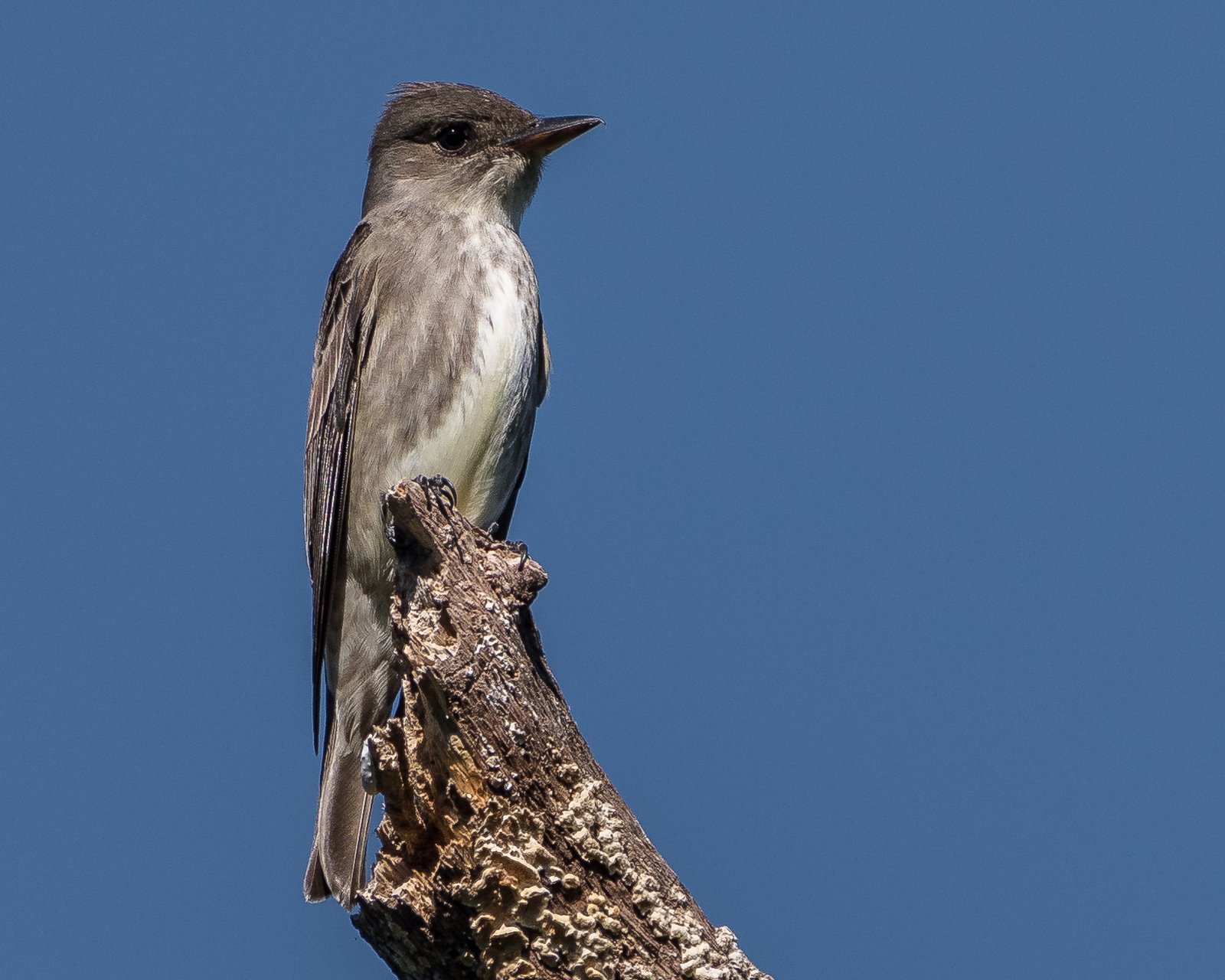
The Olive-sided Flycatcher is a large, short-tailed pewee of the boreal conifer forests and mountain forests of North America that winters in Central America and especially in the Andes and mountains of northern South America. In the Caribbean, Trinidad is the only place where it winters regularly; on the other islands it is a rare passage migrant.
Voice
In winter mainly a repeated, forceful pip-pip-pip. The song, a whistled quick-three-beers with the stress on the middle note, is rarely heard away from the breeding grounds, though sometimes shortly before departure in spring.
Recording: Greg Irving — CC BY-NC-SA 4.0 · shortened to the first 60 s, mono · xeno-canto
Identification
18–20 cm, stocky, with a large head, a short tail and long, pointed wings. The upperparts are dark greyish olive. Throat, centre of the breast and belly are white, forming a narrow white strip between dark, streaked flanks, so that the bird appears to wear an open ‘vest’. A white tuft often shows above the rump behind the wing. The wing bars are indistinct. The bill is fairly large, with a dark upper mandible and a pale base to the lower. The sexes are alike.
Confusion species
Eastern Wood-Pewee Contopus virens and Western Wood-Pewee Contopus sordidulus are smaller and slimmer, with a longer tail, more distinct wing bars and a more uniform grey breast without a sharply defined white central strip. Tropical Pewee Contopus cinereus of Trinidad is much smaller, with pale lores and greyer underparts.
Habitat
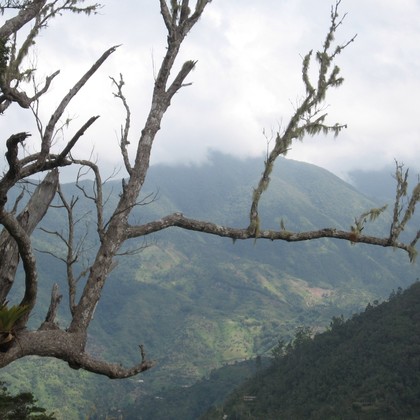
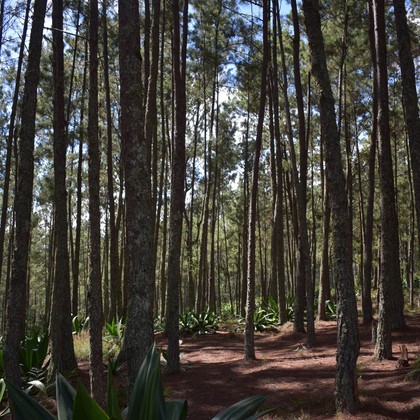
In the region montane forest and the edges of moist forest, where it perches high on a bare, dead treetop or projecting branch. It makes long sallies after flying insects, especially bees, wasps and flying ants, often returning to the same perch. Each bird holds its own territory on the wintering grounds.
Where the bird is most at home, classified by the vegetation types of the Caribbean.


Range and movements
In Trinidad a scarce but annual winter visitor to the Northern Range. A rare passage migrant in the Bahamas, the Greater Antilles and the ABC Islands; there are hardly any records from the Lesser Antilles. It breeds from Alaska through Canada to the western and north-eastern United States and northern Baja California and winters from Central America to the Andes of Bolivia.
- Resident
- Summer visitor (c. Oct–Mar)
- Winter visitor (c. Apr–Sep)
- Passage (Mar–Apr, Oct–Nov)
- dark = core range, pale = thinly spread
How and when to look
In Trinidad wintering birds are best found along mountain roads in the Northern Range, perched on dead treetops above the forest. A pewee perched high on a bare branch calling pip-pip-pip is worth checking for the white central breast strip.
Conservation status
Not threatened according to the data used here, but the population has fallen by almost 80% in fifty years. Possible causes include declining flying insects, the loss of montane forest on the wintering grounds and changes in the management of boreal forests.
Scientific name
Contopus cooperi | (Nuttall, 1831)
Nuttall described the species in 1831 as Muscicapa cooperi; because it was later moved to another genus, the author and year stand in brackets. The genus Contopus was introduced in 1855 by Cabanis. Contopus is Greek, from kontos 'pole, shaft' and pous 'foot', after the short legs. cooperi honours the American naturalist and collector William Cooper (1798–1864). The specimen the first description was based on came from Mount Auburn near Cambridge, Massachusetts (USA).