All species › Passerines › Tyrant flycatchers › Yellow-bellied Flycatcher
Yellow-bellied Flycatcher | Empidonax flaviventris
Berkenfeetiran | Mosquero ventriamarillo
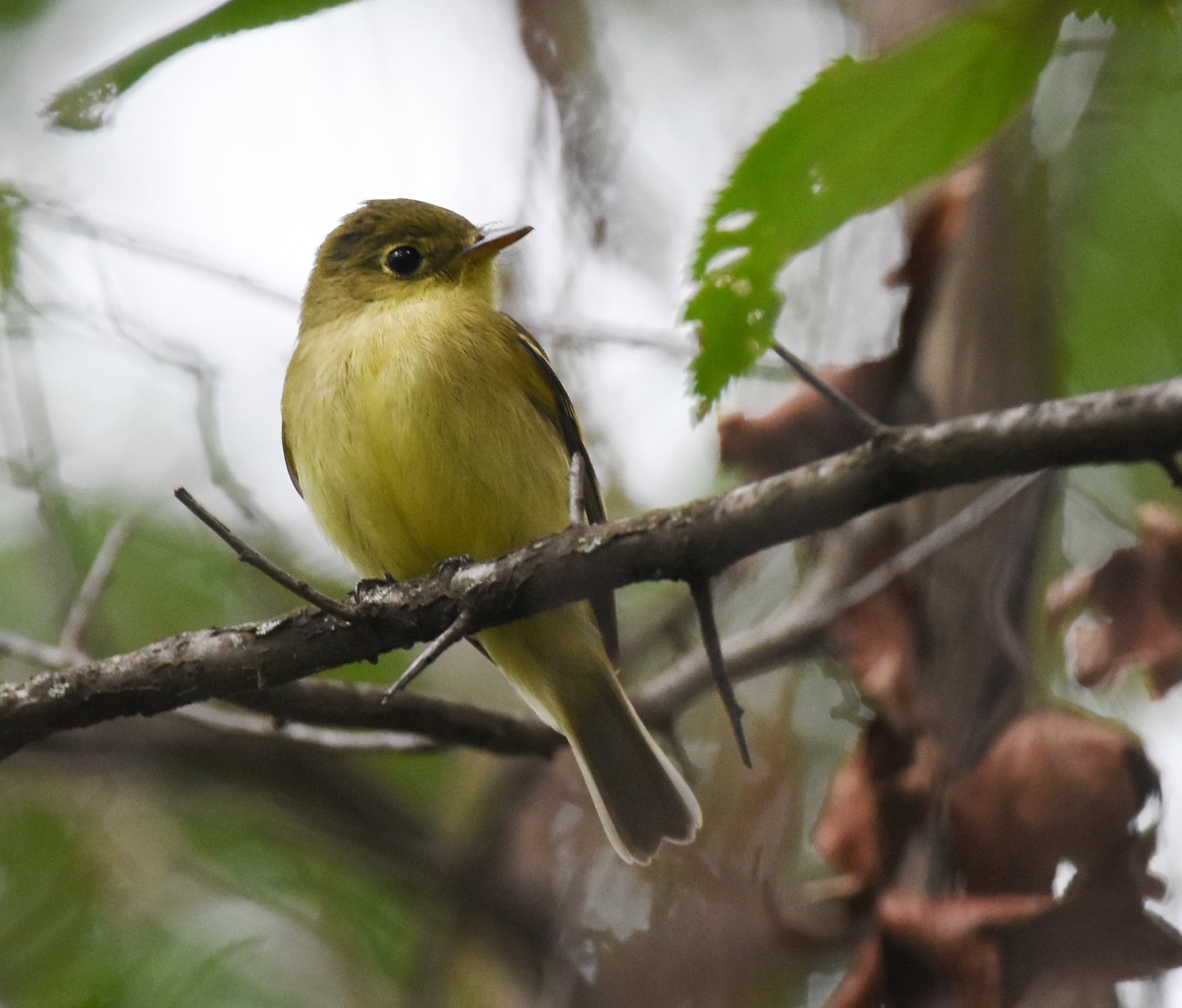
The Yellow-bellied Flycatcher is the yellowest Empidonax of eastern North America. It breeds in wet northern forests, especially spruce bogs rich in sphagnum, and migrates overland through Mexico to its wintering grounds in southern Mexico and Central America. In the Caribbean it is a very rare passage migrant in the west.
Voice
The call is a rising, whistled chu-wee or pwee, also given on migration. The song is a rough, descending tse-berk.
Recording: Stanislas Wroza — CC BY-NC-SA 4.0 · shortened to the first 60 s, mono · xeno-canto
Identification
13–15 cm, with a round head and a relatively short tail. The upperparts are greenish olive. The eye-ring is yellowish and distinct. The wings are dark, with two sharply defined white to yellowish-white wing bars. Throat and underparts are yellow, with an olive-green wash across the breast. The lower mandible is pale. Birds are brightest yellow in autumn; worn spring birds are duller.
Confusion species
Acadian Flycatcher Empidonax virescens can also look yellowish in autumn, but has a whitish throat, longer wings and a larger bill. Least Flycatcher Empidonax minimus is greyer, with a white throat and a white eye-ring. Willow Flycatcher Empidonax traillii is browner, with a white throat and a weak eye-ring.
Habitat
On migration the shady lower storey of woodland: moist and dry deciduous forest, limestone forest and coastal woodland. It forages low from a sheltered perch. On the breeding grounds the nest is placed in sphagnum on or just above the ground.
Where the bird is most at home, classified by the vegetation types of the Caribbean.




Range and movements
A very rare passage migrant in Cuba and the Cayman Islands, mainly in autumn. There are no certain records from other islands. Breeds in Canada and the north-eastern United States and winters from southern Mexico to Panama.
- Resident
- Winter visitor (c. Apr–Sep)
- Passage (Mar–Apr, Oct–Nov)
- dark = core range, pale = thinly spread
How and when to look
An Empidonax with a yellow throat in the shady undergrowth of western Cuba or the Cayman Islands in September or October deserves a careful look. The yellow throat and the rising chu-wee call separate it from the other Empidonax flycatchers.
Conservation status
Not threatened. The species has a large breeding range in the boreal forests.
Scientific name
Empidonax flaviventris | (Baird & Baird, 1843)
Baird & Baird described the species in 1843 as Tyrannula flaviventris; because it was later moved to another genus, the author and year stand in brackets. The genus Empidonax was introduced in 1855 by Cabanis. Empidonax is Greek, from empis 'gnat' and anax 'master': 'gnat-king', after its insect hunting. flaviventris is Latin, from flavus 'yellow' and venter 'belly', after the yellowish underparts. The specimen the first description was based on came from near Carlisle, Pennsylvania (USA).