All species › Passerines › Spindalises › Hispaniolan Spindalis
Hispaniolan Spindalis | Spindalis dominicensis
Hispaniolaspindalis | Cigua amarilla
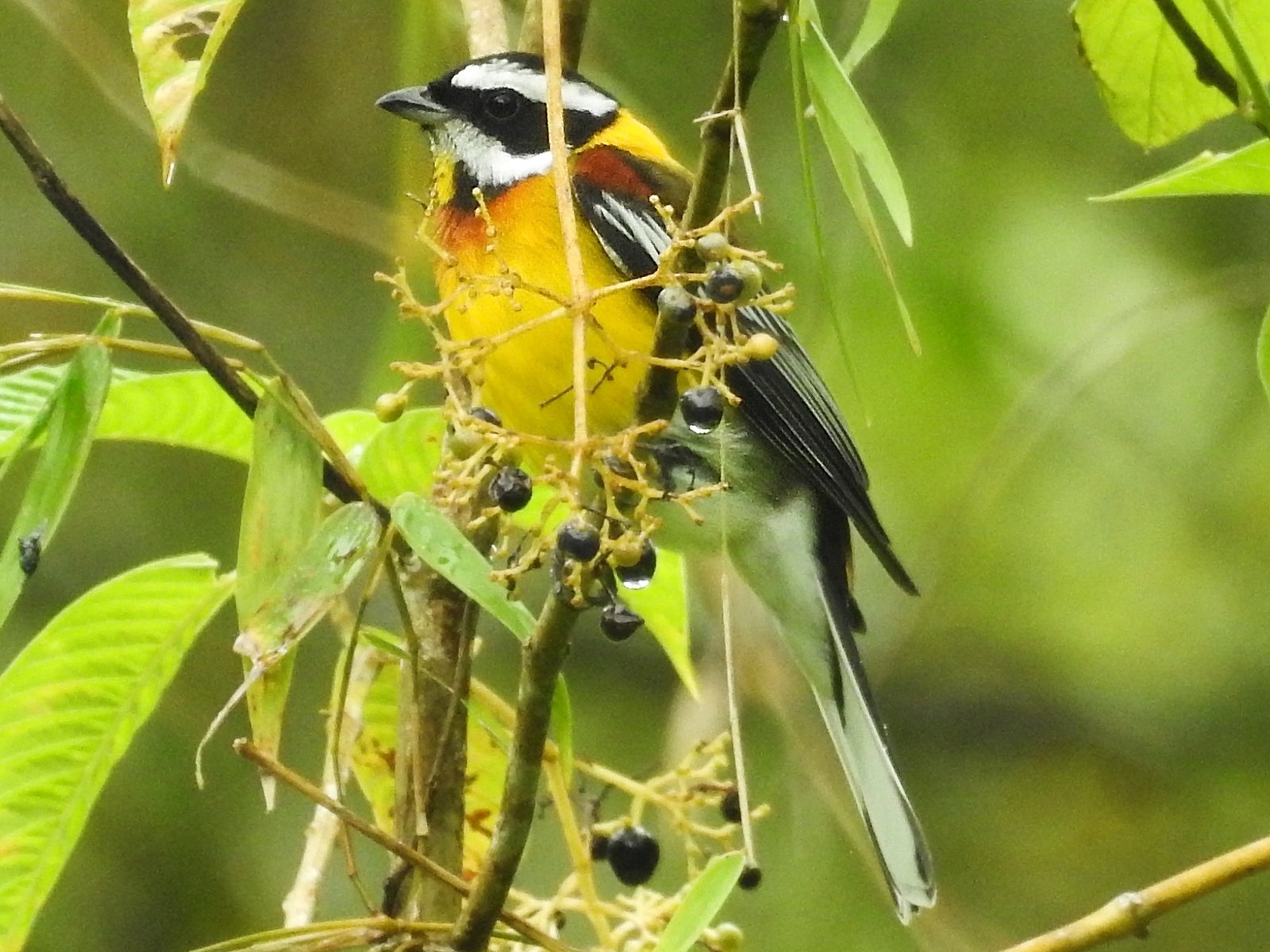
The Hispaniolan Spindalis is one of the four spindalises, a family of fruit-eating songbirds found only in the Caribbean. Of the four, the male has the most varied pattern, with a yellow throat patch and a chestnut breast. In the Dominican Republic it is called cigua amarilla.
Voice
At dawn the male sings a thin, high-pitched whistle or a prolonged, weak, sibilant tsee see see see. Calls include a high thseep and a longer seeee. Females sing a softer version.
Recording: Ross Gallardy — CC BY-NC-SA 4.0 · converted to mono · xeno-canto
Identification
About 16 cm, with a short, thick bill. The male has a black head with a white supercilium and a white moustachial stripe, a white chin and a bright yellow throat patch with black sides. The nape is yellow, the back greenish olive, the rump tawny-yellow and the uppertail coverts chestnut. The breast is deep chestnut, fading to yellow; the belly is white and the undertail coverts black. Wings and tail are black with white edges. The female is greyish olive, with a greyer head, a yellowish-olive rump, a dusky brown tail and whitish underparts with dusky streaks. Juveniles resemble the female but are duller.
Confusion species
No other spindalis occurs on Hispaniola. Hispaniolan Oriole Icterus dominicensis is black with yellow shoulders, rump and belly, and has a pointed bill. Black-crowned Palm-tanager Phaenicophilus palmarum and Grey-crowned Palm-tanager Phaenicophilus poliocephalus are green above with a grey throat and white spots around the eye. Hispaniolan Euphonia Chlorophonia musica is much smaller, with a blue crown. The female is recognised by the pale, streaked underparts and the short, thick bill.
Habitat
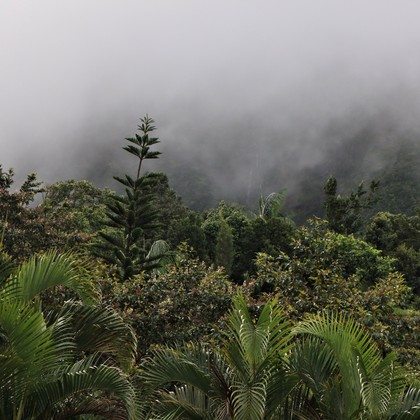
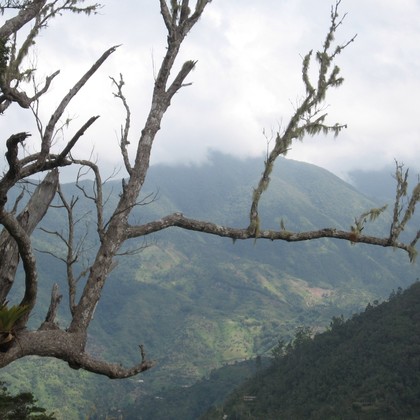
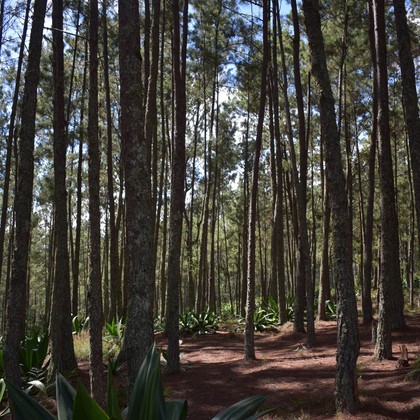
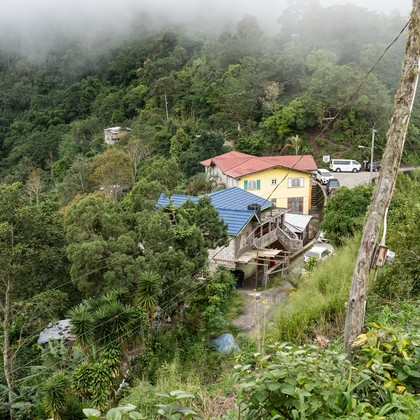
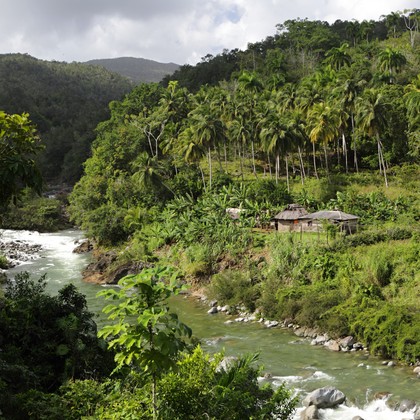
Humid forest with thickets and low growth, montane forest, cloud forest and pine forest, as well as orchards, coffee plantations and other plantings. It occurs at almost any elevation but is most numerous in the mountains. It eats mainly fruit, pecked open with the bill, and also flower buds, seeds, tender leaves and insects, from bush height to the treetops. It breeds in May and June in a small cup of dry grass up to about 4.5 m high in a tree or bush, laying three eggs.
Where the bird is most at home, classified by the vegetation types of the Caribbean.

Range and movements
Only on Hispaniola, in both Haiti and the Dominican Republic, and on the Haitian island of Gonâve. The species does not occur outside these islands.
- Resident
- dark = core range, pale = thinly spread
How and when to look
The montane forest of the Cordillera Central and the Sierra de Bahoruco in the Dominican Republic, for example in the Ebano Verde reserve, where the birds feed in fruiting trees. The thin dawn song gives away singing males in the treetops.
Conservation status
Not threatened. The species is common in the highlands. Deforestation, especially in Haiti, has greatly reduced its habitat locally.
Scientific name
Spindalis dominicensis | (Bryant, 1867)
Bryant described the species in 1867 as Tanagra dominicensis; because it was later moved to another genus, the author and year stand in brackets. The genus Spindalis was introduced in 1837 by Jardine & Selby. Spindalis comes from the Greek spindalos or pindalos, an unidentified Indian bird said to be akin to the attagas (a gamebird). dominicensis is Latin for 'of Santo Domingo', the old name for Hispaniola, where the species lives. The specimen the first description was based on came from Port-au-Prince, Haiti.