All species › Passerines › Spindalises › Jamaican Spindalis
Jamaican Spindalis | Spindalis nigricephala
Jamaicaanse spindalis | Cigua jamaicana
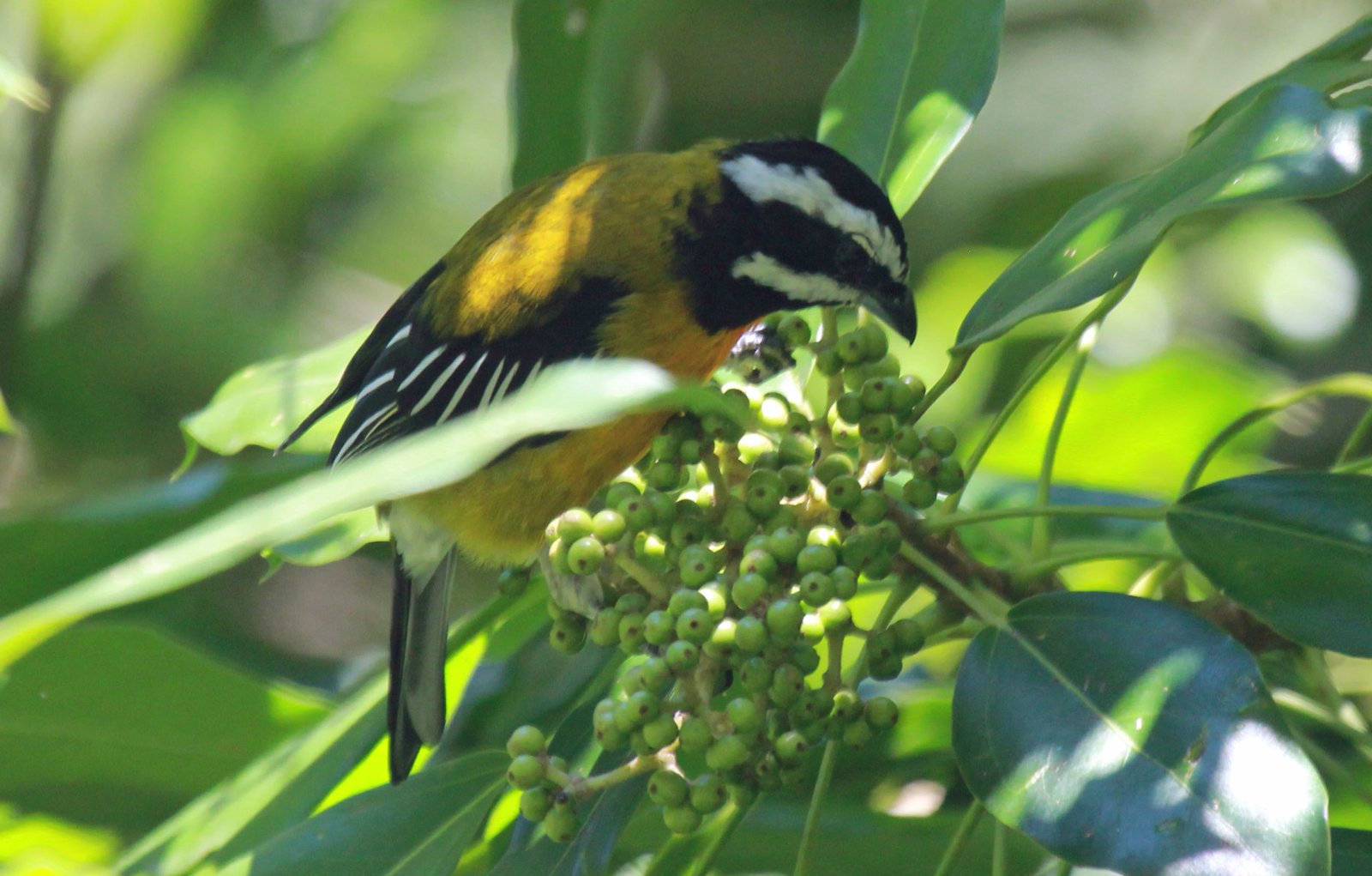
The Jamaican Spindalis is the largest of the four spindalises, a family of fruit-eating songbirds found only in the Caribbean. It occurs throughout Jamaica, most commonly in the hills and mountains, and is often seen in pairs or family groups at fruiting trees.
Voice
A rather quiet species. In flight a soft, weak seep; foraging groups give a fast, high chi-chi-chi-chi-chi. Males sing from exposed perches, and churring or rattling notes are given when disturbed. There is also a soft whisper song.
Recording: Bobby Wilcox — CC BY-NC-SA 4.0 · converted to mono · xeno-canto
Identification
About 18 cm, with a short, thick bill. The male has a black head with a broad white supercilium reaching the nape and a long, broad white moustachial stripe; the chin and upper throat are white. The back is yellow-olive, the rump and uppertail coverts orange. The breast is yellow-orange, becoming yellow on the belly, with white on the lower belly and undertail coverts. Wings and tail are black with white edges. The female is greyish olive on the head, throat and upperparts, with a pale orange-yellow breast, a pale yellow belly and an indistinct face pattern.
Confusion species
No other spindalis occurs in Jamaica. Jamaican Oriole Icterus leucopteryx is yellow with a black throat and a white wing patch, but has a pointed bill and no white head stripes. The male Orangequit Euneornis campestris is grey-blue with an orange throat and a thin, curved bill. Jamaican Euphonia Euphonia jamaica is much smaller and grey-blue to olive, without head stripes.
Habitat
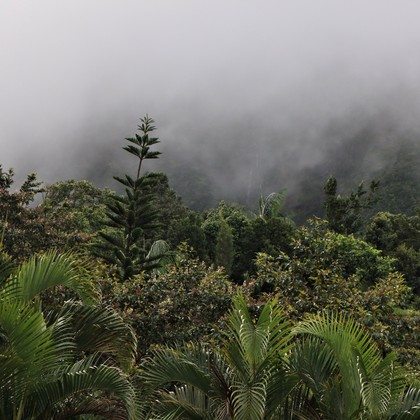
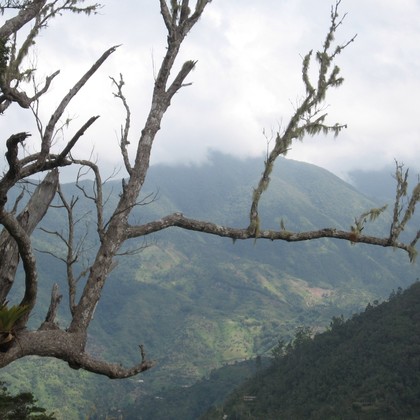
Moist and semi-evergreen forest, montane forest, forest edge, open woodland and brushy areas with fruiting trees and shrubs, from sea level to the mountains; also coffee plantations and gardens. It feeds mainly on fruit and berries of a wide range of native and introduced plants, supplemented by leaves and blossoms, sometimes hanging acrobatically from the branches. It breeds from April to July in a loose cup of grass and rootlets; the clutch is two or three eggs.
Where the bird is most at home, classified by the vegetation types of the Caribbean.




Range and movements
Only in Jamaica, throughout the island, most numerous in the interior and the mountains and local on the coast. The species does not occur outside Jamaica.
- Resident
- dark = core range, pale = thinly spread
How and when to look
Found in the Blue Mountains, in Cockpit Country and in gardens with fruiting trees in the hills. Fruiting trees along forest edges are the best places; the birds often perch in the open there and give good views.
Conservation status
Not threatened. The species is common and adapts to forest edges, gardens and plantations.
Scientific name
Spindalis nigricephala | (Jameson, 1835)
Jameson described the species in 1835 as Tanagra nigricephala; because it was later moved to another genus, the author and year stand in brackets. The genus Spindalis was introduced in 1837 by Jardine & Selby. Spindalis comes from the Greek spindalos or pindalos, an unidentified Indian bird said to be akin to the attagas (a gamebird). nigricephala is Latin/Greek for 'black-headed', from niger 'black' and kephalē 'head', after the male's black head. The specimen the first description was based on came from Jamaica.