All species › Passerines › Spindalises › Puerto Rican Spindalis
Puerto Rican Spindalis | Spindalis portoricensis
Puerto Ricaanse spindalis | Reina mora
The Puerto Rican Spindalis is one of the four spindalises, a family of fruit-eating songbirds found only in the Caribbean. It is common throughout the main island of Puerto Rico, from forest to town gardens. In Puerto Rico it is called reina mora.
Voice
Males sing from high perches, often in treetops, a long series of high, thin, sibilant notes in a regular rhythm, at frequencies of 8 kHz and above. There is also a rapid tweet and a short chi chi chi. Females give a soft whisper song from dense, low vegetation.
Recording: Rainforest Connection — CC BY-NC-SA 4.0 · converted to mono · xeno-canto
Identification
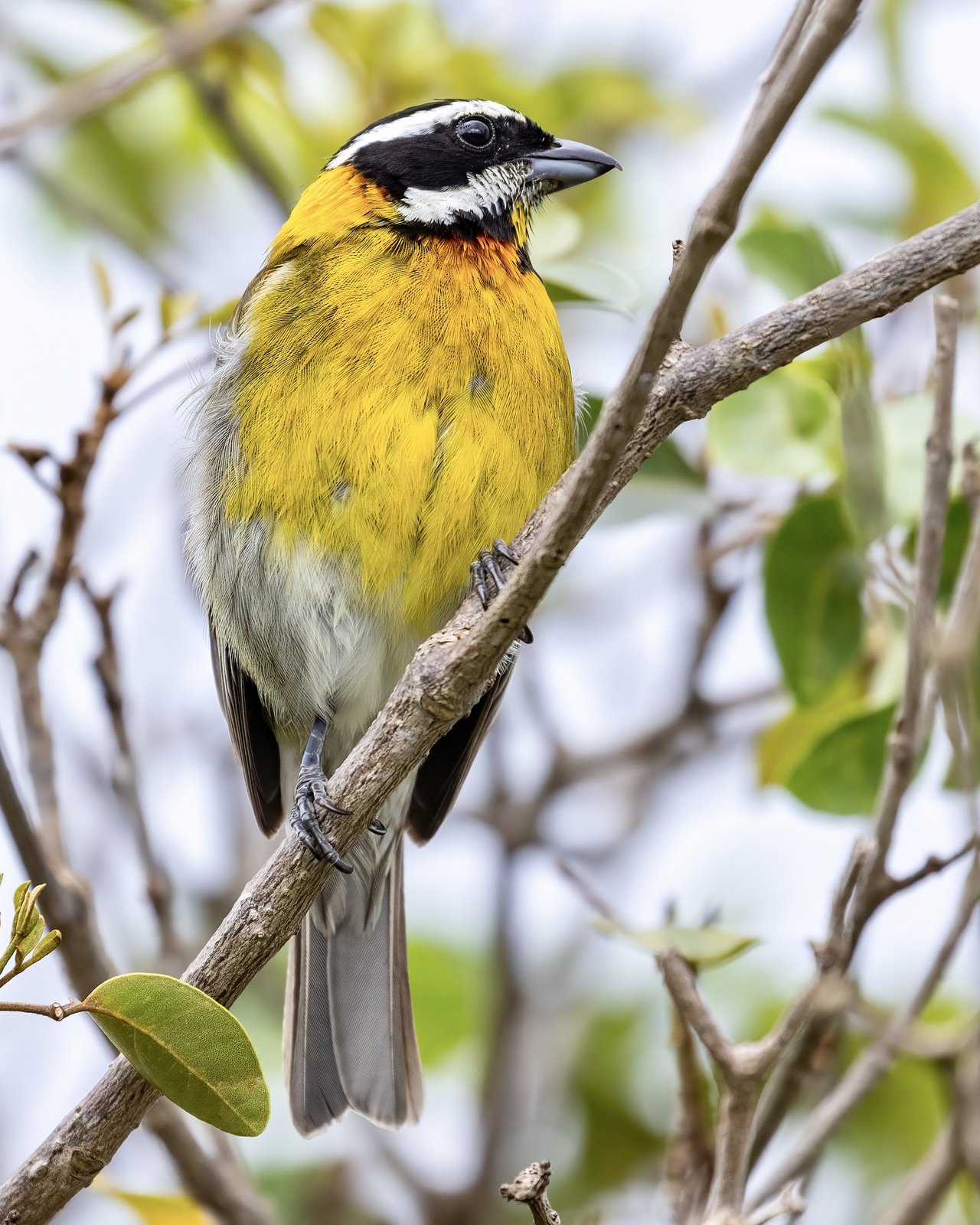
16–17 cm, with a short, thick bill. The male is yellow-green above, with blackish wings and tail with pale edges. The head is black with two white stripes: a supercilium reaching the nape and a moustachial stripe. An orange collar crosses the hindneck; throat and breast are yellow-orange, the belly paler. The female is much duller: olive-green to grey-brown above, with an indistinct white supercilium and dull white underparts with brown streaks on the throat and breast.
Confusion species
No other spindalis occurs in Puerto Rico. Puerto Rican Oriole Icterus portoricensis is black with yellow shoulders, rump and undertail, and has a pointed bill. Puerto Rican Bullfinch Melopyrrha portoricensis is black with a rufous throat, eyebrow and undertail. The female is recognised by the streaked breast, faint supercilium and thick bill; Puerto Rican Vireo Vireo latimeri is smaller, unstreaked and thin-billed.
Habitat
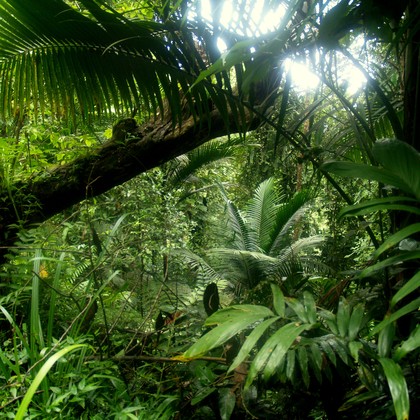
Moist forest, rainforest and montane forest, drier forest to a lesser extent, and also plantations, orchards, gardens and urban greenery. Rarely above 1000 m. It eats mainly fruit, above all that of yagrumo macho Schefflera morototoni, supplemented by insects and small lizards. The nest is a cup of plant material; the clutch is two to four pale blue eggs with brown blotches.
Where the bird is most at home, classified by the vegetation types of the Caribbean.






Range and movements
Only on the main island of Puerto Rico, throughout the island. The species does not occur outside Puerto Rico.
- Resident
- dark = core range, pale = thinly spread
How and when to look
In almost any forest in Puerto Rico, such as El Yunque and the Maricao forest, but also in parks and gardens in San Juan. Fruiting trees are the best places. The high, rhythmic song is the first lead; the singing male often sits at the top of a tree.
Conservation status
Not threatened. The population is considered stable, and the species adapts well to plantations, gardens and urban greenery.
Scientific name
Spindalis portoricensis | (Bryant, 1866)
Bryant described the species in 1866 as Tanagra portoricensis; because it was later moved to another genus, the author and year stand in brackets. The genus Spindalis was introduced in 1837 by Jardine & Selby. Spindalis comes from the Greek spindalos or pindalos, an unidentified Indian bird said to be akin to the attagas (a gamebird). portoricensis is Latin for 'of Puerto Rico', the island where the species lives. The specimen the first description was based on came from Puerto Rico.