All species › Passerines › Tanagers › Grassland Yellow Finch
Grassland Yellow Finch | Sicalis luteola
Graslandsaffraangors | Chirigüe sabanero
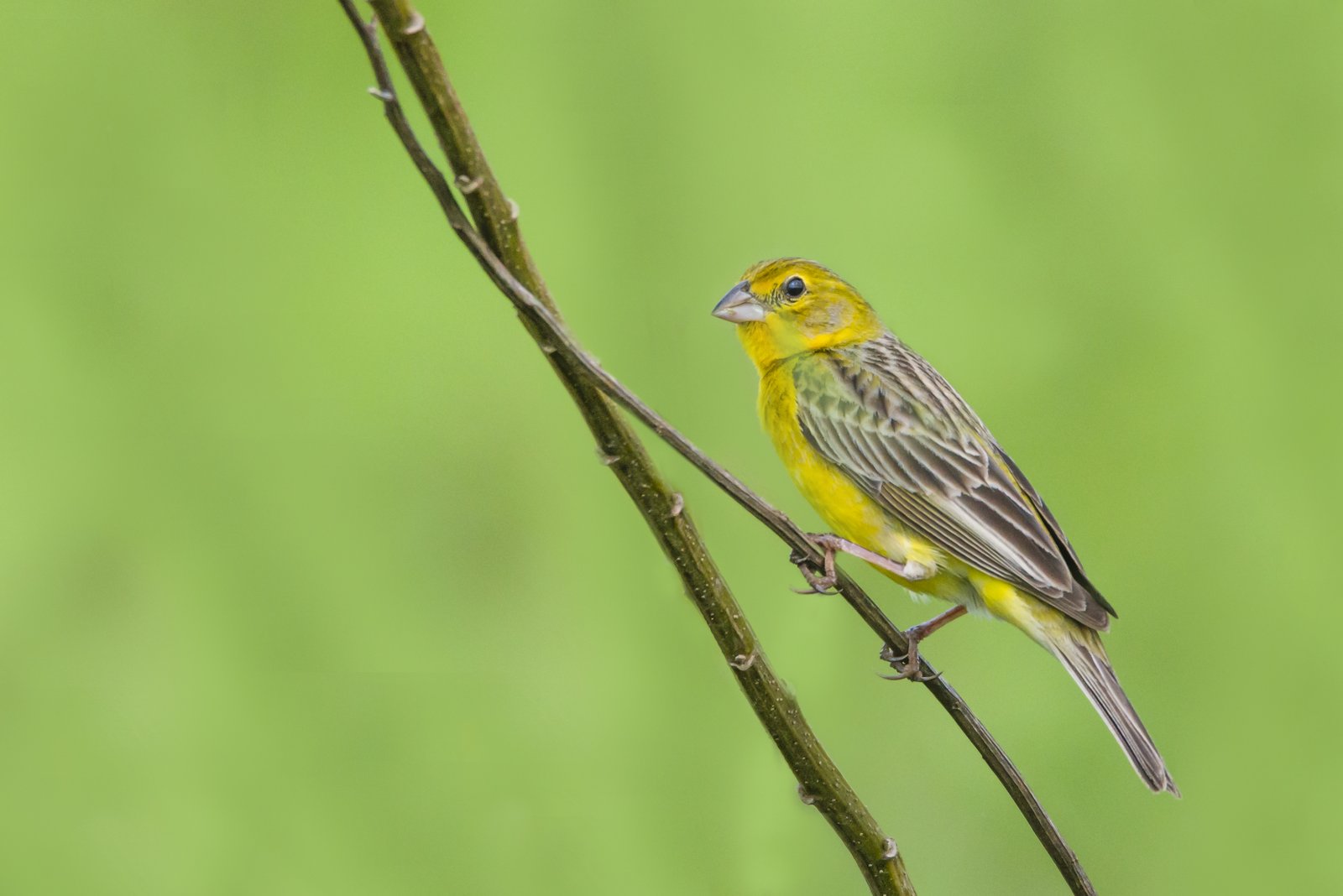
The Grassland Yellow Finch is a small, streaked yellow finch of open grassland. In the Caribbean it has a twofold origin: on Barbados and some other islands of the Lesser Antilles it probably descends from birds released on Barbados around 1900, whereas it reached Trinidad on its own from Venezuela.
Voice
The call is a sharp te-tsip, often given in flight. The song is a series of chips, buzzes and trills, delivered from a stem or bush or in a display flight over the grassland.
Recording: Mateus Gonçalves Santos — CC BY-NC-SA 4.0 · shortened to the first 60 s, mono · xeno-canto
Identification
11–12.5 cm, small, with a short, conical bill. The male is olive-brown above, with dark streaks on crown, nape and back, and has a yellow rump. Around the eye and on the lores it is bright yellow; the underparts are yellow, with an olive wash on the breast. The female is pale brown above with dark streaks and duller, pale yellow below. Juveniles are browner and more washed-out yellow, with fine streaks on the breast.
Confusion species
Saffron Finch Sicalis flaveola is larger, has an orange forehead and crown and an almost unstreaked yellow back. Female Yellow-bellied Seedeater Sporophila nigricollis has a shorter, thicker bill, an unstreaked olive-brown back and a pale yellowish belly. The yellow around the eye and the streaked back separate Grassland Yellow Finch from other small yellow birds.
Habitat
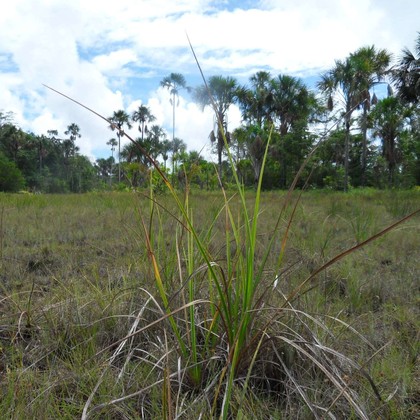
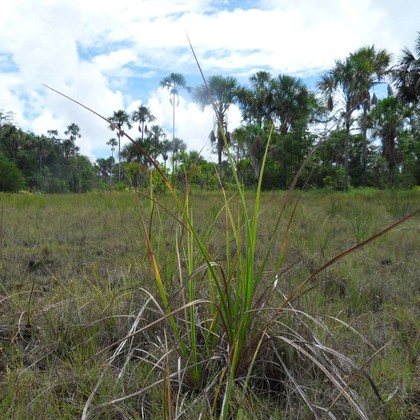
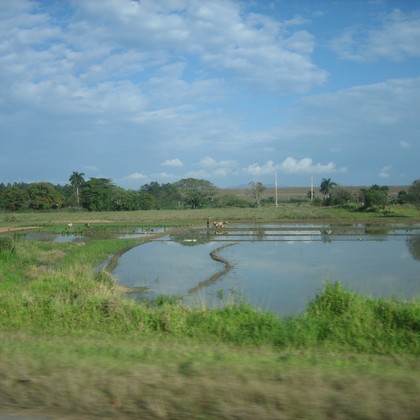
Open grassland, savanna, pastures, fields and rank areas with tall grass, also the edges of marshes and wet grassland. It searches the ground and the grass for seeds. Outside the breeding season it is often in flocks, sometimes with other seedeaters. The nest is placed low in a grass tussock.
Where the bird is most at home, classified by the vegetation types of the Caribbean.


Range and movements
Introduced to Barbados, according to the literature probably around 1900, and locally common there since. From there or through further introductions it became established on Martinique, St. Lucia, St. Vincent and Grenada; there are also records from Guadeloupe and Antigua. On Trinidad first recorded around 2004, probably after natural colonisation from Venezuela, and now locally present in open grassland and farmland. Elsewhere in South America from Colombia and the Guianas to Argentina, with isolated populations in Central America and Mexico; birds from the south of the range move north in the austral winter.
- Resident
- Winter visitor (c. Apr–Sep)
- Passage (Mar–Apr, Oct–Nov)
- dark = core range, pale = thinly spread
How and when to look
On Barbados in grassland, pastures and rough field margins in the lowlands. The birds often sit low in the grass and flush only at short range; the yellow rump and sharp flight call then help with identification.
Conservation status
Not threatened. The species has a large range and benefits from the clearing of forest for pasture and fields. In the Lesser Antilles it is an introduced species.
Scientific name
Sicalis luteola | (Sparrman, 1789)
Sparrman described the species in 1789 as Emberiza luteola; because it was later moved to another genus, the author and year stand in brackets. The genus Sicalis was introduced in 1828 by Boie. Sicalis comes from Greek sikalis, a small black-headed bird mentioned by Aristotle and Epicharmus, perhaps a Sylvia warbler. luteola is a diminutive of Latin luteus 'saffron-yellow', after the yellow plumage. The specimen the first description was based on came from not stated.