All species › Passerines › Tanagers › Saffron Finch
Saffron Finch | Sicalis flaveola
Gewone saffraangors | Chirigüe azafranado
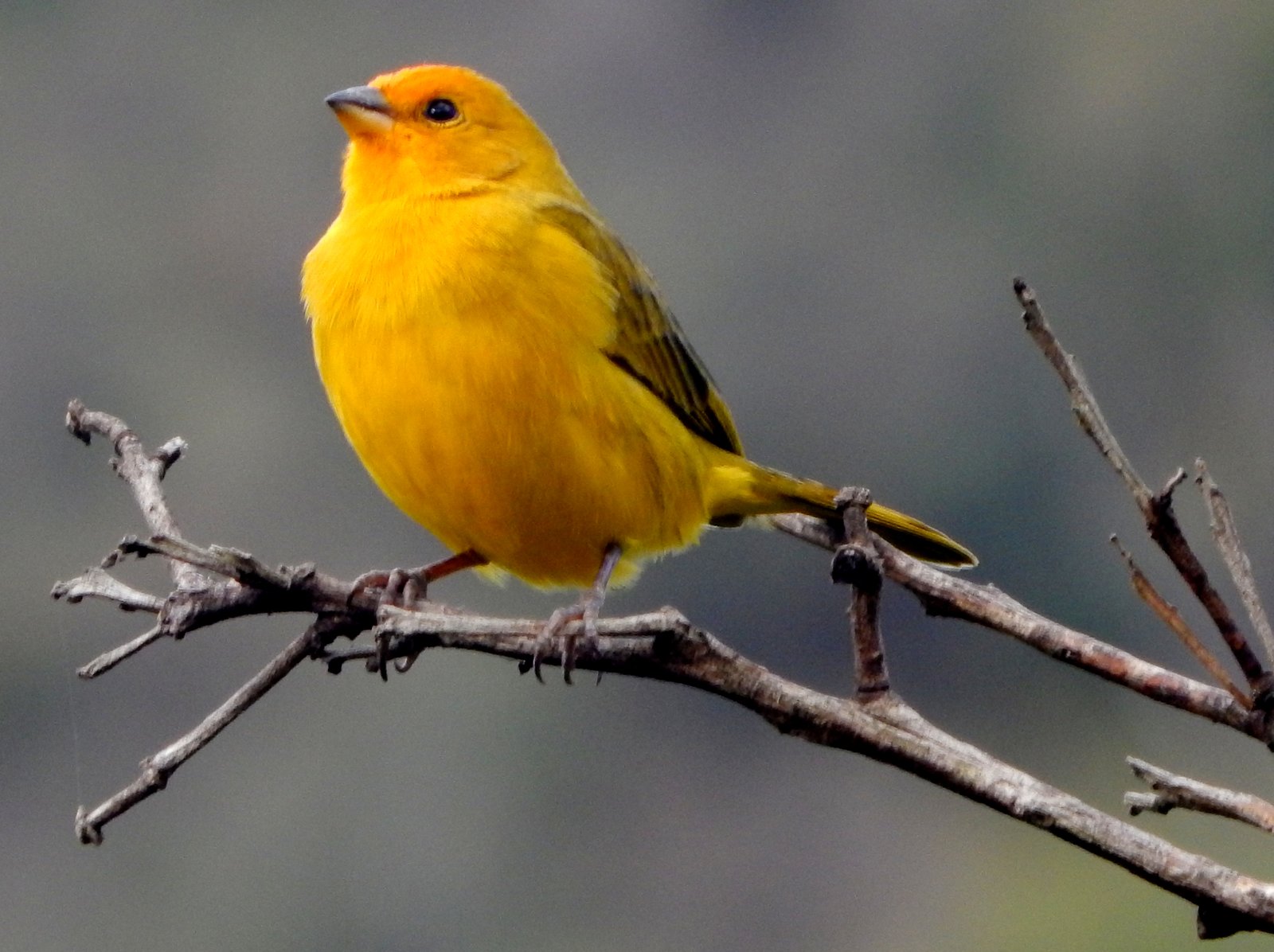
The Saffron Finch is a yellow, sparrow-like finch of lawns, yards and open ground. Its natural range in the region is limited to Trinidad, but as a popular cage bird it has been introduced or has escaped on several islands and become established there. It is not shy and often feeds in small groups on the ground, even in the middle of villages and towns. In Venezuela it is called canario de tejado.
Voice
The call is a short, clear pink or tsip. The song is a series of repeated chirping and whistled notes, often given from a roof, post or wire; the species is kept as a cage bird for this song.
Recording: Jacob Wijpkema — CC BY-NC-SA 4.0 · shortened to the first 60 s, mono · xeno-canto
Identification
13–15 cm, compact, with a short, conical bill. The male is bright yellow with an orange forehead and crown; the back is olive-yellow with faint dark streaks, wings and tail are dark with yellow edges. In northern birds the female resembles the male but is duller and less orange on the head. Juveniles are grey-brown and lightly streaked, with a yellow band across the breast and yellow undertail; they become yellower gradually, so mixed-coloured birds are often seen.
Confusion species
Grassland Yellow Finch Sicalis luteola is smaller, has a clearly streaked brown back and crown, and lacks the orange on the head. Mangrove Warbler Setophaga petechia has a thin bill and searches trees and shrubs for insects rather than the ground for seeds. Young Saffron Finches are told from other grey-brown finches by the yellow breast band.
Habitat
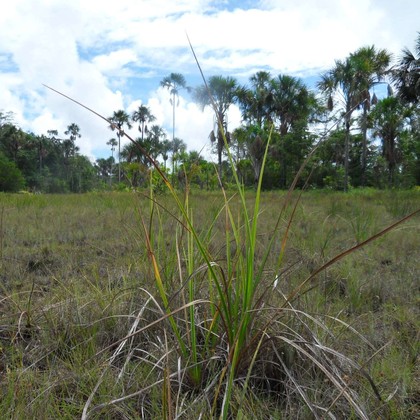
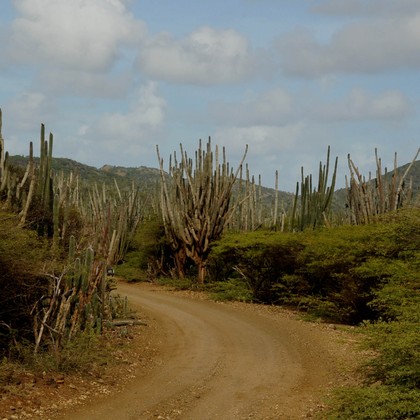
Open and semi-open lowlands: lawns, parks, yards, pastures, roadsides and the edges of dry scrub; on the ABC Islands also in and around thorn scrub. It searches the ground for grass and weed seeds and also eats small insects. Outside the breeding season it is found in small groups. It nests in cavities: abandoned nests of other birds, hollow branches and bamboo, and often under roof tiles or in holes in buildings.
Where the bird is most at home, classified by the vegetation types of the Caribbean.


Range and movements
On Trinidad a resident of the nominate form flaveola, which also occurs in Colombia, Venezuela and the Guianas. Introduced to Jamaica, according to the literature as early as the nineteenth century, and now locally common in the lowlands. Introduced and established on Puerto Rico, including the urban area around San Juan. Common on Curaçao and Bonaire, scarce on Aruba; whether these populations arose from escaped cage birds or from natural colonisation from the mainland is not known for certain. There are a few isolated reports from the Cayman Islands and the Bahamas, probably of escaped birds. Outside the region across most of South America outside the Amazon Basin; also introduced to Panama and Hawaii.
- Resident
- dark = core range, pale = thinly spread
How and when to look
On Curaçao and Bonaire it is often seen on hotel lawns, in gardens and in yards. On Puerto Rico and Jamaica the birds are found mainly on mown grass in and around built-up areas. Groups with young birds consist of a mix of grey-brown, streaked and yellow individuals.
Conservation status
Not threatened. The species has a large range and benefits from open, man-made landscapes. In many places birds are trapped for the cage-bird trade. On Jamaica and Puerto Rico it is an introduced species.
Scientific name
Sicalis flaveola | (Linnaeus, 1766)
Linnaeus described the species in 1766 as Fringilla flaveola; because it was later moved to another genus, the author and year stand in brackets. The genus Sicalis was introduced in 1828 by Boie. Sicalis comes from Greek sikalis, a small black-headed bird mentioned by Aristotle and Epicharmus, perhaps a Sylvia warbler. flaveola is a diminutive of Latin flavus 'golden-yellow', after the bright yellow plumage. The specimen the first description was based on came from Suriname (designated later).