All species › Passerines › Vireos › Golden-fronted Greenlet
Golden-fronted Greenlet | Pachysylvia aurantiifrons
Goudvoorhoofdvireo | Verdillo luisucho
The Golden-fronted Greenlet is a small, active vireo of forest and forest edge in Panama, Colombia and Venezuela. In the Caribbean it occurs only in Trinidad, where it is a fairly common resident. It likes to forage in mixed flocks with other small birds in the canopy.
Voice
The song is a short, quick, semi-musical phrase often repeated over and over, rendered as de-wichy-de-wheter. Calls include a double chee-vee and a chattering or chirping note.
Recording: Pedro Luis Castillo — CC BY-NC-SA 4.0 · converted to mono · xeno-canto
Identification
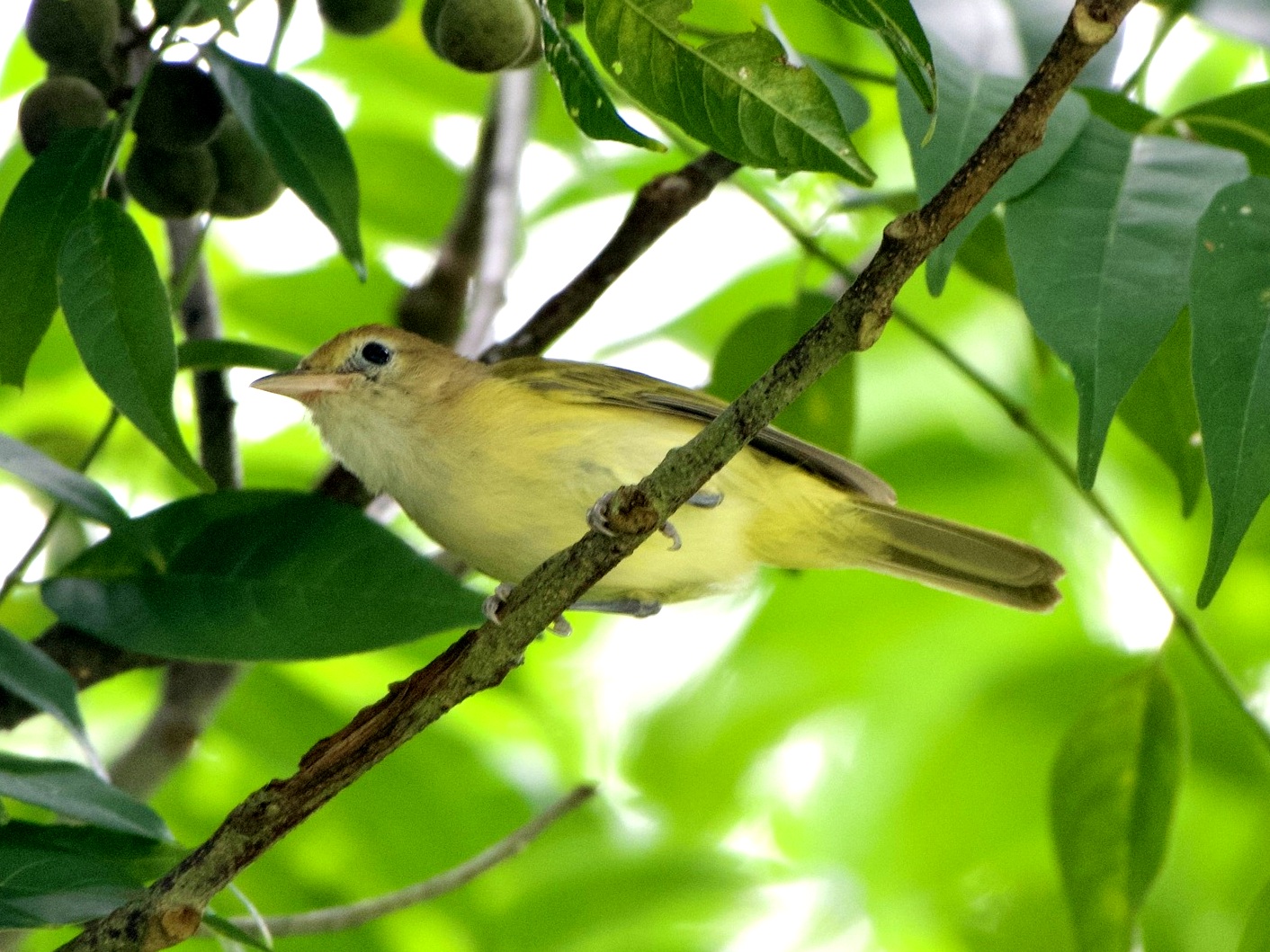
11–12 cm, small and compact, with a short tail and a thin, pale bill. The forehead is ochre-yellow, the crown brownish, the upperparts brownish olive-green. Chin and throat are pale buff, breast and belly yellow with an ochre wash, brightest on the breast. Wings without wingbars. The iris is dark, the legs grey-brown. Trinidad birds belong to the subspecies saturata, which is brighter yellow below than the nominate. The sexes are alike.
Confusion species
Red-eyed Vireo Vireo olivaceus is larger, with a grey crown, a black-bordered white eyebrow, a red iris and white underparts. Scrub Greenlet Hylophilus flavipes is more similar but lives only on Tobago and has a pale iris and a greyer head. Female American Yellow Warblers Setophaga aestiva are more uniformly yellow and have yellow edges to the wing feathers.
Habitat
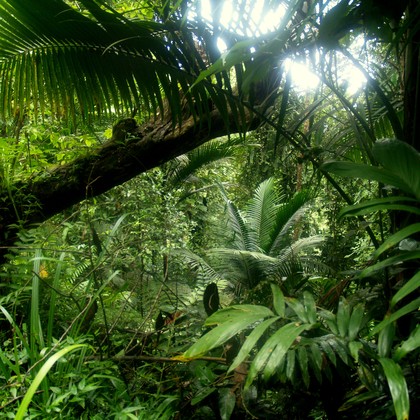
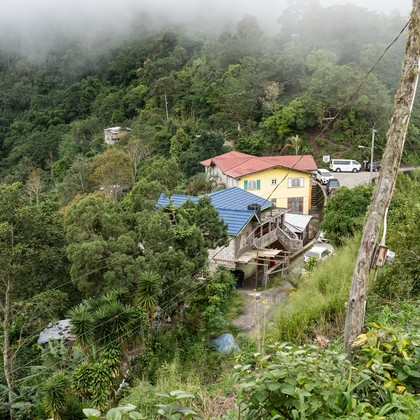
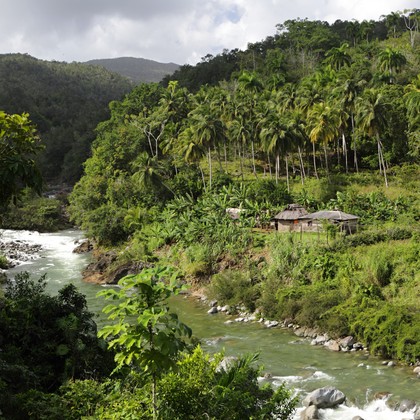
Deciduous, semi-evergreen and moist forest, secondary growth, edges of evergreen forest, shaded cacao plantations and gardens with trees, from sea level into the hills. It searches actively among leaves and thin twigs in the middle and upper levels for small insects, often in mixed flocks with warblers, tanagers and other small birds.
Where the bird is most at home, classified by the vegetation types of the Caribbean.



Range and movements
In the region only in Trinidad, where it is widespread wherever there is forest or trees. It is absent from Tobago, where Scrub Greenlet lives instead. Outside the region from Panama through northern Colombia to Venezuela.
- Resident
- dark = core range, pale = thinly spread
How and when to look
Mixed flocks of small birds at forest edges and in cacao plantations are the place to look, for example in the Arima Valley. The constantly repeated short phrase gives away a singing bird; the yellow forehead then shows as soon as it pauses.
Conservation status
Not threatened. The species is fairly common across its range and tolerates secondary forest and plantations. In Trinidad its nests are regularly parasitised by Shiny Cowbird.
Scientific name
Pachysylvia aurantiifrons | (Lawrence, 1861) (GBIF: Hylophilus aurantiifrons)
Lawrence described the species in 1861 as Hylophilus aurantiifrons; because it was later moved to another genus, the author and year stand in brackets. The genus Pachysylvia was introduced in 1850 by Bonaparte. Pachysylvia combines Greek pakhus 'thick, stout' with the genus Sylvia (warblers), after the stocky build. aurantiifrons is Latin, from aurantius 'orange' and frons 'forehead', after the golden forehead. The specimen the first description was based on came from along the Panama Railroad, Panama.