All species › Passerines › Vireos › Scrub Greenlet
Scrub Greenlet | Hylophilus flavipes
Struikvireo | Verdillo matorralero
The Scrub Greenlet is a small, plainly coloured vireo of dry thickets and forest edge in southern Central America and northern South America. In the Caribbean it lives only in Tobago, as its own subspecies insularis. It is absent from Trinidad, where the related Golden-fronted Greenlet occurs.
Voice
On Tobago the song is a musical series of four to more than twenty equal, clear notes on one pitch, such as chew-chew-chew-chew. Also a nasal, scolding nyeh-nyeh. It sings mainly in the morning.
Recording: Johan Chaves — CC BY-NC-SA 4.0 · shortened to the first 60 s, mono · xeno-canto
Identification
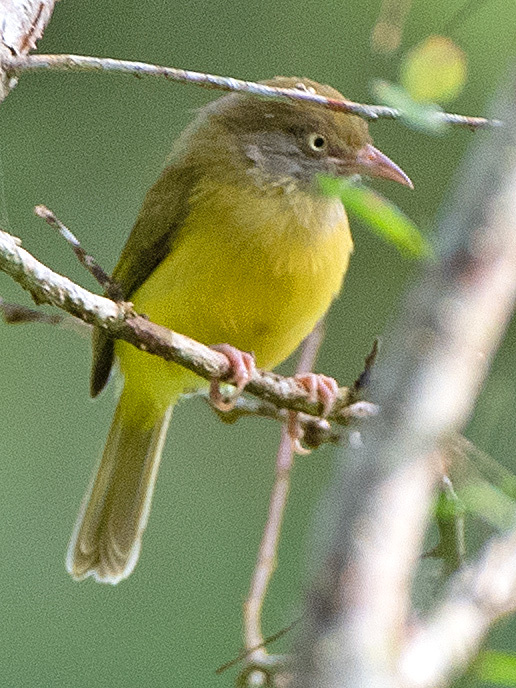
11–12 cm, small and slim, with a fairly long, pointed bill that is pale below. Tobago birds are greyer than mainland ones: crown and upperparts dull olive-grey to olive-green, the sides of the head pale grey without clear markings. Wings grey-black with greenish edges and no wingbars. Throat and breast greyish white, belly pale yellow. The iris is pale, the legs pale pinkish to yellowish. The sexes are alike.
Confusion species
Red-eyed Vireo Vireo olivaceus, a breeding bird on Tobago, is larger, with a grey crown, a black-bordered white eyebrow and a dark eyestripe. Females of American Yellow Warbler Setophaga aestiva and Mangrove Warbler Setophaga petechia are yellower, with a short, sharp bill and yellow edges to the wing feathers. No other small vireo occurs on Tobago.
Habitat
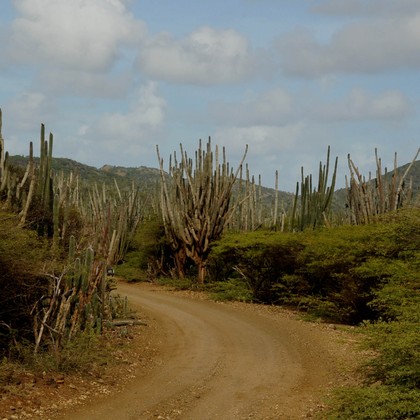
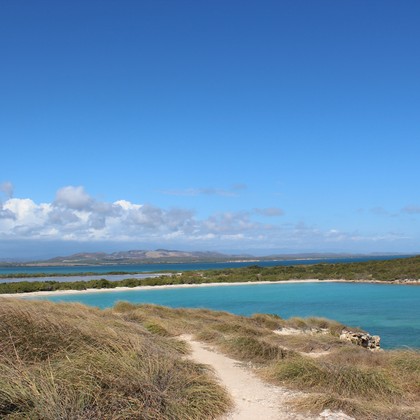
Low, dense scrub, dry and semi-evergreen secondary forest, forest edge, coastal woodland and overgrown plots with bushes, mainly in the lowlands. It forages in pairs or small groups, often with other species, in the lower and middle levels, searching twigs and leaves for small insects and spiders.
Where the bird is most at home, classified by the vegetation types of the Caribbean.





Range and movements
In the region only in Tobago, where it occurs throughout the island in scrub and forest edge. Outside the region in Costa Rica, Panama, Colombia and Venezuela.
- Resident
- dark = core range, pale = thinly spread
How and when to look
On Tobago it can be found in almost any patch of scrub and secondary forest, for example along roads in the dry south-west and on the slopes around the Main Ridge forest. The series of equal notes is the best lead; the bird then gives itself away by moving in the bushes.
Conservation status
Not threatened. Common on Tobago, and the species tolerates disturbed, secondary scrub well.
Scientific name
Hylophilus flavipes | de Lafresnaye, 1845
De Lafresnaye described the species in 1845 and placed it straight away in the genus where it still stands. The genus Hylophilus was introduced in 1822 by Temminck. Hylophilus is Greek, from hulē 'woodland' and philos 'loving': 'woodland-lover'. flavipes is Latin, from flavus 'yellow' and pes 'foot', after the pale yellowish legs. The specimen the first description was based on came from Bogotá, Colombia.