All species › Passerines › Vireos › Philadelphia Vireo
Philadelphia Vireo | Vireo philadelphicus
Philadelphiavireo | Vireo de Filadelfia
The Philadelphia Vireo breeds in deciduous and mixed forest in southern Canada and the far north-east of the United States and winters in Central America. Most birds migrate via Mexico or across the Gulf of Mexico, so the Caribbean lies just outside the main route. In the Bahamas, Cuba, Jamaica and the Cayman Islands it is a rare passage migrant and winter visitor; further east it is a vagrant.
Voice
The song, rarely heard in the region, is very like that of Red-eyed Vireo: short whistled phrases separated by pauses, but slightly higher and slower. The call is a nasal, descending meeah and a short, raspy chatter.
Recording: Stanislas Wroza — CC BY-NC-SA 4.0 · shortened to the first 60 s, mono · xeno-canto
Identification
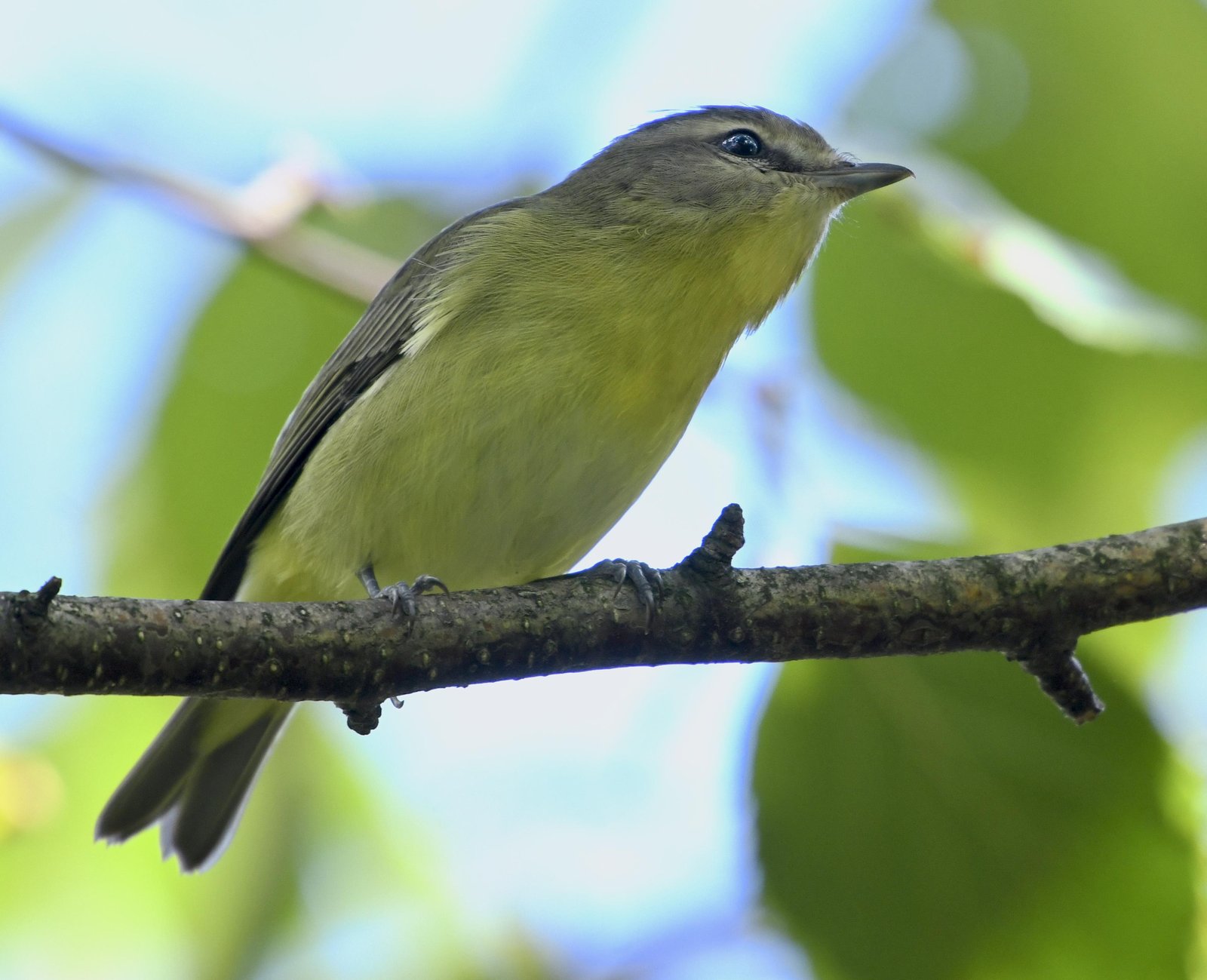
12–13 cm, small and compact for a vireo, with a rounded head and a short, fairly thick bill. Crown grey, upperparts grey-olive, without wingbars. A white eyebrow is bordered below by a dark eyestripe that also crosses the lores. Underparts pale yellow, brightest on the throat and centre of the breast; autumn birds in particular can be almost white with only a yellow tinge. Iris dark. No eye-ring. The sexes are alike.
Confusion species
Tennessee Warbler Leiothlypis peregrina has a thinner, sharper bill, white undertail coverts and often a paler face, and is more restless. Red-eyed Vireo Vireo olivaceus and Black-whiskered Vireo Vireo altiloquus are larger and slimmer, with a longer bill, a black-bordered white eyebrow and white underparts with at most yellow flanks and undertail coverts; Black-whiskered also has a dark malar stripe. In Philadelphia Vireo the throat is the yellowest part, in those species it is white.
Habitat
On migration and in winter at forest edges, in dry and semi-evergreen forest, coastal woodland and gardens and parks with trees. It searches the upper levels for insects, often in mixed flocks with warblers.
Where the bird is most at home, classified by the vegetation types of the Caribbean.




Range and movements
Rare passage migrant and winter visitor in the Bahamas, Cuba, the Cayman Islands and Jamaica, with most records in October and in spring. Vagrant to Hispaniola, Puerto Rico and a few other islands. Breeds from eastern British Columbia to Newfoundland and in northern New England, and winters from southern Mexico to Panama and extreme north-western Colombia.
- Summer visitor (c. Oct–Mar)
- Winter visitor (c. Apr–Sep)
- Passage (Mar–Apr, Oct–Nov)
- dark = core range, pale = thinly spread
How and when to look
The best chance is during autumn migration in Cuba and on Grand Cayman, among flocks of migrant warblers and vireos at forest edges. A small vireo with a yellow throat, dark lores and no wingbars is worth a careful look and a photograph.
Conservation status
Not threatened. The population is large and appears stable. In the Caribbean the species is scarce and irregular.
Scientific name
Vireo philadelphicus | (Cassin, 1851)
Cassin described the species in 1851 as Vireosylvia philadelphica; because it was later moved to another genus, the author and year stand in brackets. The genus Vireo was introduced in 1808 by Vieillot. Vireo was used by Latin authors for a small, green, migratory bird, probably the Eurasian golden oriole, though the European greenfinch has also been suggested. philadelphicus refers to Philadelphia, Pennsylvania, where the species was discovered in 1842. The specimen the first description was based on came from near Philadelphia, Pennsylvania.