All species › Passerines › Thrushes › Eastern Red-legged Thrush
Eastern Red-legged Thrush | Turdus ardosiaceus
Oostelijke roodpootlijster | Zorzal patirrojo oriental
The Eastern Red-legged Thrush is the eastern half of what was long treated as a single species, the Red-legged Thrush. On the basis of differences in plumage and genetics it was split in 2025 from the Western Red-legged Thrush of the Bahamas, Cuba and the Cayman Islands. It is a noisy, fairly tame thrush that often hops over the ground with its tail raised.
Voice
The song is a slow series of short, varied phrases of one to three notes, recalling that of Pearly-eyed Thrasher. Calls include a low wet-wet, a loud chu-week and a rapid, high chatter when disturbed. In Hispaniola it is named chuá-chuá after its call.
Recording: sofiamm_ — CC BY-NC 4.0 · Converted to mp3, mono, full length · iNaturalist
Identification
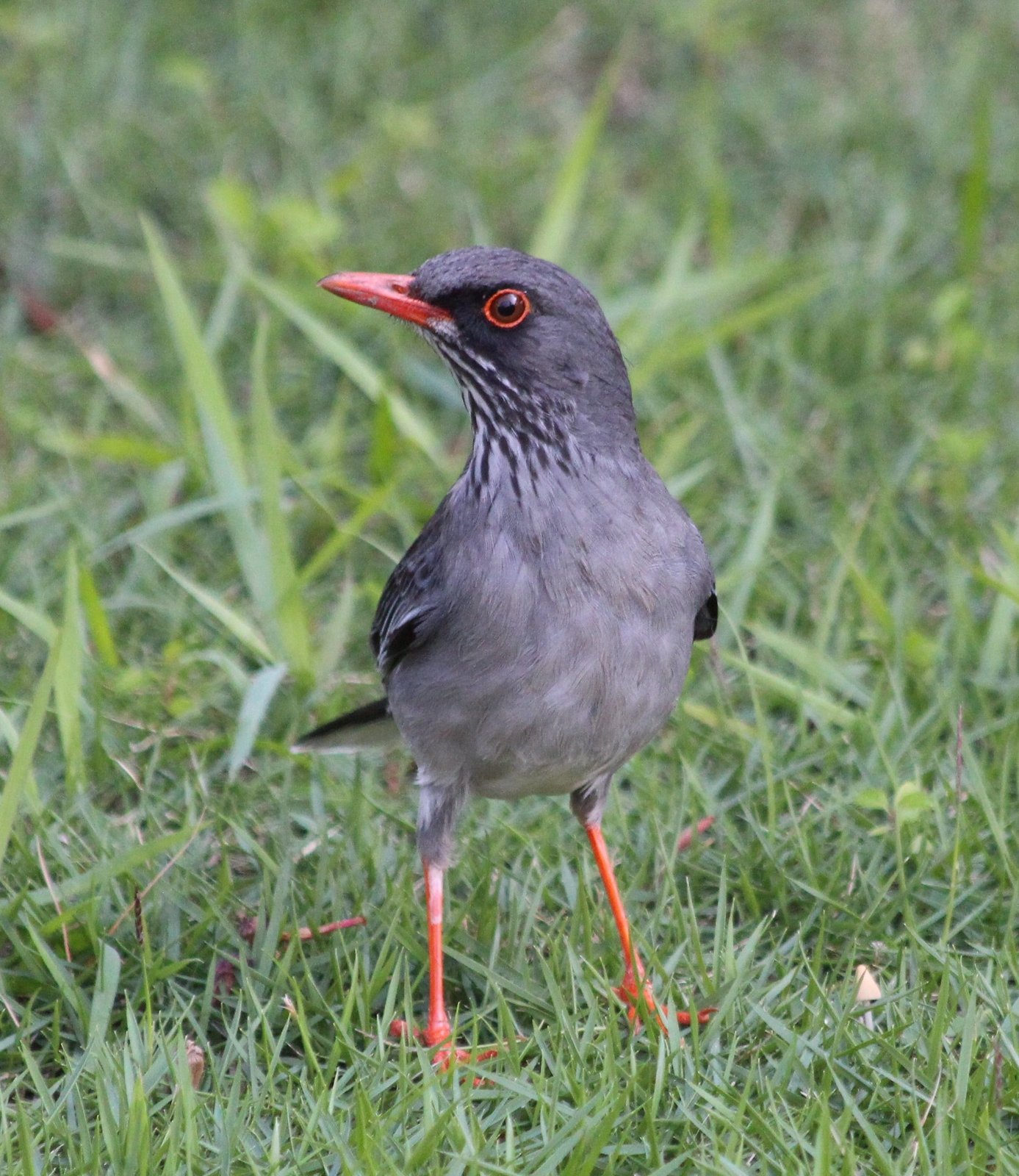
25–28 cm, a large, long-tailed thrush. The upperparts are slate grey, the throat white with black streaks, the breast grey and the belly white. Bill, eye-ring and legs are orange-red. The tail is dark with white tips to the outer feathers, visible in flight and when fanned. The sexes are alike. In Dominica (subspecies albiventris) the belly is brighter white. Juveniles are duller, with dark spots on the breast and a dark bill.
Confusion species
Western Red-legged Thrush Turdus plumbeus does not share the same range; Cuban birds have an orange-tinged belly. In Hispaniola, La Selle Thrush Turdus swalesi has a blackish head, a rufous belly and no orange legs; it lives only in high montane forest. In Dominica, Forest Thrush Turdus lherminieri is brown with white scaling on the breast and a yellow eye-ring. Pearly-eyed Thrasher Margarops fuscatus is brown, with a white iris and a streaked breast.
Habitat
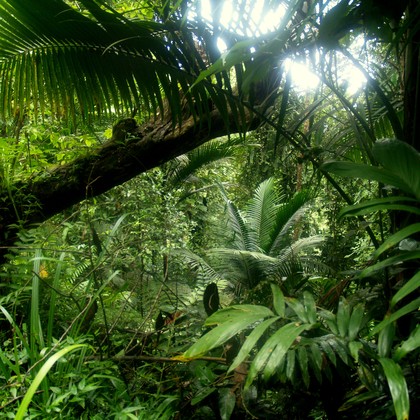
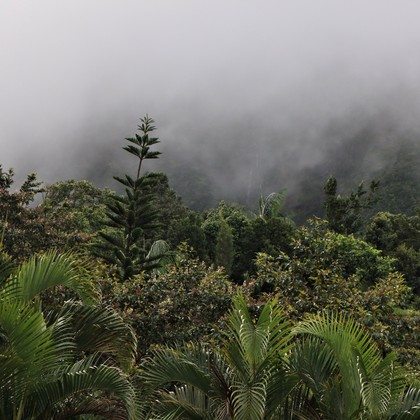
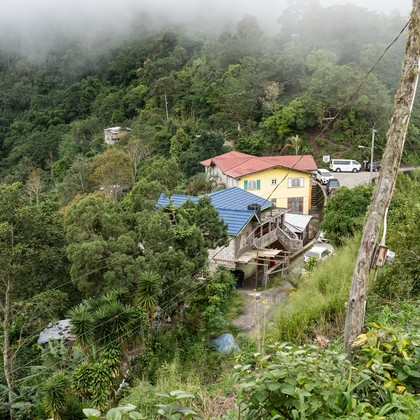
Forest of almost every type, from dry lowland and limestone forest to moist montane forest, as well as coffee plantations, scrub, gardens and parks with trees. It often forages on the ground and in the lower storeys. It eats mainly fruit; about a third of its diet consists of insects, snails, frogs, lizards and occasionally the eggs of other birds. The nest is a cup of grass and leaves in a tree, palm or bromeliad.
Where the bird is most at home, classified by the vegetation types of the Caribbean.




Range and movements
Resident in Hispaniola (Haiti and the Dominican Republic, with Gonâve and Tortuga), Puerto Rico and Dominica. Dominica holds the subspecies albiventris, the other islands the nominate form. The species does not occur outside these islands.
- Resident
- dark = core range, pale = thinly spread
How and when to look
In Puerto Rico common in the northern karst region and in El Yunque, also at picnic areas and along roads. In Dominica often seen on forest trails in the Morne Trois Pitons area. Birds are most active at dawn and after rain, when they forage on open ground.
Conservation status
Not threatened. The species is common on most islands and tolerates secondary forest, plantations and gardens. Thrushes are hunted locally, and deforestation in Haiti limits its habitat.
Scientific name
Turdus ardosiaceus | Vieillot, 1822
Vieillot described the species in 1822 and placed it straight away in the genus where it still stands. The genus Turdus was introduced in 1758 by Linnaeus. Turdus is the ordinary Latin word for 'thrush'. ardosiaceus is New Latin, from French ardoise 'slate', after the slate-grey plumage. The specimen the first description was based on came from Hispaniola.