All species › Passerines › Tyrant flycatchers › Eastern Phoebe
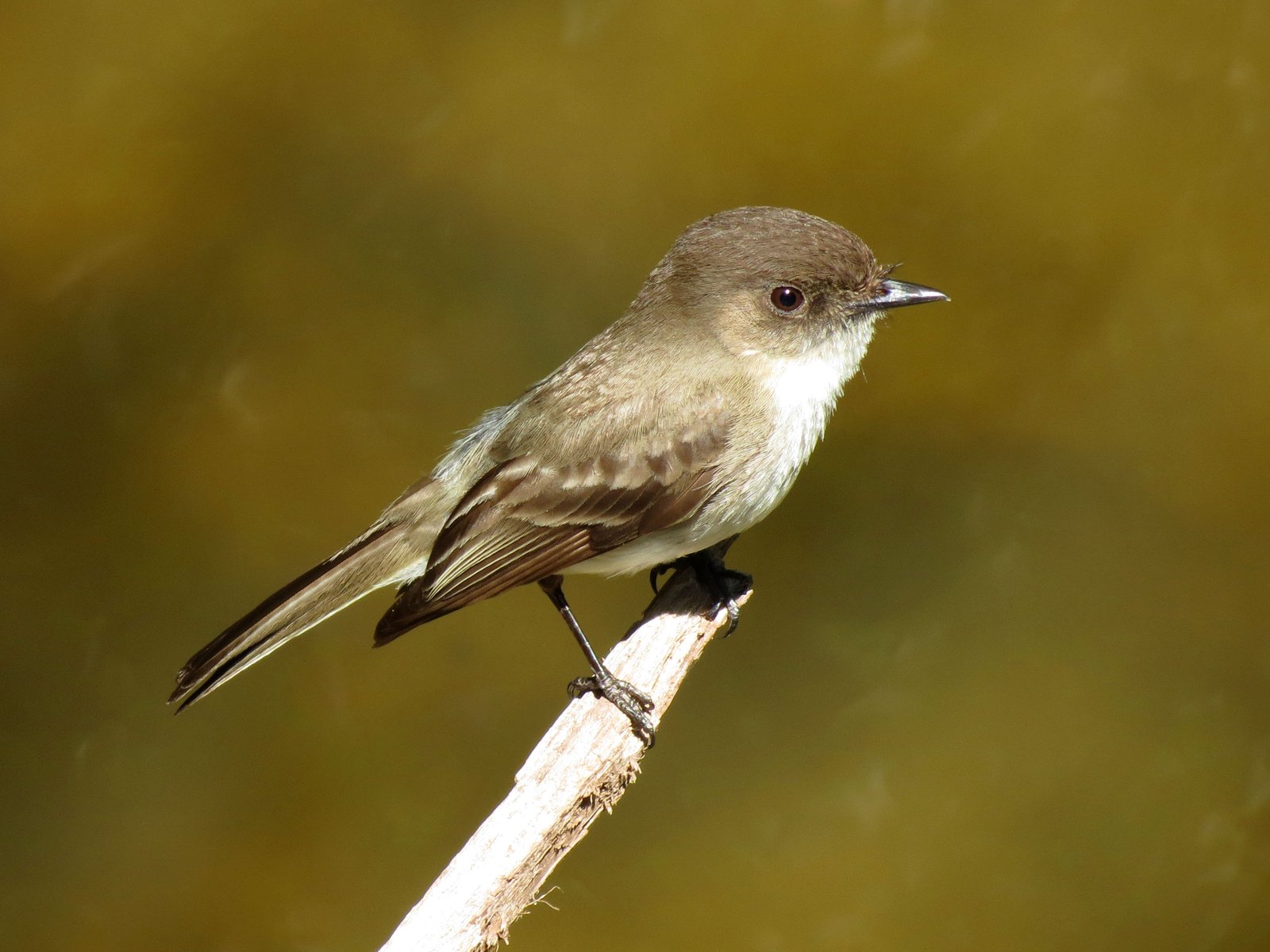
Eastern Phoebe | Sayornis phoebe
Oostelijke phoebe | Mosquero fibí
The Eastern Phoebe is a flycatcher of eastern North America that returns early in spring and leaves late in autumn. It winters mainly in the south-eastern United States and Mexico, so the Caribbean lies just outside its normal winter range. In the north-western Antilles a few birds appear occasionally in winter.
Voice
The call is a sharp, short chip, also given in winter. The song, a hoarse fee-bee that gives the species its name, is rarely heard on the wintering grounds.
Recording: Jim Berry — CC BY-NC-SA 4.0 · shortened to the first 60 s, mono · xeno-canto
Identification
14–17 cm, with a large head that looks even bigger when the slight crest is raised. The upperparts are grey-brown, the head darker sooty brown, without an eye-ring. The wing bars are faint, pale buff in young birds. The throat is white, the breast dusky grey at the sides, the belly whitish; birds in fresh autumn plumage often show a yellowish wash on the belly. The bill is all black. A constant downward pumping of the tail is characteristic.
Confusion species
Eastern Wood-Pewee Contopus virens has longer wings with distinct wing bars, a pale lower mandible and a dark breast band, and does not pump its tail. Cuban Pewee Contopus caribaeus of Cuba and the Bahamas is smaller, with a white crescent behind the eye and buffy underparts. Least Flycatcher Empidonax minimus is smaller, with a white eye-ring and distinct wing bars.
Habitat
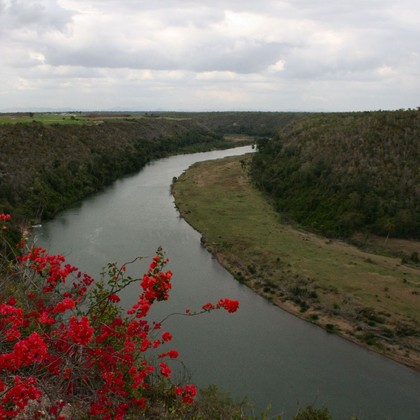
In winter open country with scattered trees near water: the banks of streams and ponds, farmland, gardens and woodland edges. It hunts flying insects from a low perch and in winter also eats berries. On the breeding grounds it nests under bridges, rock overhangs and eaves, in a nest of mud and moss.
Where the bird is most at home, classified by the vegetation types of the Caribbean.



Range and movements
A rare winter visitor to the Bahamas, mainly the northern islands, and a very rare winter visitor to Cuba and the Cayman Islands, mostly from October to March. Not recorded elsewhere in the region. Breeds in eastern and central North America, from Canada to the southern United States, and winters from the south-eastern United States to Mexico.
- Winter visitor (c. Apr–Sep)
- dark = core range, pale = thinly spread
How and when to look
A grey-brown flycatcher sitting on a post, fence or branch near water in winter and constantly pumping its tail is worth checking, especially in the northern Bahamas and western Cuba. The tail-pumping and lack of an eye-ring separate it from pewees and Empidonax flycatchers.
Conservation status
Not threatened. The species is common on its breeding grounds, where it benefits from bridges and buildings as nest sites.
Scientific name
Sayornis phoebe | (Latham, 1790)
Latham described the species in 1790 as [Muscicapa] Phoebe; because it was later moved to another genus, the author and year stand in brackets. The genus Sayornis was introduced in 1854 by Bonaparte. Sayornis honours the American naturalist Thomas Say (1787–1834), via Bonaparte's Muscicapa saya, with Greek ornis 'bird': 'Say's bird'. phoebe is another name for the moon goddess Diana, but probably mainly imitates the 'fee-bee' call. The specimen the first description was based on came from New York.