All species › Passerines › Tyrant flycatchers › Euler's Flycatcher
Euler's Flycatcher | Lathrotriccus euleri
Eulers tiran | Mosquero de Euler
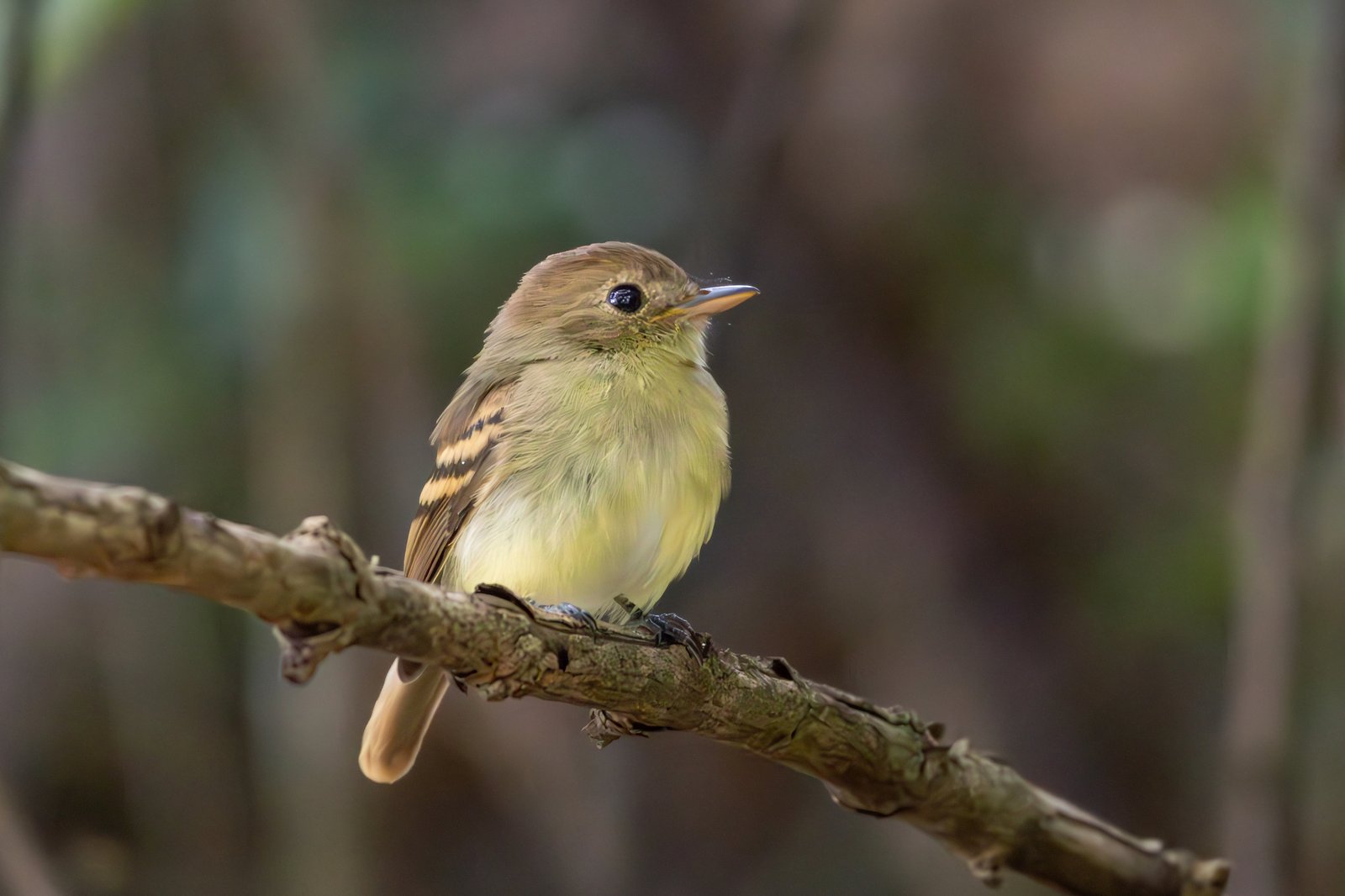
Euler's Flycatcher is a small olive-brown flycatcher of the lower storey of humid forest in South America, closely related to the Empidonax species. Within the region it lives in Trinidad. Grenada had its own subspecies, flaviventris, which has not been recorded since 1950 and is considered extinct.
Voice
In Venezuela an abrupt, almost explosive feeu, repeated from a hidden perch. Elsewhere in the range two-syllabled, descending variants are given.
Recording: Juan Freile — CC BY-NC-SA 4.0 · converted to mono · xeno-canto
Identification
12.5–13.5 cm, with a rather large head and a short tail. The upper mandible is black, the lower dull pinkish. Crown, nape, cheeks and upperparts are warm olive-brown, the rump browner. There is a whitish eye-ring and a pale line above the lores. The wings are dark with two pale buffy wing bars. The throat is greyish white, the breast brownish olive, the belly pale yellow to white. The sexes are alike.
Confusion species
Fuscous Flycatcher Cnemotriccus fuscatus is slightly larger and longer-tailed, more rufous-brown, and has a clear white supercilium instead of an eye-ring. Tropical Pewee Contopus cinereus is greyer, without an eye-ring, longer-winged, and uses higher, open perches. Willow Flycatcher Empidonax traillii, a very rare visitor to Trinidad, is greyer olive with a whiter throat and a faint eye-ring.
Habitat
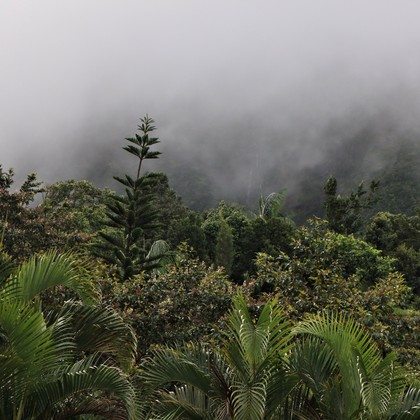
The lower and middle storey of humid primary and secondary forest and forest edges, in Trinidad mainly in the valleys and lower slopes of the Northern Range. It catches insects with short sallies from a sheltered perch in the shade. The nest is an open cup in a crevice or cavity of a tree or among epiphytes.
Where the bird is most at home, classified by the vegetation types of the Caribbean.


Range and movements
Within the region an uncommon resident in Trinidad, mainly in the Northern Range; not on Tobago. Extirpated from Grenada, with the last record in 1950. Outside the region across much of South America, from Colombia, Venezuela and the Guianas to Bolivia, Paraguay, northern Argentina, Uruguay and south-eastern Brazil; southern populations move north in the austral winter.
- Resident
- Summer visitor (c. Oct–Mar)
- Winter visitor (c. Apr–Sep)
- Passage (Mar–Apr, Oct–Nov)
- dark = core range, pale = thinly spread
How and when to look
In Trinidad best looked for in the lower Arima Valley and other valleys of the Northern Range, low in the shade along forest trails. Careful scanning of the undergrowth is needed; the call often gives away its position.
Conservation status
Not globally threatened, although the overall population is declining. The Grenada subspecies flaviventris probably disappeared through deforestation. In Trinidad the species depends on the forests of the Northern Range.
Scientific name
Lathrotriccus euleri | (Cabanis, 1868)
Cabanis described the species in 1868 as Empidochanes Euleri; because it was later moved to another genus, the author and year stand in brackets. The genus Lathrotriccus was introduced in 1986 by Lanyon & Lanyon. Lathrotriccus is Greek, from lathrios 'hidden' and trikkos 'small bird': the species long lay 'hidden' within the genus Empidonax. euleri honours Carl Hieronymus Euler (1834–1901), Swiss settler in Brazil, vice-consul in Rio de Janeiro and amateur ornithologist. The specimen the first description was based on came from Cantagalo, Rio de Janeiro, Brazil.