All species › Passerines › Tyrant flycatchers › Acadian Flycatcher
Acadian Flycatcher | Empidonax virescens
Beukenfeetiran | Mosquero verdoso
The Acadian Flycatcher is the largest of the Empidonax flycatchers of eastern North America. It breeds in shady deciduous forest, often along streams, and migrates through Mexico and the western Caribbean to its wintering grounds in Central America and north-western South America. In Cuba it is the most frequently recorded Empidonax during migration.
Voice
The call, also given on migration, is a soft peet. The song is an explosive peet-sa, in the region heard mainly in spring and then rarely.
Recording: Mario Reyes Jr — CC BY-NC-SA 4.0 · converted to mono · xeno-canto
Identification
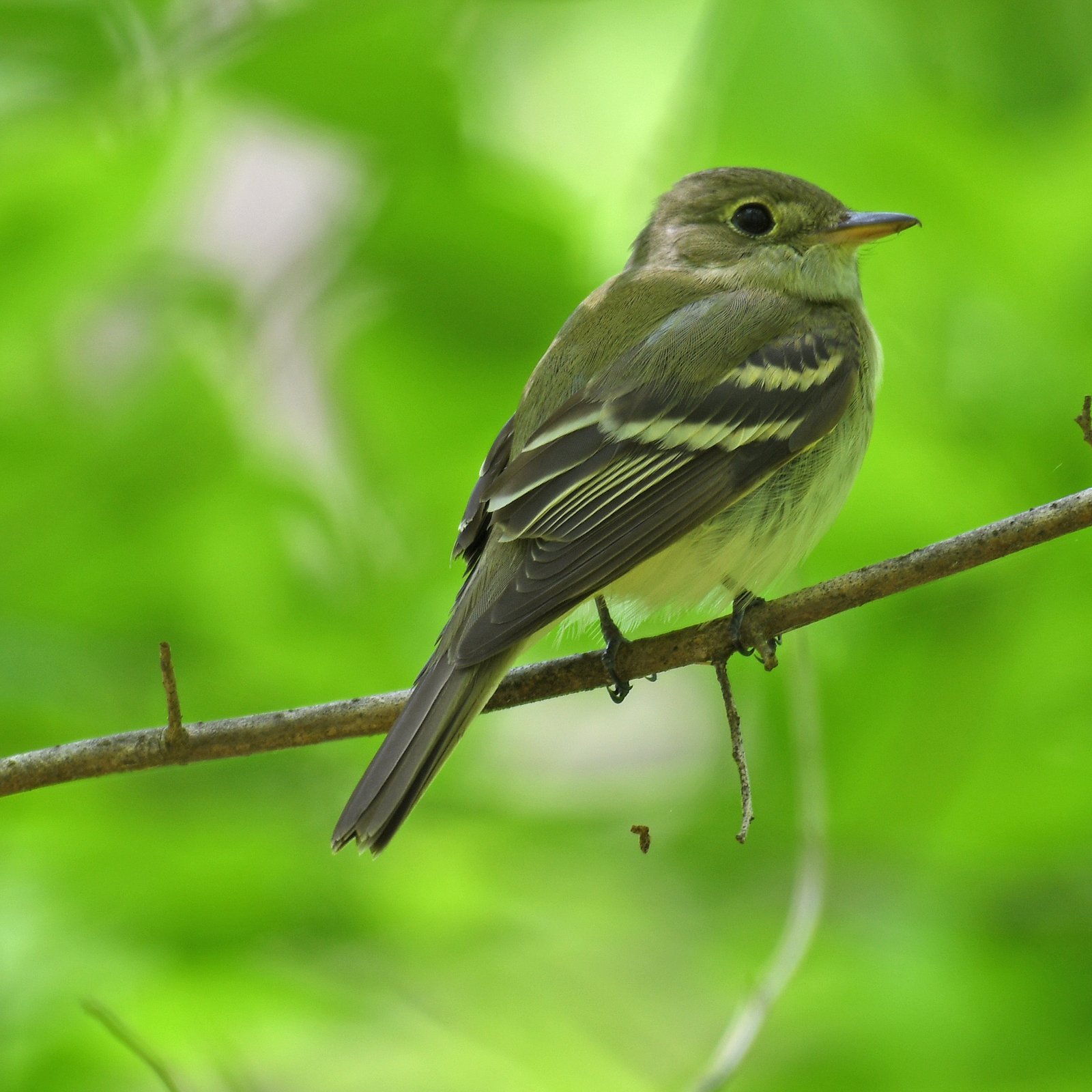
14–15 cm, with long wings and a long primary projection. The bill is long and broad, with an entirely pale yellow-orange lower mandible. The upperparts are greenish olive, with a narrow yellowish-white eye-ring. The wing bars are white to buff, paler buff in young birds in autumn. The throat is whitish, a pale olive band crosses the breast, and the belly and undertail coverts are washed pale yellow. The sexes are alike.
Confusion species
Yellow-bellied Flycatcher Empidonax flaviventris has a yellow throat, shorter wings and a rounder head. Willow Flycatcher Empidonax traillii and Alder Flycatcher Empidonax alnorum are browner olive, with a weaker eye-ring and a shorter primary projection. Least Flycatcher Empidonax minimus is smaller and greyer, with a short bill and a distinctive white eye-ring. Silent Empidonax often cannot be identified with certainty.
Habitat
On migration in shady woodland: moist and dry deciduous forest, limestone forest, coastal woodland and streamside growth. It hunts from a perch in the middle storey, picking insects from leaves or catching them in flight. On the breeding grounds a shallow, hanging cup in a horizontal fork at the end of a branch.
Where the bird is most at home, classified by the vegetation types of the Caribbean.




Range and movements
An uncommon passage migrant in Cuba, mainly in September and October and in April and May, and a rare visitor to the Bahamas, the Cayman Islands and Puerto Rico; there are a few records of uncertain status from Jamaica. Not recorded elsewhere in the region. Breeds in the eastern United States and the extreme south of Ontario and winters from southern Central America to Colombia, western Venezuela and Ecuador.
- Resident
- Summer visitor (c. Oct–Mar)
- Winter visitor (c. Apr–Sep)
- Passage (Mar–Apr, Oct–Nov)
- dark = core range, pale = thinly spread
How and when to look
The best chance is in autumn in western Cuba, at places where migrant songbirds gather, such as the Guanahacabibes and Zapata peninsulas. An Empidonax with a long, entirely pale lower mandible, a white throat and greenish upperparts is probably this species; the call is a useful aid.
Conservation status
Not threatened. On the breeding grounds the species is sensitive to forest fragmentation, which increases nest parasitism by Brown-headed Cowbird Molothrus ater.
Scientific name
Empidonax virescens | (Vieillot, 1818)
Vieillot described the species in 1818 as Platyrhynchos virescens; because it was later moved to another genus, the author and year stand in brackets. The genus Empidonax was introduced in 1855 by Cabanis. Empidonax is Greek, from empis 'gnat' and anax 'master': 'gnat-king', after its insect hunting. virescens is Latin for 'greenish', after the olive-green upperparts. The specimen the first description was based on came from near Philadelphia, Pennsylvania (USA).