All species › Gannets and cormorants › Cormorants › Double-crested Cormorant
Double-crested Cormorant | Nannopterum auritum
Geoorde aalscholver | Cormorán orejudo
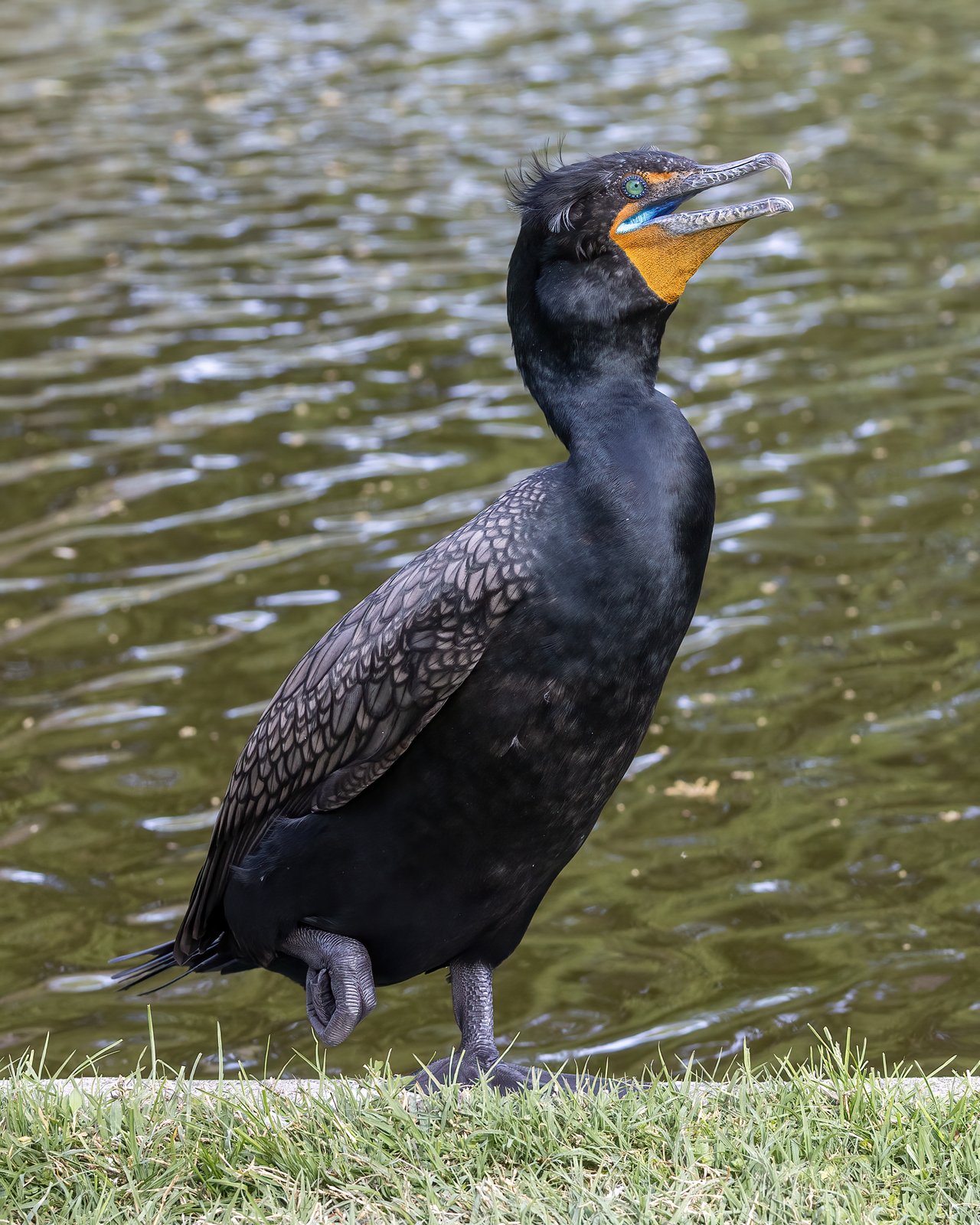
The Double-crested Cormorant is the large cormorant of the north of the region, with breeding populations in the Bahamas and Cuba. Here it lives mainly on the coast, in bays, lagoons and mangroves, and in Cuba it is therefore called corúa de mar, the sea cormorant. The birds of San Salvador in the Bahamas belong to the small subspecies Nannopterum auritum heuretum, which breeds in the mangroves around that island's inland lakes. Its name refers to the two tufts that adults briefly carry above the eyes in the breeding season.
Voice
Almost silent away from the colony. At the colony low grunting and croaking sounds, such as a deep ok-ok-ok.
Recording: Bruce Lagerquist — CC BY-NC-SA 4.0 · converted to mono · xeno-canto
Identification
70–90 cm, a bulky, dark cormorant with a fairly short tail and a thick, hooked bill. Adults are black with a greenish gloss and bronze-brown wing coverts scaled with black. Lores and bare throat skin are bright orange-yellow; the pouch has a rounded rear edge. In the breeding season two tufts grow above the eyes, white in Bahamian birds. Juveniles are grey-brown, with a pale, often whitish neck and breast that darkens towards the belly. In flight the neck shows a clear kink and the head appears slightly raised.
Confusion species
Neotropic Cormorant Nannopterum brasilianum is smaller and slimmer, with a longer tail, a thinner bill, dark lores and a small, dull pouch ending in a point behind the bill. Anhinga Anhinga anhinga has a dagger-shaped bill, a very thin neck and silvery-white wing markings. Pale-breasted young Double-crested Cormorants are told from young Neotropics, which are more uniformly brown, by their larger size and the orange throat skin.
Habitat
Sheltered coastal waters, bays, seagrass beds, mangroves, salt pans and coastal lagoons, including around small cays; less on fresh water than Neotropic Cormorant, but locally on lakes and reservoirs. It fishes by diving from the surface, alone or in groups. It rests and dries its wings on posts, buoys, wrecks and bare branches. It breeds in colonies in mangroves, shrubs or on the ground of small islets.
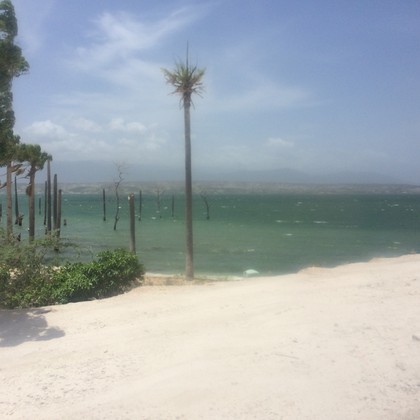
Where the bird is most at home, classified by the vegetation types of the Caribbean.


Range and movements
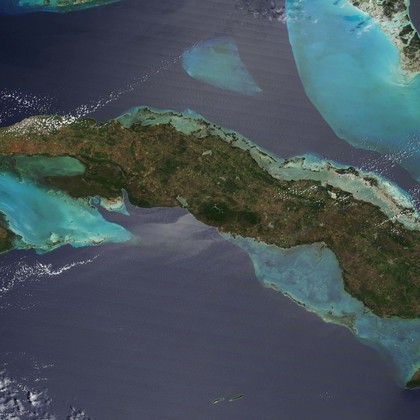
Resident in the Bahamas, where it breeds on several islands, and in Cuba, mainly along the coasts and on the cays. Regular in the Turks and Caicos Islands. In the northern winter migrants from North America reach the region, and the species then also turns up in the Cayman Islands, Jamaica, Hispaniola, Puerto Rico and the Virgin Islands, on most of these islands in small numbers. A vagrant to the Lesser Antilles. Outside the region across much of North America, from Alaska and Canada to Mexico.
- Resident
- Summer visitor (c. Oct–Mar)
- Winter visitor (c. Apr–Sep)
- Passage (Mar–Apr, Oct–Nov)
- dark = core range, pale = thinly spread
How and when to look
In Cuba along the north coast and around the cays of the Sabana-Camagüey and Jardines de la Reina archipelagos; in the Bahamas in harbours and bays. In winter on Hispaniola and Puerto Rico it pays to check groups of cormorants for size, tail length and lore colour.
Conservation status
Not threatened. In North America the species declined sharply in the 1960s through DDT and persecution, and has since recovered. The small populations in the Bahamas and Cuba are vulnerable to disturbance at colonies and the clearing of mangroves.
Scientific name
Nannopterum auritum | (Lesson, 1831) (GBIF: Phalacrocorax auritus)
Lesson described the species in 1831 as Carbo auritus; because it was later moved to another genus, the author and year stand in brackets. The genus Nannopterum was introduced in 1899 by Sharpe. Nannopterum is Greek, from nannos 'dwarf' and pteron 'wing', after the stubby wings of the flightless Galápagos cormorant for which the genus was erected. auritum is Latin for 'eared', after the two crests on the head in breeding plumage. The specimen the first description was based on came from North America (originally given in error as New Zealand).