All species › Pelicans, herons and ibises › Ibises and spoonbills › Scarlet Ibis
Scarlet Ibis | Eudocimus ruber
Rode ibis | Ibis escarlata
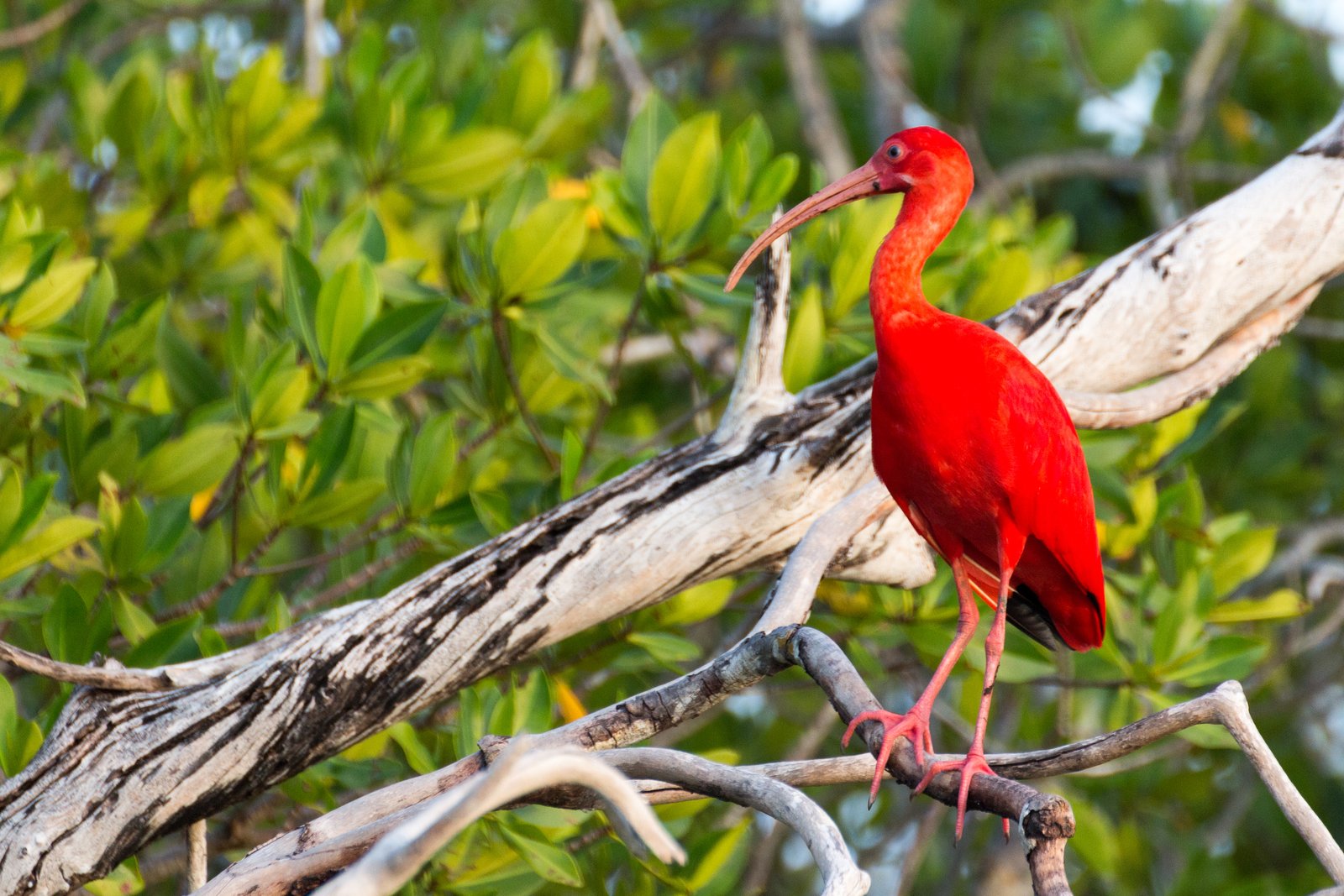
The Scarlet Ibis is a medium-sized ibis with wholly scarlet plumage, which it owes to pigments in the crabs and other crustaceans it eats. Within the region it is tied to Trinidad, where thousands of birds come in to roost in the mangroves of the Caroni Swamp each evening. Together with the Cocrico it is the national bird of Trinidad and Tobago.
Voice
Usually silent. At the roost and the breeding colony a low, hoarse grunting and short quacking chatter.
Recording: David Darrell-Lambert — CC BY-NC-SA 4.0 · converted to mono · xeno-canto
Identification
56–61 cm, with a long, downcurved bill and fairly long legs. Adults are almost entirely scarlet, with reddish face and legs and a dark to reddish bill; only the tips of the outer primaries are inky black. Juveniles are grey-brown above and white below, and colour up through blotchy pink to red over about two years. It flies with the neck outstretched, on rapid beats interspersed with short glides, in groups in a V or in long undulating lines.
Confusion species
Roseate Spoonbill Platalea ajaja is paler pink, with a white neck and a flat, spoon-shaped bill. American Flamingo Phoenicopterus ruber is much larger, with very long neck and legs and a bent bill. Young Scarlet Ibises closely resemble young American White Ibises Eudocimus albus; the two interbreed in the wild, and orange or white-and-red birds may be hybrids.
Habitat
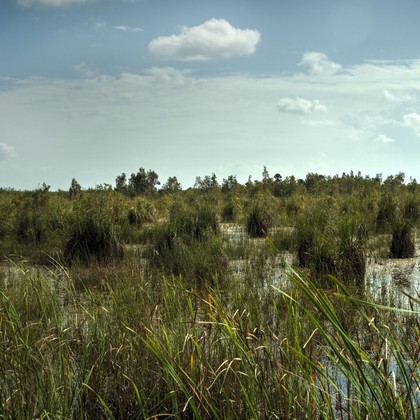
Mangroves, tidal mudflats, estuaries and shallow coastal lagoons; locally also freshwater marshes behind the coast. It feeds in shallow water and on mud by probing with the curved bill for crabs, shrimps, molluscs, small fish and insects. It roosts and breeds in groups in mangrove trees.
Where the bird is most at home, classified by the vegetation types of the Caribbean.



Range and movements
In the region mainly in Trinidad, with the largest roost in the Caroni Swamp on the west coast; smaller numbers elsewhere along the island's west and south coasts. Whether, and to what extent, the species currently breeds in Trinidad, and what share of the roosting birds come from the Venezuelan mainland, is not clearly established. There are hardly any recent records from Tobago. Elsewhere in the region a rare vagrant, including to Aruba, Grenada, Jamaica and Cuba. Beyond the region along the coasts of northern South America, from Colombia and Venezuela through the Guianas to Brazil, and in the llanos of Venezuela and Colombia.
- Resident
- Summer visitor (c. Oct–Mar)
- Winter visitor (c. Apr–Sep)
- Passage (Mar–Apr, Oct–Nov)
- dark = core range, pale = thinly spread
How and when to look
The Caroni Swamp, on a boat trip through the mangroves in the late afternoon; in the last hour before sunset groups of Scarlet Ibises arrive at the roost trees, where they remain visible as red spots against the green of the mangroves. Numbers at the roost vary through the year.
Conservation status
Not threatened. In Trinidad the species came under pressure from hunting and from the draining of parts of the Caroni Swamp for rice growing; the swamp is a protected area and hunting the species is prohibited. Disturbance at the roost and poaching remain concerns.
Scientific name
Eudocimus ruber | (Linnaeus, 1758)
Linnaeus described the species in 1758 as Scolopax rubra; because it was later moved to another genus, the author and year stand in brackets. The genus Eudocimus was introduced in 1832 by Wagler. Eudocimus is Greek, from eudokimos 'glorious, esteemed' (eu 'good' and dokimos 'excellent'). ruber is Latin for 'red', after the scarlet plumage. The specimen the first description was based on came from the Bahamas.